Gustavo Arellano: Petty Trump spikes football over nearly 200-year-old Mexican-American War
Published in Op Eds
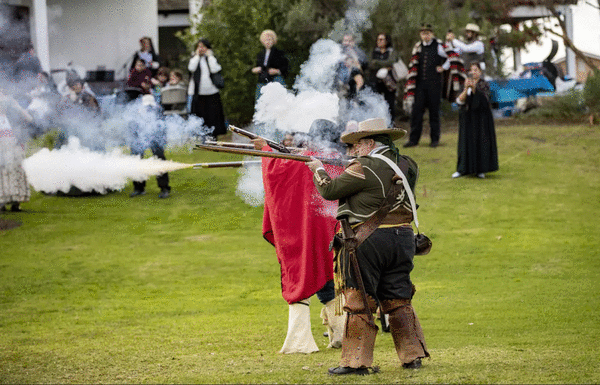
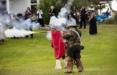
It was a war fueled by colonialism, launched with the intent of humiliating a weaker country, fought in the name of revenge and waged by a racist president.
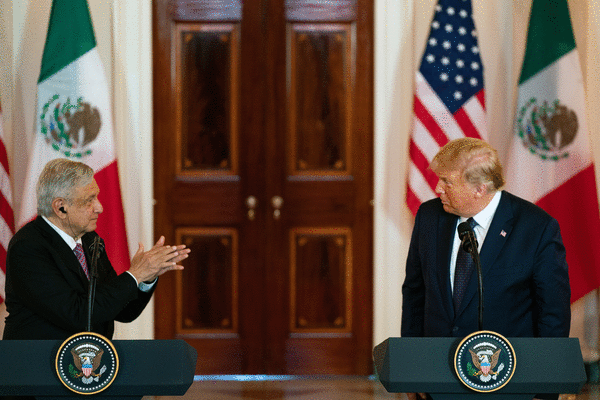
So leave it to President Donald Trump to spike the proverbial football over the U.S. victory 178 years ago in the Mexican-American War.
Abraham Lincoln first earned national attention by calling out President James K. Polk's lies about the lead-up to the conflict, which lasted from April 1846 to February 1848, on the floor of Congress. Ulysses S. Grant called the war "one of the most unjust ever waged." Henry David Thoreau's famous essay "Resistance to Civil Government" was written partly in response to the Mexican-American War, which he decried as "the work of comparatively a few individuals using the standing government as their tool."
Other American paragons of virtue who were publicly opposed at the time: William Lloyd Garrison, Ralph Waldo Emerson and Frederick Douglass. Yet on Feb. 2, the anniversary of what Mexico calls the American Intervention, Trump declared that a war in which the United States conquered more than half of its southern neighbor for no reason other than it wanted to was a testament to "the unmatched power of the American spirit" and guided by "divine providence."
And in case anyone was still wondering why Trump would feel fit to commemorate events that happened almost 200 years ago, he argued the job wasn't done.
"I have spared no effort," he blared, "in defending our southern border against invasion, upholding the rule of law, and protecting our homeland from forces of evil, violence, and destruction."
No president since the Civil War has ever publicly bragged about the Mexican-American War in official proclamations. To do so would be rude, politically perilous, insulting to our biggest trade partner and just plain weird.
So of course Trump did it.
As I've repeatedly pointed out in my columnas, history is one of Trumpworld's most important battlefronts. Like the pharaohs and emperors of antiquity, the president weaponizes the past to justify his present actions and future plans, omitting and embellishing events of yesteryear to fit a bellicose agenda. This is the guy, after all, who renamed the Gulf of Mexico as the Gulf of America with one of his first executive orders in his second term and has punished news agencies that refuse to comply.
Trump has shown a special obsession with the Mexican-American War and its architect, Polk. The Wall Street Journal reported last year that the president saw his predecessor as a "real-estate guy," which is like calling Josef Stalin an aficionado of big coats and bushy mustaches.
A former Tennessee governor and speaker of the House, Polk won the presidency in 1844 by promising to expand the United States by any means necessary. He annexed Texas despite the objections of the Mexican government, tried to buy Cuba from Spain and signed a treaty with Britain that secured for the U.S. what's now Oregon, Washington, Idaho and parts of Montana and Wyoming.
But the grand prize for Polk was the modern-day American Southwest, which he and his allies viewed as untapped land wasted on mixed-race Mexicans and necessary for the U.S. to fulfill its Manifest Destiny.
He tried at first to buy the territory from Mexico; when the country refused, Polk sent troops to the Rio Grande and dared the Mexicans to attack. When they did, Polk went before Congress to seek a declaration of war, claiming Mexico had long inflicted "grievous wrongs" on Americans up to and including ripoffs and deaths and thus needed to be dealt with.
"We are called upon by every consideration of duty and patriotism," the president said, "to vindicate with decision the honor, the rights, and the interests of our country."
No wonder Trump's recent proclamation called the Mexican-American War "legendary."
Polk brushed aside the Treaty of Guadalupe Hidalgo, which ended the Mexican-American War and secured land rights and American citizenship for Mexicans who decided to stay in their new country. Many of those Mexicans saw their property squatted on or seized by the courts of their new nation. Indigenous people saw their numbers plummet and their way of life obliterated. White settlers and corporations quickly swooped in to tap into the vast natural riches of these new territories, relegating the original inhabitants to being strangers in their own land.
No wonder Trump replaced a portrait of Thomas Jefferson in the Oval Office with one of Polk shortly after the start of his second term.
Trump has made expansionism a hallmark of his second presidential term, including trying to wrest Greenland from Denmark and constantly referring to Canada as the "51st state." Critics accuse him of trying to usher in a new era of imperialism. But all he's doing is continuing the Mexican-American War, which never really ended.
Americans have been skeptical of brown-skinned people since the days of the Alamo, always fearful Latinos are one step away from insurrection and thus must always be subjugated. My ethnic group has suffered lynchings, legal segregation and stereotypes that continue to the present day. This is the mindset and legacy Trump relies on for his deportation deluge, the playbook he uses to persecute undocumented people with demonizing language and wholesale lies.
Relations between the United States and Mexico will always be fraught — our relationship is just too complicated. But when another American president marked the hundredth anniversary of the Mexican-American War, his approach was far different.
In 1947, Harry S. Truman became the first U.S. commander in chief to visit Mexico City. At a state dinner at the National Palace, he acknowledged that "it would be foolish to pretend that fundamental differences in political philosophies do not exist" and euphemistically referred to the Mexican-American War as a "terrible quarrel between our own states."
But Truman spent the rest of the speech preaching allyship in a new world where Mexico and the United States should see each other not as enemies but friends.
"Though the road be long and wearisome that leads to a good neighborhood as wide as the world, we shall travel it together," Truman told the appreciative audience. "Our two countries will not fail each other."
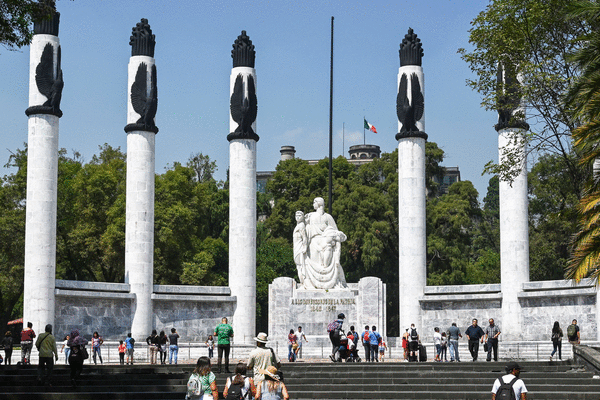
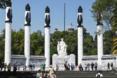
The following day, the president visited a shrine to the Niños Héroes — the Boy Heroes, six teenage military cadets who died in one of the last battles of the Mexican-American War and thus hold an exalted place in the Mexican psyche. Truman, to the surprise of his hosts, placed a wreath on the monument.
"Throughout the day," the New York Times reported, "people shouted his name, with the inevitable 'viva,' wherever United States citizens appeared on the streets or in cafes."
Today, "Viva" sure isn't going to be a word Mexicans use if they utter Trump's name.
____
©2026 Los Angeles Times. Visit at latimes.com. Distributed by Tribune Content Agency, LLC.

















































Comments