Commentary: The US and Venezuela are both pursuing a devil's bargain
Published in Op Eds
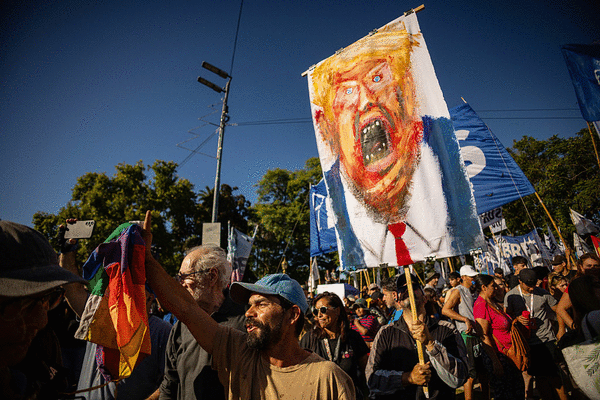
What has followed the forced extraction of Nicolás Maduro from power in Venezuela is neither transition nor collapse, but takeover. The dictator is gone; the dictatorship is not. Whatever its strategic objectives, the American intervention did not remake Venezuela’s political order; it replaced its commander.
That distinction matters because much commentary about Venezuela has retreated into a kind of moral bookkeeping: One less autocrat in Latin America is counted as a gain; another American military intervention is logged as a loss. This accounting misses that the outcome and the means do not cancel each other out so neatly — and that their meaning demands greater precision. The intervention removed the figurehead without occupying the country. The outcome was not regime change but regime capture. Two early scenes make the point.
The first was President Donald Trump’s press conference after Maduro’s ouster. Standing at the podium, Trump talked about oil reserves, production targets, market access — about “running” Venezuela. The cynicism was familiar; the ease was new. Power spoke without pretense, in the bare language of force, as if normative justification had become unnecessary.
Within days, the response from Caracas supplied the complement. The Bolivarian regime’s first reflex was not retreat but pursuit. Security forces resumed targeted operations: detentions of activists, raids without judicial warrants, the reactivation of surveillance networks that had briefly gone quiet. What surfaced was not improvisation, but muscle memory. Whatever uncertainty existed at the top, the lower levels of the state moved with practiced efficiency, reverting to routines designed not only to repress, but to preempt political action.
Taken together, these scenes resist the familiar split-screen. This is not imperial aggression on one side and authoritarian resilience on the other. It is their fusion: a right-wing American government not toppling but co-opting a left-wing Latin American dictatorship. What remains is a political field in which conventional thinking offers little shelter.
How Democracy Was Erased
In the summer of 2024, democracy in Venezuela was violated in plain sight. Venezuelans voted, the result was clear, and those who lost refused to leave.
The elections were held under conditions designed to suppress participation. Candidates were disqualified, media access tightly controlled, intimidation routine. And yet the opposition mobilized voters at a scale the regime did not anticipate. By every credible measure, the opposition — led by Edmundo González after María Corina Machado was banned from running — won.
The regime’s response was blunt. Power was retained not through persuasion or legality, but through fraud backed by force. With that, the regime openly forfeited any remaining claim to electoral legitimacy.
And then came Trump.
Once US forces plucked out Maduro, the 2024 mandate was not restored. In Washington, the operative question was not who had won the election, but who could deliver results for Trump: preserve the governing apparatus, hold the Bolivarian coalition together and keep the country stable. In that calculus, Delcy Rodríguez — Maduro’s vice president — became the hinge. What mattered was compliance and control, not legitimacy.
First denied by the Venezuelan autocracy, democracy was then rendered irrelevant by the American intervention. That convergence is the story. Its result has been an imperial-authoritarian administration: Venezuelans treated less as a people with agency than as a population to be managed.
A Not-So-New World
The American intervention in Venezuela is often presented as the moment that finally shattered what remained of the postwar international order. Yet the liberal rules-based order did not collapse in Venezuela. It arrived already hollowed out. Its authority eroded not through a single violation, but through an accumulation of precedents, each widening the gap between rules and reality.
Some of those precedents took the form of interventions that still came with a justificatory script: Kosovo in the name of humanitarian necessity, Libya under a UN mandate to protect civilians, Iraq in the language of security. Others took the form of non-enforcement — constraints withheld in the name of caution while mass violence continued, from Rwanda to Gaza. The cases differ in nature and scale, but they share a common logic: law applied unevenly.
What the Trump administration has added is not the first breach, but something more radical: the abandonment of pretense. Earlier interventions — and earlier refusals to act — however strained, still gestured toward some principle: legality, multilateralism, humanitarian necessity, political prudence, geopolitical balances. Here, those gestures receded. The novelty lay not in what was done, but in dispensing altogether with the need to render it morally acceptable.
Seen this way, what happened in Venezuela does not inaugurate a new world. It makes legible the one that was already in place, in which “rules” survive largely as vocabulary, not constraint.
Sovereigntism Also Protects the Predatory State
Sovereignty has been repeatedly invoked to repudiate the American intervention. There are good reasons why it carries such emotional weight in Latin America. It names a long history of defeat and dispossession — tutelage, dependency, territorial loss, and the recurring experience of having political futures decided elsewhere. It is not a neutral term, but a living historical wound.
Yet sovereignty has a double life. It can shield societies from external domination. It can also shield predatory states from accountability to their own people.
Authoritarian regimes have learned to weaponize sovereignty: branding dissent as foreign sabotage, dismissing rights as external impositions, portraying scrutiny as imperial meddling. In these cases, sovereignty ceases to function as a condition of self-rule and becomes a rhetorical instrument used to suffocate it.
Any serious anti-imperial position must confront this complication. Otherwise, sovereignty hardens into a doctrine of exception. Borders become moral enclosures, presumed to confer legitimacy by default on whatever occurs within them. The result is a posture that condemns coercion from abroad while bracketing repression at home. This logic is not speculative. It has a long pedigree in the region — most clearly embodied in Cuba — where sovereigntism functioned simultaneously as protection against imperial pressure from abroad and as a durable exemption from democratic accountability at home.
True, the idea that foreign intervention is wrong and should never occur has obvious appeal. It offers moral reassurance at low cost. It replaces judgment with certainty, politics with principle. But Venezuela muddies the choice between intervention and non-intervention. It presents a concrete situation in which external domination and internal repression are now reinforcing one another.
In Venezuela, as in Cuba, non-intervention has been a policy with consequences. It allowed an authoritarian system to consolidate, adapt and endure — often through criminal economies and growing impunity. In such contexts, inaction is a choice and it carries a body count.
At the same time, force does not arrive untainted. Mafia states sometimes fracture only when pressure comes from outside, yet the means that break them can also deform what follows. External actors extract compliance, cut deals, prioritize stability, and entrench new injustices or reinforce old ones. The apparatus of domination does not disappear; it mutates. There are no clean exits — only different distributions of abuse.
To acknowledge this is not to endorse intervention unconditionally, but to reject false innocence. The central issue is not whether intervention is good or bad in the abstract, but how power is exercised. Who defines the limits? Who enforces them, and by what means? Who bears the costs? These questions matter more than slogans precisely because they determine whose lives absorb the damage and whose are insulated from it.
A Transaction, not a Transition
Speaking before his Democratic critics in the U.S. Senate on Jan. 28, Secretary of State Marco Rubio said a Venezuelan “transition” will take time, comparing it to what happened in Spain and Paraguay many decades ago. But the congressional hearing offered a starker description of the present. Senator Chris Murphy argued that the administration is effectively “taking their oil at gunpoint” — selling Venezuelan crude, parking the proceeds offshore, and deciding how the money will be used. That looks less like a settlement than a stopgap: a way of keeping the state running while deferring the harder work of political reconstruction. What the exchange makes plain is that in Venezuela, today, talk of “transition” is too much work too early. It suggests a desirable yet improbable passage from dictatorship to democracy, as if the problem were primarily chronological: first removal, then rebuilding. But what has emerged is not a predictable sequence. It is a precarious governing arrangement. A hard look at Venezuelan prospects requires more sobriety.
A transition is, above all, a redistribution of power. It demands actors willing to negotiate limits, institutions capable of enforcing them, and guarantees credible enough to alter political behavior. None of those conditions are in place.
Washington has, for the time being, two overriding concerns: avoiding boots on the ground and ruling without having to govern. This is where Trump’s comment about avoiding an Iraq-style fiasco has purchase. The lesson of the US’s de-Baathification policy was politically clear even if morally counterintuitive: Purging an authoritarian apparatus can end up dismantling the only machinery capable of enforcing some sort of order. Co-optation may be ugly, but it keeps the wheels in motion at a lower political cost than occupation. In this logic, the relevant metric is not who can claim authority, but who can impose it.
That logic, nonetheless, does not settle the question it postpones. Foreign intervention can dislodge rulers and even preserve autocratic continuity under new imperial management, but it cannot manufacture durable legitimacy. An AtlasIntel poll published by Bloomberg reports that 53% of Venezuelans support the US military intervention to depose Maduro, while 35% oppose it. Yet endorsement of his removal is not the same as consent to his successor: 52% of Venezuelans would rather see María Corina Machado lead the country, versus Delcy Rodríguez’s 14%. That gap does not translate into actual power, but it distinguishes two different currencies: popular support and political control. Machado still holds the first; the new arrangement has kept the second. Control can delay succession — but delay is not settlement, and uncertainty does not stay put. It filters downward as rivalry, hedging and exit-seeking.
Could the regime break? It is possible — precisely because the Bolivarian coalition is not a party as much as an ecosystem: military command, security services, political brokers, criminal networks, business intermediaries. A split becomes thinkable when cohesion turns costly — when spoils shrink, when new leadership demands too much, when someone is singled out, when a revenue stream is reassigned, when accountability looms, when survival starts to look safer outside the racket than within it. If that happens, some form of amnesty — conditional, partial, enforceable — can become an exit ramp. Without credible immunity, an authoritarian coalition held together by mutual incrimination has no reason to step aside; it has every motive to cling to power — and, when cornered, to turn to violence.
This may be the darker lesson of the takeover: Removing the figurehead does not vanish the structure, merely forcing it to renegotiate. Its loyalties are not moral or ideological so much as contractual: access to rents, protection against prosecution, control over coercion. In that sense, regime capture works precisely because the apparatus is both powerful and reusable. It can serve a new overseer without being dismantled — especially if dismantling risks the very disorder that Washington and Caracas both want to avoid. Until something binds power again, “transition” is only a name for a void.
____
This column reflects the personal views of the author and does not necessarily reflect the opinion of the editorial board or Bloomberg LP and its owners.
Carlos Bravo Regidor is a political analyst based in Mexico City. He is the author of "Mar de dudas. Conversaciones para navegar el desconcierto."
©2026 Bloomberg L.P. Visit bloomberg.com/opinion. Distributed by Tribune Content Agency, LLC.

















































Comments