Commentary: The Fed can beat populist demagogues by educating the public
Published in Op Eds
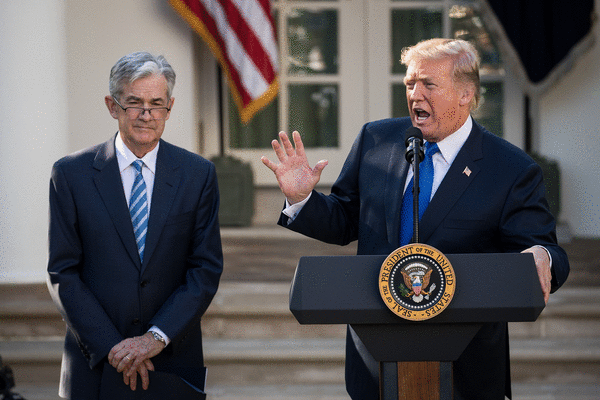
The Donald Trump administration’s criminal investigation of Federal Reserve Chair Jerome Powell has engaged allies in Congress. Yet the real threat to the Fed isn’t Trump’s investigation — it’s the erosion of public support. The Fed’s only real strategy to successfully pushing back against attacks on its independence is to engage the public directly. But this will require real change.
Public confidence in the Fed is weak and deeply polarized. An Economist/YouGov poll found 45% of the respondents trusted the Fed over Trump. This is a far cry from the Alan Greenspan era, when members of both parties largely trusted the institution. That confidence has never recovered since the 2008 bailout, when the government rescued Wall Street while ordinary Americans lost their homes.
Many within the Fed assume that Trump in the end will not dare contradict financial market insiders and the politicians who support them in Congress. But central bank independence is newer and more fragile than it appears. It rests not on law but on political convention. Calls to constrain or eliminate Fed independence have come from political strategist Steve Bannon on the right and U.S. Sen. Bernie Sanders on the left — a sign of how vulnerable the institution actually is. The Fed’s only real defense in this new environment is to make the case, to a changed nation, that it is acting in the interest of ordinary Americans and that it is a constructive and accountable partner in the national project.
The first step is a massive public engagement campaign. Here, the Fed actually has a very good story to tell. Its current stance on interest rates protects ordinary Americans in two ways. Higher interest rates mean savers earn better returns on bank accounts and certificates of deposit — a lifeline for retirees. Lower rates advocated by the president would funnel cheap borrowing to corporations and wealthy investors at the expense of ordinary savers. Moreover, by resisting rate cuts, Powell guards against inflation, which disproportionately affects working people who spend most of their income on necessities such as groceries and rent.
After 2008, loose monetary policy inflated asset prices for those holding stocks while workers’ wages stagnated. This time, the Fed is on the side of ordinary Americans.
Yet Powell rarely explains this to the public. In a video statement last month, he spoke of whether the Fed can set rates “based on evidence and economic conditions” or will be “directed by political pressure.” This is stale institutional language, not the language of groceries and rent.
But a communication strategy alone won’t solve this crisis. Because what has changed is that the public has rejected the myth that the Fed operates in a purely technical realm. When then-Chair Janet Yellen insisted in 2016 that “partisan politics plays no role in our decisions,” she was technically correct — the Fed doesn’t favor one candidate over another. But what she didn’t say is what every insider knows: Every policy decision involves choices about who wins and who loses. Those choices are political, in a more general sense, and deserve public deliberation, not technocratic decree.
Trump’s attacks on Powell are crude, but they resonate because millions of Americans already sense that the Fed makes decisions based on a mix of value choices and technical calculations. And that fuels suspicions of bias.
The only way forward is something that will not come easily to Fed insiders — to treat the public as stakeholders whose input matters, not subjects whose behavior needs managing. Legitimacy comes from collaboration with citizens, not autonomy from them. People need straightforward talk about trade-offs — between price stability and employment, between protecting savers and stimulating growth. These choices reflect competing values, and they deserve public deliberation. This means acknowledging what insiders already know: Central banks don’t act alone but are embedded in politics, markets and culture.
Other central banks have succeeded at this. Danish central bank governors built legitimacy not through technical explanations but by speaking to what citizens actually value: consensus and social solidarity. Rather than defending their independence, they framed monetary policy as a shared national commitment. The result: Support for the central bank became inseparable from support for the nation itself.
Powell doesn’t need to become a populist or abandon expertise. But he does need to speak honestly about hard choices, acknowledge the values embedded in them and invite Americans to deliberate with the Fed about what economy we want to build.
What this looks like in practice: regular forums where Fed officials hear from workers, small-business owners and consumer advocates, of the kind they regularly hold with market participants. Statements that speak to citizens and acknowledge the shades of gray. Broadening the skill set and diversifying the backgrounds of Fed insiders so that they are more attuned to the perspectives of citizens that Trump is channeling.
Without a robust legitimacy narrative, demagogues fill the vacuum. Powell needs to address underlying causes, not just symptoms. This is important not just to survive the political knife fight of the present but to plan for the future. The next crisis will be far more politically complex than 2008. If the public doesn’t feel heard now, they won’t accept backroom bailouts then.
____
Annelise Riles is a professor of law at Northwestern University and the author of the Everyday Ambassador Substack.
___
©2026 Chicago Tribune. Visit at chicagotribune.com. Distributed by Tribune Content Agency, LLC.



















































Comments