Lisa Jarvis: South Carolina's measles milestone is everyone's problem
Published in Op Eds
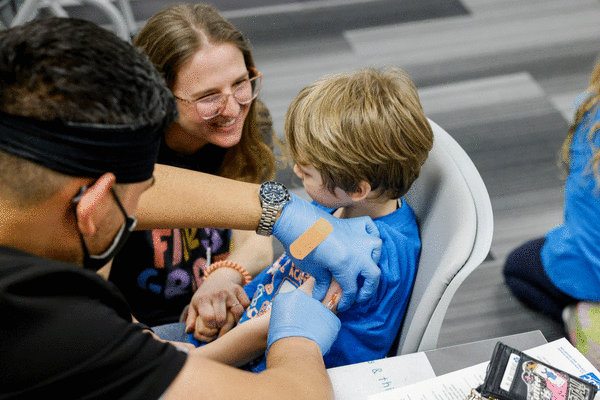
A fast-moving measles outbreak in South Carolina reached a grim milestone last week: It is now the biggest outbreak in the U.S. in a quarter century.
It’s the latest public health record to be broken as vaccine hesitancy and increasingly permissive state laws — both now intensified by Health and Human Services Secretary Robert F. Kennedy Jr. — create more and larger pockets of disease vulnerability in the U.S.
Last year, a measles outbreak in Texas led to 762 infections and the first deaths from the disease in the U.S. in a decade. Nationwide, cases hit a 34-year high. The U.S.’s measles-free status, established in 2000, is likely to fall next — a fate that will be determined in April when a team from the Pan American Health Organization, the regional office for the World Health Organization, meets.
We’re entering a stage where measles is becoming the status quo, rather than the rare exception; where the stray case can easily turn into a monthslong outbreak, rather than a quickly contained incident. Consider that just a month into the year, the U.S. has already logged 588 infections — about a quarter of the number recorded in all of 2025.
The response from top health officials has been blasé. Last month, Centers for Disease Control and Prevention principal deputy director Ralph Abraham told reporters that losing measles elimination status in the U.S. would be “just the cost of doing business.”
His response is at once stunning for a leader of an agency tasked with protecting public health, and entirely unsurprising. While surgeon general of Louisiana, Abraham had been a vocal critic of COVID vaccines and, later emboldened by Kennedy’s appointment as health secretary, banned the state’s health department from promoting all vaccines.
Abraham went on to suggest global travel and open borders were to blame, and mixed his endorsement of the measles vaccine with an emphasis on the importance of personal freedom.
The way that one person’s choices can affect everyone’s health was underscored by a recent report from Abraham’s own agency. The CDC last week detailed the impact of one sick traveler who spent a night in Denver last May. Colorado health officials found the traveler had contracted measles while visiting another state experiencing an outbreak, traveled abroad, and was experiencing a fever and cough on their return trip. They stayed overnight at a hotel during an 11-hour layover in Denver before getting on a flight to another state.
The traveler infected nine people in Colorado and six residents of other states, with two of those 15 cases leading to other infections. Four ended up in the hospital.
The investigation highlights what a huge challenge measles poses to public health officials. When someone is exposed to the virus, symptoms typically take up to two weeks to appear. And the first signs of an infection — things like a cough, fever, runny nose or watery eyes — can be easily mistaken for more mundane viruses. That means people might not realize they are infected with the world’s most contagious disease and go about their daily routines, potentially passing it on to others with every cough or sneeze.
That, in turn, makes it very tough to quickly contain a measles outbreak, especially when not enough people are vaccinated. When the infected traveler in the CDC report spread measles to an unvaccinated child sitting in their parent’s lap some two rows away, the telltale rash didn’t appear until 12 days after the flight.
The CDC report also makes clear how easily a single case can seed infections around the country — and why the lack of a strong, unified message from federal health officials advocating vaccination alongside weakening vaccine policy is dangerous for everyone, no matter where they live. In Kennedy’s year leading the Department of Health and Human Services, he has upended vaccine oversight in the U.S., culminating last month in major changes to the CDC’s childhood vaccine schedule.
Kennedy’s audacious moves undermining confidence in the safety of routine shots have motivated state public health leaders and lawmakers to make it easier for parents to refuse vaccinations for children attending daycares and public schools. That trend even includes South Carolina, where amid the outbreak, a lawmaker proposed a bill that would ban vaccine requirements for children under the age of 2.
The worry, of course, is that already weakening vaccination rates in the U.S. will worsen, leaving more children vulnerable as schools, counties and whole states potentially fall below the vaccine coverage needed to ensure community-wide protection.
That makes outbreaks like the one in South Carolina, where nearly 850 people have been infected in just four months, so scary for parents, especially those in neighboring states. (So far, at least one case in North Carolina has been linked to the Spartanburg County outbreak.)
In a briefing with reporters last week, South Carolina’s state epidemiologist Linda Bell noted that unlike Texas, where last year’s outbreak occurred in a relatively rural area, her state is “very geographically compact.” Without better vaccination coverage, the disease will continue to spread, potentially to other areas of the state. “It’s just disconcerting to consider what our final trajectory will look like,” she said.
This same scenario, scary as it is, could easily look much worse. And as laws and norms around vaccination continue to diverge from the scientific consensus, that will put everyone at risk for this entirely avoidable, dangerous infection.
_____
This column reflects the personal views of the author and does not necessarily reflect the opinion of the editorial board or Bloomberg LP and its owners.
Lisa Jarvis is a Bloomberg Opinion columnist covering biotech, health care and the pharmaceutical industry. Previously, she was executive editor of Chemical & Engineering News.
_____
©2026 Bloomberg L.P. Visit bloomberg.com/opinion. Distributed by Tribune Content Agency, LLC.




















































Comments