David M. Drucker: Democrats have to stop dodging trans rights
Published in Op Eds
Some of the prominent Democrats interested in pursuing the presidency appear confused about what it takes to win the White House.
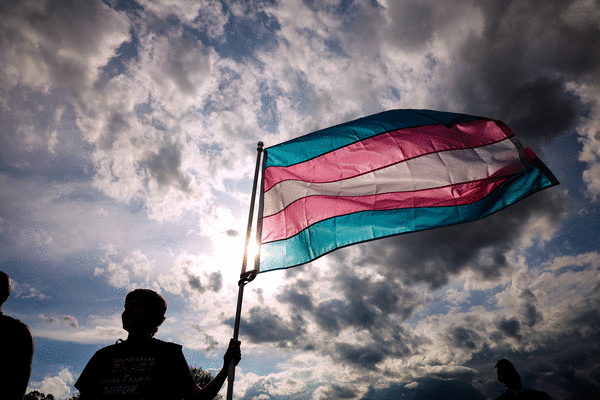
How else to explain their ducking and dissembling on the politically charged issue of transgender rights, helpfully reported by the “Axios 2028” newsletter. Reporters Alex Thompson and Holly Otterbein asked roughly 20 prominent Democrats the following: Should transgender girls be allowed to participate in girls’ sports? Should transgender minors receive puberty blockers and hormones? Can a man become a woman? Several, including California Governor Gavin Newsom, declined to comment or did not respond.
Democrats may view these queries as “gotcha” questions. Maybe they are. It doesn’t matter.
Transgender rights, especially as they relate to girls’ athletics, continue to be a major flashpoint at all levels of government. And even if you believe it’s a wedge that Republicans invented to divide Democrats, it’s one of those topics on which voters expect politicians to have an opinion. Candidates who regularly hide from tough questions tend to lose competitive campaigns.
Liam Kerr, cofounder of Welcome PAC, a Democratic-aligned group pushing the party to embrace mainstream positions on key issues, told Axios that adhering to best practices for successful candidates requires having a “clear answer, whatever it is,” to questions about transgender rights. I asked Kerr to elaborate. “Delegitimizing the question is unsustainable,” he told me. “It’s hard to convince neutral observers that questions repeatedly asked by trusted nonpartisan pollsters, like the Pew Research Center, Gallup and KFF, are somehow beyond the pale for journalists to ask presidential candidates.”
Democrats who have firm convictions one way or the other — for or against — should say so. They’d get points for candor, at least. President Donald Trump has certainly proven that voters are willing to support candidates they disagree with—if politicians are authentic and confident.
To be sure, a clear answer would spark some disagreement. No doubt the Democratic base would take issue with a presidential primary candidate who, for instance, opposed transgender girls competing in women’s sports. Progressives tend to be strong supporters of expansive transgender rights, especially as related to health care and workplace discrimination, in addition to the issue of sports participation.
But the broader electorate would approve. Transgender rights are one of those “70/30” issues, as political professionals tend to describe them, and that’s where the Democratic nominee should aim to be, explained Lanae Erickson, senior vice president for social policy, education and politics at Third Way, a centrist Democratic think tank in Washington. “You obviously want to be somewhere in the realm of where voters are,” she said.
Third Way’s political guidance is based on 30-plus rounds of polling, focus groups and other research into voter sentiment on transgender rights and related issues. On the issue of transgender girls participating in female athletics, the winning position is one that accepts inherent biological differences between the sexes, validates voters’ concerns about fairness and supports rules to preserve competitiveness — but locally and case-by-case rather than through blanket government bans.
The think tank’s research has firmly established that rules restricting transgender girls’ participation in girls’ sports, on fairness grounds, are popular with voters and viewed as commonsensical. In other words, the politics of this issue has not changed since the 2024 election and the devastating impact of a Trump campaign advertisement that declared Vice President Kamala Harris “is for they/them.”
That this particular ad so damaged Harris’s campaign raises another red flag for Democrats hoping to sidestep questions about transgender rights.
The former vice president was vulnerable to this attack because of comments she made during her short-lived 2020 White House bid, during which she affirmed support for gender-transition health care for inmates in the federal prison system. That campaign unfolded in a political environment that saw the Democratic Party embrace far-reaching policies on transgender rights that were unpopular with the public writ large. Harris could have saved herself a lot of grief four years later if she had dared to tell the progressive base “no.”
Ironically, telling the base “no,” even amid a competitive primary, can be the surest path to the nomination — and the Oval Office. Why is that?
Here’s what Rahm Emanuel, President Barack Obama’s first White House chief of staff and a potential 2028 contender, had to say on the matter when I interviewed him for The Dispatch late last month. “People, to project you in the Oval, they’ve got to see that you have strength,” he said. “If you’re willing to tell a member of the family: ‘Shut the f—k up’—it’s not what you pick that counts, it’s that you willingly have balls to do it.”
After November’s midterm elections, the race for the 2028 Democratic presidential nomination is going to get underway in earnest. By then, Democratic contenders will need to have better answers to the question What’s your position on transgender rights? Otherwise, this and other contested cultural issues could stand between Democrats and the White House — no matter how unpopular Trump gets.
_____
This column reflects the personal views of the author and does not necessarily reflect the opinion of the editorial board or Bloomberg LP and its owners.
David M. Drucker is a columnist covering politics and policy. He is also a senior writer for The Dispatch and the author of "In Trump's Shadow: The Battle for 2024 and the Future of the GOP."
_____
©2026 Bloomberg L.P. Visit bloomberg.com/opinion. Distributed by Tribune Content Agency, LLC.





















































Comments