Noah Feldman: If ICE can kill with impunity, the rule of law is already gone
Published in Op Eds
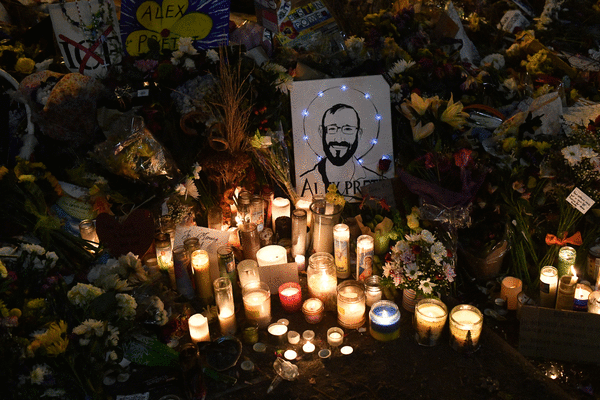
If ICE agents can shoot civilians at point-blank range and never be held accountable, then we aren’t living under the rule of law. We’re living in a police state.
The law on the books is extremely clear that Minnesota prosecutors and law enforcement have the authority to investigate and criminally charge Immigration and Customs Enforcement agents who have not acted in a way that is “necessary and proper” to carry out their official duties. That certainly includes unjustified shootings. Legal immunity from state prosecution for federal officials arises only if they are found to have been carrying out their duties in that manner.
The problem is the law on the ground. In practice, the federal government is doing everything it can to impede those investigations. We are therefore at a crucial juncture for the rule of law in the U.S.
Minnesota officials can commence investigations and thereby preserve the rule of law — without waiting for coordination with the federal government, which hasn’t been forthcoming.
The straightforward answer for Minnesota law enforcement is: Just get started. Formally announce that you are opening investigations. Interview witnesses. Gather information. If the federal government tries to stop witness interviews, go to court and have state judges issue subpoenas ordering those witnesses to appear. Rely on video evidence, if necessary. There are highly sophisticated techniques for identifying suspects from visual images. Use them. If the feds have already corrupted the crime scene, work around it — cases are routinely prosecuted without a pristine crime scene.
The goal should be to gather enough evidence to present to a grand jury and actually indict the officers in question, provided there is sufficient evidence to charge them with crimes — as appears extremely likely based on the publicly available videos. Failure to do so will erode confidence in the justice system, effectively putting ICE above the law, where it is not supposed to be.
As a legal matter, ICE officials charged with crimes while in the performance of their duties can seek to move the case from state court to federal court. However, even in federal court, state law would still apply. State prosecutors would still bring the case. The change in venue is only about procedure, not about legal substance. President Donald Trump cannot pardon ICE officials for violations of state law. The Department of Justice will have no formal role whatsoever in the proceedings beyond endorsing the removal of the case to federal court. It would not be responsible for defending the ICE agents against criminal charges, which isn’t part of the Justice Department’s role.
The federal government and the Trump administration have no legal leg to stand on in attempting to impede the investigations. Courts should affirm that. If some legal back-and-forth between the federal and state lawyers takes place, that’s fine. That’s how the legal system is supposed to work. The important thing is to ensure that the investigations of these potentially serious crimes proceed.
All of this needs to start immediately. The reason time is of the essence is that, for every day that the ICE agents who shot and killed Renee Good and Alex Pretti go uninvestigated, the perception spreads that ICE agents are entitled to shoot to kill, despite the unlawfulness of doing so when there is no reasonable danger to the lives of the officers or bystanders. That perception affects everybody: ICE officials, civilians on the ground, citizens across the U.S. and observers from around the world.
When it comes to creating and maintaining the rule of law, perception is almost as important as reality. The entire system is based on the collective understanding that no one can escape punishment if they commit a crime in broad daylight, with the whole world watching. No criminal justice system catches every criminal, and no just criminal justice system convicts every criminal who is apprehended. There is room for error and for resource limitations. What there is no room for is obvious impunity and lack of accountability.
Impunity is worse when it’s a government official who violates the law. The very definition of a police state is that the law applies to ordinary people, but not to the police — which, in this context, includes ICE.
There is therefore nothing more undermining to the rule of law than for government officers to commit crimes in full view of the public and be free of any investigation or responsibility for doing so. It is certainly necessary for law enforcement officers to have procedural rights and appropriate investigative processes. No one, no matter the circumstances, should be criminally convicted in the public eye before they have had a chance to raise a defense. But if there is no investigation, the public’s interest in ensuring that the law is followed is quickly vitiated.
The Trump administration’s entire strategy in its attack on the rule of law — from deporting people unlawfully to usurping congressional power to cutting funding in violation of the First Amendment and beyond — is to break norms, then wait and see if anyone does anything about it. Protests are absolutely crucial. Peaceful protesters deserve all the support we can give them.
But state officials have an opportunity to play a fundamental role here — because they represent the state and its citizens. They are the officials responsible for enforcing Minnesota law. They can and should announce that they are enforcing that law. By doing so, they can begin vindicating the rule of law — and do so in a highly public fashion. Otherwise, the law will cease to function, and everyone will know it.
As pressure mounts on the Trump administration to launch its own investigation, Minnesota officials should not wait to act. Doing so would play into the hands of the Trump administration, which can take its time and ultimately seek to publicly vindicate the ICE officers, as they’ve already signaled they will do. At a minimum, a federal investigation designed by Trump officials might deflect public attention from the shootings; at a maximum, it might make the issue go away entirely amid subsequent headlines.
Parallel investigations at the state and federal levels are perfectly lawful, legitimate and appropriate. The Trump administration is trying to impede the rule of law as a step in actually breaking it. If it succeeds, the consequences will be felt far beyond Minnesota.
Minnesota public officials have spoken out strongly and appropriately against ICE, and it’s now time to add legal action to the rhetoric.
____
This column reflects the personal views of the author and does not necessarily reflect the opinion of the editorial board or Bloomberg LP and its owners.
Noah Feldman is a Bloomberg Opinion columnist. A professor of law at Harvard University, he is author, most recently, of “To Be a Jew Today: A New Guide to God, Israel, and the Jewish People."
©2026 Bloomberg L.P. Visit bloomberg.com/opinion. Distributed by Tribune Content Agency, LLC.

















































Comments