Marc Champion: Putin just sent a reminder he's a threat to NATO
Published in Op Eds
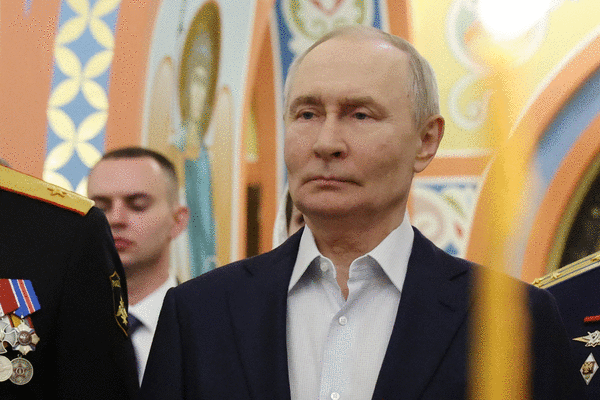
One central question about Russia’s invasion of Ukraine has always been whether Vladimir Putin would be satisfied if allowed to succeed, or if he’d go further, aiming to collapse NATO from within and reestablish a sphere of influence for Moscow that just a few decades ago stretched deep into central Europe. More importantly, could he?
It was U.S. General “Stormin’ Norman” Schwarzkopf who said he judged opponents by their capabilities, not their intentions, and on Thursday night Russia sent a reminder that it remains capable.
For only the second time since the start of Russia’s invasion in 2022, it used one of its 12,000 km-per-hour-plus, multi-warhead Oreshnik missiles, targeting a gas-storage facility outside the West Ukrainian city of Lviv. The location, so close to the Polish border, made it clear that this was a message and that the desired audience was European. Putin was telling Europe’s leaders that he can strike anywhere on the continent, using an intermediate-range ballistic missile that would give very little notice or possibility of interdiction.
This has not been a great period for Russia’s military reputation. In recent weeks and months, Moscow has claimed victories in two Donbas cities, only to have Ukraine President Volodymyr Zelenskyy show up to parade for the cameras in one, Kupyansk, and for Kyiv’s forces to hold on in the other, Pokrovsk, after well over a year under attack.
In Venezuela, Russian air defenses failed to stop U.S. aircraft and special forces from breaching the capital to abduct President Nicolas Maduro. There were similar failures to protect allies in Iran and Syria last year. And for all the Kremlin’s success in portraying its victory in Ukraine as inevitable, actual advances have been extraordinarily slow and costly.
As former Australian Army Major General Mick Ryan writes on the Oreshnik strike, this was “the sign of a fearful, worried leader with challenges at home and abroad, and not one that is confident and anticipating victory.”
I’d add that Putin was also expressing frustration over the fact that Ukraine and its European partners seem to have persuaded President Donald Trump to back away from his initial embrace of a 28-point, made-in-Moscow plan for ending the war on its terms. The latest, non-Kremlin draft offers Kyiv security guarantees that would involve stationing French and British troops on Ukrainian territory to ensure the ceasefire held. You can argue about how effective those forces would be if tested (likely a key part of the Oreshnik’s intended message), but Putin’s demands when starting the war were that all North Atlantic Treaty Organization forces should be withdrawn from ex-Warsaw Pact and Soviet Union states. He did not fight it to see NATO deploy to Ukraine.
Trump, in an interview with The New York Times, said he had agreed for the U.S. to play a supporting role in those security guarantees because he believed Putin wouldn’t try to break the ceasefire, in any case. Like Schwarzkopf, you have to ask if that confidence is based on assumptions about the Russian leader’s intent, or his capabilities.
You can make a strong case for why Putin shouldn’t want to risk taking on NATO. It would seem a tall order after the heavy weather Russian forces have made of trying to occupy Ukraine. Western estimates of the country’s military losses run as high as 1.2 million personnel killed or wounded, not to mention thousands of tanks, hundreds of aircraft and more than two dozen warships.
Yet this is misleading. For all their problems, Russia’s mobilized, combat-ready armed forces are considerably larger and more experienced than they were four years ago. Personnel have been replaced, command and control improved and Russian troops have developed advantages in drone and electronic warfare that only Ukraine can match. Tank and artillery numbers now seem to matter less. On top of that, an operation to destabilize NATO would likely be a different kind of conflict than the territorial war of attrition in Ukraine.
A new study of improvements in the Chinese and Russian air forces by Justin Bronk, an airpower specialist at the UK’s Royal United Services Institute, makes fascinating reading. He points out that most Russian fighter jets destroyed in the war have been models that would not be of much use in a conflict with NATO. And because the vast majority were either hit while empty on the ground, or while in Russian airspace allowing safe ejection, pilot losses have been much lower. Those pilots are far more experienced and able after four years of high-intensity combat than they were in 2022.
In the meantime, Russia has shifted to a war economy, found sources for sanctioned weapons components and built more planes than it has lost old ones. While it has one or two fewer heavy bombers, its air force is bigger and better at its job. The result, says Bronk, is that the West has lost its guarantee of air superiority over China and Russia just as it had become most reliant on that advantage.
Hungary’s Prime Minister Viktor Orban is one of many who believe Europe and NATO have nothing to fear from Putin, because he’s “hyper-rational” and would therefore be unwilling to take on Europe, with its advanced if fractured militaries and vastly larger population and economy.
This could be true, but not because Putin is hyperrational. If he were, there would be no war in Ukraine. NATO would still be honoring its 1997 deal not to station troops on the territory of the alliance’s newer East European members, as it did until Russia annexed Crimea and started a war in Eastern Ukraine in 2014. Ukraine’s constitution would still prohibit it from joining NATO, as it did until December that year. Finland and Sweden would remain neutral. The outlook for Russia’s economy would be rosy, unburdened by sanctions and lost human capital, and made rich by Europe’s once-insatiable demand for its oil and gas.
If you want a reminder of why Putin went to war, read the 7,400-word screed of historical fantasies and resentments he delivered in a televised address three days before the invasion. So yes, it would make no sense for Putin to restart his war in Ukraine, or to launch new declared or hybrid wars aimed at collapsing NATO. But invading Ukraine didn’t add up either. With the conventional, let alone nuclear, capabilities still at his disposal, it’s plain foolish to act based on assumptions about what he intends.
____
This column reflects the personal views of the author and does not necessarily reflect the opinion of the editorial board or Bloomberg LP and its owners.
Marc Champion is a Bloomberg Opinion columnist covering Europe, Russia and the Middle East. He was previously Istanbul bureau chief for the Wall Street Journal.
©2026 Bloomberg L.P. Visit bloomberg.com/opinion. Distributed by Tribune Content Agency, LLC.


















































Comments