Editorial: Only in Chicago, do you get targeted for 'leaking' a public meeting
Published in Op Eds
People who want to keep secrets for one reason or another often detest leaks to the media. Naturally, we’re hardwired to oppose that petulant and shortsighted approach to American life, but within such realms as law or business, there can be valid arguments for enforcing secrecy through confidentiality agreements and investigations.
Sometimes. Rarely.
But almost never when it comes to government, at least outside matters of national defense. And never when it comes to discussions as to matters that impact the public education of our kids. Government always benefits from sunlight.
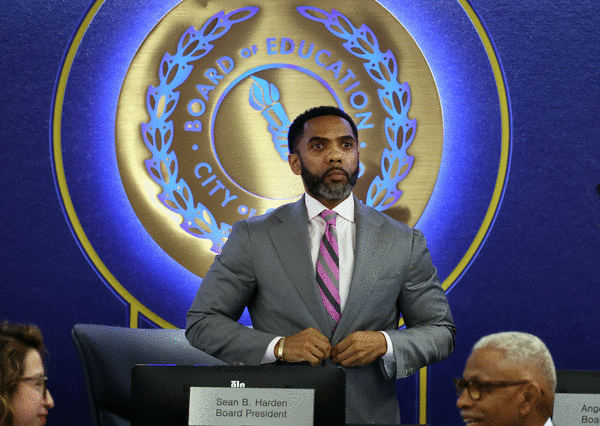
So we were stunned to read about how Sean Harden, chair of the Chicago Board of Education as duly appointed by Mayor Brandon Johnson, reportedly had launched two internal investigations into how that board’s super-secret business got into the hands of reporters. By “internal investigations,” we mean hiring an Evanston-based law firm, Salvatore Prescott Porter & Porter, PLLC.
The secret business in question? The “leaking” of information as to the names of the finalists for the open position of superintendent of the Chicago Public Schools, post-Pedro Martinez. And, more recently, the existence of a coming meeting wherein the Board of Education would discuss hitting up tapped-out Chicagoans for another $25 million as part of their collective property-tax bill. (Not so shockingly, the CPS board went ahead and grabbed the $25 million out of taxpayers’ pockets.)
Harden’s actions are so comically absurd, we hardly know where to start.
But we’ll begin with this rich irony. The leaker, or leakers, seemingly were undeterred, which is how we all know about the legal investigation.
On Tuesday, Fox 32 political reporter Paris Schutz posted on X the memo Harden sent around to fellow board members, warning them that the Evanston lawyers would be sniffing around, presumably into their email, social media and/or other forms of contact. “You have a duty to cooperate with this investigation,” he wrote, “(and) to keep this outreach and your discussion with them confidential.”
How is that working out for you, Mr Harden?
We prefer board members acting according to their conscience. Do you?
The wildest aspect of this is that the Board of Education is required to post its meeting schedule and make its meetings accessible to the public. We won’t waste your time listing all the reasons why this is a good thing, because they are blatantly obvious. Whether its members are elected or appointed by the mayor (and things currently are in transition to a fully elected group), the board represents the people of Chicago and its business is the business of the people of Chicago.
Apparently, Harden was incensed Schutz had the scoop on the coming meeting a few hours before it was made public. This was a hot potato, with interested parties waiting to see if the meeting would be called, because, if so, its outcome was predictable.
Maybe Harden was worried also this reporter knew more than that but that’s show business in a high-profile, political kind of job. More likely, he was hoping to quietly schedule the meeting at a downtime without undue attention from the public because he wanted to minimize any pre-meeting opposition and knew the result would not be popular. Either way, it’s all ridiculous. The people had a right to know. The timing made no difference. Nor did the amplification of the meeting’s existence.
The second matter involved leaked names of the finalists for the top job.
This is a tad more nuanced. As is the case with university presidential searches, among other things, candidates often don’t like their names surfacing because it arguably bespeaks to their current employer of a lack of commitment (although it can also suggest desirability and mobility leading to pay raises and the like). Search firms routinely promise confidentiality, especially in the early stages of a search.
But good reporters on campuses often ferret out the finalists’ names, especially if their candidates are holding meetings with a variety of stakeholders. It’s often as easy as reading a sign on a noticeboard. Wise candidates applying for a high-profile job know of this risk. It’s all part of the marketplace and, frankly, a worthwhile risk in an open society.
We’d argue the Board of Education should have made its finalists public and specifically said that the confidentiality of finalists cannot be guaranteed. Even in the absence of that, leaks are facts of life, especially given the importance of the position. Harden (and the mayor pulling his strings) should accept that reality for the greater good and move on. Certainly, no money should be expended on an outside law firm to intimidate board members into the kind of secrecy that no board of education should be promoting.
Frankly, we’d like to have seen some of the fine student journalists we have met with from Chicago’s public schools find out these names and whatever other plans Harden might have that will impact them and their peers. That would be an indication of excellent journalistic education, serving the interests of the people of Chicago.
_____
©2026 Chicago Tribune. Visit chicagotribune.com. Distributed by Tribune Content Agency, LLC.




















































Comments