Editorial: Slashing foreign aid risks millions of lives
Published in Op Eds
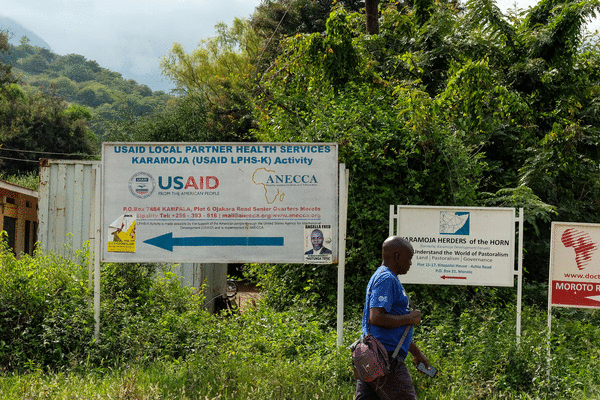
The White House announced last January that waging war on the “foreign aid industry and bureaucracy” would be among its first orders of business. Unfortunately, many other rich-country governments are following its lead. If current and planned cuts to foreign aid stand, the cost could be millions — repeat, millions — of lives lost.
No question, the U.S. and others need to change the way they design and administer aid. Too many of their programs have failed to promote development. Bureaucracies proliferate, spending is badly allocated, money is wasted. But the recent cuts are failing to discriminate between good and bad projects and aren’t even trying to improve efficiency. Worst of all, many of them threaten critical health interventions in the poorest countries, programs that are proven to save lives at relatively little cost. Aid should be streamlined and repurposed, not blindly cut.
Over the years, aid to promote economic growth has had mixed results, to put it generously. There’s no sure formula for success, but lessons have been learned and governments should put them into practice. Simpler administration, clearer accountability for providers and beneficiaries, fewer intermediaries, and a shift from top-down to bottom-up design would all help. In general, a stronger focus on poverty relief and straightforward cash transfers would likely achieve better results than standard, heavily bureaucratized approaches.
But health interventions are different. They’re aimed at saving lives, not promoting growth — and they work. Aid in suppressing HIV, tuberculosis and malaria is estimated to cost between $2,000 and $5,000 per life saved. Set against other public-spending programs, those costs are modest — and the benefits enormous. Such programs should be expanded, not squeezed. Note too that cuts in aid for health and emergency humanitarian relief will likely fall disproportionately on the poorest people in the world’s poorest countries — whose governments may be unable to direct their own meager resources toward such programs.
Just how steeply U.S. aid spending fell in 2025 is hard to say — proving that weak management and opaque accounting are indeed legitimate concerns. The administration’s most recent budget request proposed to reduce funding for health programs from $10 billion in 2025 to $4 billion, including a 50% cut in spending to fight HIV/AIDS. But its initial sprawling list of canceled awards was repeatedly overridden or revised, and Congress subsequently moved to soften the blow to health programs.
The past year’s administrative chaos, including widespread layoffs and the dismantling of the U.S. Agency for International Development, has compounded the problem. Together with the customary lags between commitments and outlays, it has made keeping track of foreign assistance close to impossible. Still, the overall outlook isn’t disputed: U.S. spending on aid is set to fall sharply this year and beyond, and the most cost-effective health and poverty-relief programs won’t be spared. According to one study, implementing the administration’s proposed cuts would mean a million or more lives lost each year.
If you hoped that other advanced economies would make good on the shortfall, think again. Many governments, setting earlier promises aside, have joined the U.S. in squeezing aid: The Organization for Economic Cooperation and Development estimated a combined cut of 9% to 17% in 2025 (including a cut of as much as 28% in aid for sub-Saharan Africa), with further reductions to follow this year. France, Germany, the UK and the U.S., together accounting for about two-thirds of official assistance over the past decade, have all cut their aid budgets. They’re the first such reductions in decades.
The U.S. and many of its peers face severe fiscal challenges: high spending, gaping deficits and relentlessly mounting debts. Firmer discipline is indeed essential. Aid shouldn’t be exempt from efforts to economize, especially since its record in many respects has been disappointing. But by any measure of cost-effectiveness, aid budgets also include programs that have succeeded admirably — saving or improving millions of lives at comparatively trivial cost. Turning away from such interventions is indefensible.
____
The Editorial Board publishes the views of the editors across a range of national and global affairs.
©2026 Bloomberg L.P. Visit bloomberg.com/opinion. Distributed by Tribune Content Agency, LLC.



















































Comments