Abby McCloskey: Backing away from the Hyde Amendment is a big deal
Published in Op Eds
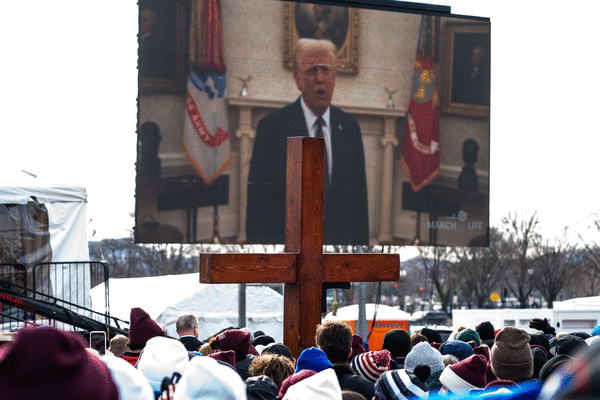
The anger among conservatives about President Donald Trump’s comments on the Hyde Amendment, which bars federal funds from being used for abortion, is not insider Beltway baseball. It’s not a splinter in the MAGA coalition, generously salted by mainstream media outlets. It’s a historic departure on one of the clearest moral issues in conservative orthodoxy.
Two-thirds of Republicans believe abortion is always, or almost always, morally wrong, according to Pew Research. No Republican president has ever waffled on his support of it — until now. “You have to be a little flexible on Hyde, you know that,” Trump told congressional Republicans at a retreat. “You gotta be a little flexible. You gotta work something … we’re all big fans of everything. But you have to have flexibility.”
For fifty years, the Hyde Amendment has stood as a bipartisan bulwark on abortion. It’s been the area — however humble — of deep political agreement on the emotional and divisive issue of undesired or untenable pregnancies. It has remained constant as pro-lifers and pro-choicers sorted themselves into rival parties, as the Supreme Court did an about-face on Roe v. Wade, as states have adopted radically different abortion policies, through the advent of social media and polarization.
What it does is simple: The Hyde Amendment prevents federal funds from being used for abortions, save for a few exceptions: rape, incest and the mother’s life. It has been law since 1976, when following the 1973 Roe decision, federal Medicaid funds were being used to pay for around 300,000 abortions annually. Because the Hyde Amendment sits as a “rider” or an amendment to the annual appropriations bill for the Department of Health and Human Services, it must be passed every year.
And each year, Congress and the sitting President have done so without fail. Even President Obama and his trifecta Democratic government adhered to it. The Democratic-led Affordable Care Act did not wobble on Hyde. The ACA explicitly stated that federal funds for insurance subsidies could not be used to pay for abortion, except in the standard Hyde exemptions.
To be sure, some blue states have created workarounds, allowing state taxpayer funds for abortions. Hyde has critics on the left, and President Joe Biden suggested during the 2020 campaign — to the shock of many of his fellow Catholics — that he would not renew it. (He ultimately did.) But for red states and Republicans, it’s been non-negotiable. Until President Trump.
Talk about a reversal. In 2022, thanks largely to Trump-appointed justices to the Supreme Court and a half century of advocacy, marches, and grassroots campaigns, Roe was overturned and abortion policy was returned to the states. A year later, Trump announced, “I’m proud to be the most pro-life president in American history.”
Pro-lifers understandably thought that they had won. Instead, the number of abortions post-Dobbs increased by 12%, reaching a decade high in 2023, according to the Guttmacher Institute. For the first time, most Americans began identifying as pro-choice, increasing from a historic average of 41–50% to 55%. And in 2024, 23% of registered voters reported they would only vote for a pro-choice candidate, relative to 8% who would only vote for a pro-life candidate — a historic flip from pro-lifers being the most energized voters.
One thing that did not reverse following Dobbs is that most voters still oppose taxpayer funds for abortive procedures.
But under Trump 2.0, the GOP began creating distance from the pro-life causes they had long championed. Long-standing pro-life language in the Republican platform was removed in 2024. Trump spoke out against the heartbeat law in his home state of Florida. And during his third presidential campaign, Trump said on Truth Social: “My administration will be great for women and their reproductive rights.”
Not that many conservatives seemed to mind. White evangelicals congregated in their support of Trump in record numbers in 2024, the biggest constituency bringing him to power. That’s because the GOP’s saving grace on abortion has been that politics is a game of comparisons. Democrats have had their own evolution on the issue, from “safe, legal, and rare” during the Clinton era to “shout your abortion” today. The party’s resistance to any restrictions on abortion is out of step with the American public, the majority of whom oppose abortions performed after the first trimester.
Abortion has made a mess of both political parties.
My personal views on the issue: I’m Anglican and believe in the innate value of every human life. I am pro-life, although my beliefs on life extend beyond the womb to a whole-life ethic. I believe we could do a better job as a nation supporting mothers and children, especially in the wake of Dobbs. We also could do a better job caring for the vulnerable of all ages, races, and economic conditions. This is the holistic, cross-partisan (and largely Democratic) way that the pro-life movement began, as documented by Daniel Williams in “Defenders of the Unborn,” before the pro-life movement focused its efforts in the later part of the 20th century as largely a Republican and evangelical effort.
My beliefs on life aren’t represented in our two-party system. I don’t expect them to be any time soon. The tiny upside of this political homelessness is that this provides the freedom to look at when the political parties get it wrong (or right) on dignity-of-life issues.
This matters because political parties and coalitions are shifty and shifting, especially these days. Bedrock principles should not be. And regardless of whether you find yourself on the pro-choice or pro-life side of the aisle, these are big and weighty issues dealing with vulnerable people that should not be decided on the back of budget deals or on political whims.
The Hyde Amendment is the longest-standing and most bipartisan policy we have on abortion. What an irony if it’s lost by the very “pro-life” Republicans.
____
This column reflects the personal views of the author and does not necessarily reflect the opinion of the editorial board or Bloomberg LP and its owners.
Abby McCloskey is a columnist, podcast host, and consultant. She directed domestic policy on two presidential campaigns and was director of economic policy at the American Enterprise Institute.
©2026 Bloomberg L.P. Visit bloomberg.com/opinion. Distributed by Tribune Content Agency, LLC.



















































Comments