Juan Pablo Spinetto: The Year of the Right is looming in Latin America
Published in Op Eds
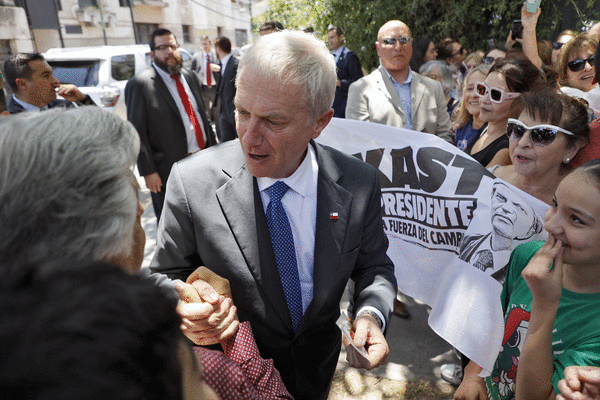
José Antonio Kast wasted no time. Less than 36 hours after being elected Chile’s next president, the conservative leader boarded a plane, crossed the Andes and paid a visit to his ideological ally, Argentina’s libertarian standard-bearer Javier Milei. As political images go, it was powerful: Right-wing ideals have become the binding glue between two leaders who could hardly be more different in style, temperament and life choices.
If 2025 marked the reemergence of Latin America’s right — with Milei securing a crucial midterm victory in October, conservatives prevailing in Ecuador and Honduras, and, most strikingly, the end of socialism in Bolivia after nearly two decades in power — then 2026 is likely to cement it. Elections in Costa Rica, Peru, Colombia and, above all, Brazil could amplify the trend, redrawing alliances and transforming a loose drift into a solid blue tide. It would hardly be surprising if, a year from now, the region’s four largest economies had all swung right, leaving Mexico as the lone leftist outlier.
After more than two decades covering Latin American politics, I’ve learned to distrust electoral predictions, and this column makes none now. In Colombia, a left-wing candidate could still exploit divisions across the right and the center to succeed Gustavo Petro. In Brazil, the seemingly ageless Luiz Inácio Lula da Silva holds a respectable lead over a fractured opposition, though convincing voters to grant him a record fourth term may prove far harder come October. And recent history offers reminders that political disruptors can still burst onto the scene at the eleventh hour.
Yet step back from the individual races and the broader trend is unmistakable. Latin America is shifting right, pushed by voters’ growing anger over insecurity, corruption and stagnant living standards. Latinobarómetro shows that last year the share of people placing themselves closer to the right reached its highest level since 2002. The cult popularity of Nayib Bukele’s iron-fisted approach in El Salvador, the region-wide rejection of Nicolás Maduro’s socialist autocracy in Venezuela, and even the muted response to US President Donald Trump’s bellicose posture in the Caribbean Sea all point in the same direction: The political mood is shifting — and fast. Should Trump succeed in forcing regime change in Venezuela (still a big if), the fall of Maduro could trigger knock-on effects in Cuba and Nicaragua, the region’s remaining leftist dictatorships.
Among Latin Americanists, the debate is whether this shift reflects a genuine ideological realignment or simply the familiar pendulum swing after years of left-leaning governments that didn’t deliver decisive results (see a recent discussion on this on the AQ Podcast.) The answer is probably both. Conservative ideas — from shrinking the state’s role in the economy to rejecting progressive gender agendas — are gaining traction. Unlike other right-leaning administrations of the past decade, such as Mauricio Macri’s in Argentina or Sebastián Piñera’s in Chile, this new wave is less interested in reaching across the aisle and unapologetic about wearing the right-wing label.
Timing, however, matters just as much as ideology. Voters across the region are proving ruthless with governments that fail to deliver quick, tangible results — and this time the left is the one paying the price. Chile, where presidents cannot seek immediate reelection, is a case in point: Kast’s victory marks the fifth left-right U-turn in just two decades.
Incoming leaders must absorb that lesson quickly. Some argue this right-wing momentum will lead to hardline policies on issues such as immigration, climate change and social issues, further expanding the club of countries drifting outside the political mainstream. Color me not convinced. Culture wars and ideological camaraderie may energize core supporters and smooth political obstacles, but elections are still won — and lost — on far more prosaic grounds: improving security, reducing crime, easing the cost of living and raising incomes. On those measures, right-wing newcomers will be judged no differently than the governments they replace. When economies underperform, durable political legacies are hard to build.
More importantly, we should resist the temptation to treat these movements as monolithic. Beyond the tired right-versus-left narrative lies a landscape of grey zones and political nuance, shaped as much by local power dynamics as by ideology. Argentina is not the free-market libertarian paradise Milei claims it to be, and Mexico is working closely with Trump’s White House despite the anti-American instincts of President Claudia Sheinbaum’s nationalist Morena movement. Other similar examples abound. Recognizing this complexity is essential for companies, investors and strategists navigating the region’s volatile politics, which often affect markets far more deeply than elsewhere. The first step toward reducing polarization and truly understanding Latin America is to resist the urge to turn politics into a Barcelona–Real Madrid football match, where team loyalty trumps honest analysis.
The year ahead will be especially testing for Latin American policymakers, not least because of Trump’s renewed focus on the Western Hemisphere. In an environment of heightened uncertainty, the most decisive assets will be political dexterity and the ability to seize opportunities — not just ideological purity.
____
This column reflects the personal views of the author and does not necessarily reflect the opinion of the editorial board or Bloomberg LP and its owners.
JP Spinetto is a Bloomberg Opinion columnist covering Latin American business, economic affairs and politics. He was previously Bloomberg News’ managing editor for economics and government in the region.
©2025 Bloomberg L.P. Visit bloomberg.com/opinion. Distributed by Tribune Content Agency, LLC.



















































Comments