POINT: The increase in polarization mirrors the growth of government
Published in Op Eds
Politicians and policy experts like to talk about the “root causes” of crime, homelessness, poverty, rising prices and other problems. If they want to understand the root cause of political polarization, they might want to consider the whole picture and look in the mirror.
In a book published 40 years ago, economist and political philosopher Anthony de Jasay (1925-2019) proposed an explanation that did not receive the attention it deserved. Born in Hungary and trained as an economist at Oxford University, de Jasay spent most of his professional life as a banker and financier in France. He published his first book, “The State,” in 1985; it was republished in America in 1998.
In de Jasay’s view, politics is necessarily polarizing. It is just a matter of degree. The larger the scope of the state (the entire apparatus of government), the more politics you have. And more politics leads to more polarization.
With the state extending its reach nearly continuously since what de Jasay called “the brilliant 19th century,” you may even be surprised that polarization has not yet reached the breaking point (though some may argue it came close with the advance of communist parties in Western European countries after World War II).
The link between the size and scope of the state and the growth of political polarization rests on a simple fact: Individuals are not identical. We have different desires, needs, tastes and values.
Government policies, however, are necessarily one-size-fits-all. They impose, or aim to impose, the same laws and rules on everyone, creating dissatisfaction and discontent among those whose preferences are ignored or rejected.
Understandably, the discontented then demand laws — subsidies, tax preferences, affirmative action and other legal privileges — that favor their side. Especially in democratic societies, this leads politicians out of power to seek to regain it by promising to grant these favors and privileges, which triggers new discontent on the other side.
This messy process continues, with each side constantly upping the ante.
Consider a “cultural” example. The left mandates diversity, equity and inclusion (DEI) policies, even imposing them on private companies and organizations. The right prohibits DEI, including private DEI. Each side employs the power of the state to prevent the discrimination it doesn’t like. In the process, government power grows, becoming more threatening to everybody.
Virtually all politicians try, in their own interest, to satisfy their political constituencies, party or tribe. Politicians become drudges trying to pull promised miracles for their clients, who remain dissatisfied and ungrateful. Despite their favored stations in life, politicians are also not happy and complain nonstop.
In short, the more the state intervenes in the economy — that is, in people’s lives — the more it becomes true that it cannot help anybody without hurting somebody else.
The state — what de Jasay calls “the adversary state” — takes sides in all disagreements. As a result, polarization increases, and increases again, and again.
What will be the endgame? De Jasay was not optimistic. Being continuously asked to give without taking anything away, to intervene without harming, the state will finally have to nationalize the whole economy, he suggested.
It could look like “state capitalism,” starting slowly with a handful of companies, such as U.S. Steel, Intel, MP Materials and Vulcan Elements. However, the more workers are directly or indirectly employed by the state, the more they will vote for themselves less work and higher wages. At some point in the brave new world of state capitalism, de Jasay suggested, democratic elections will be abolished, and we’ll all become property of the state, as slaves were owned by their plantation masters.
Impossible in America? Perhaps. Let’s hope.
Yet, given the government’s relentless growth in both size and power over many decades, the end of individual liberty is not as utterly inconceivable as many had thought. That’s why polarization is likely to increase, rather than decrease, in the years ahead.
_____
ABOUT THE WRITER
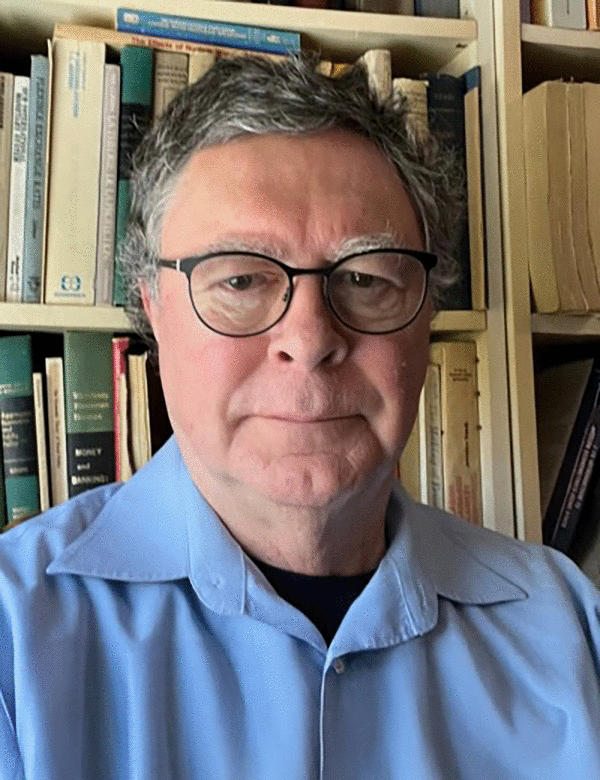
Pierre Lemieux is a research fellow at the Independent Institute and an economist with the Department of Management Sciences at the University of Quebec in Canada. He wrote this for InsideSources.com.
_____
©2025 Tribune Content Agency, LLC
















































Comments