Commentary: Gutting food programs won't make us healthy
Published in Op Eds
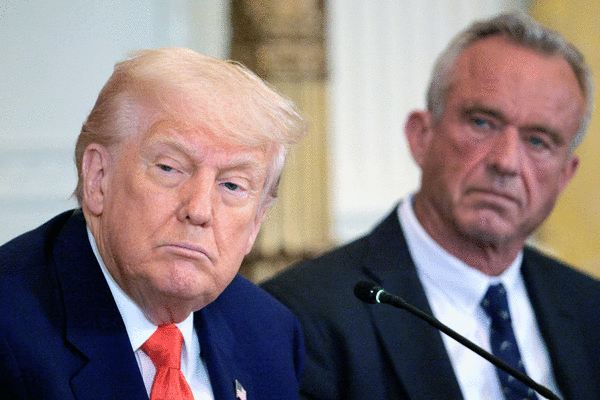
In early September, the Trump administration’s Make America Healthy Again Commission released a highly anticipated roadmap for improving the health of the nation’s children. Many within the MAHA movement hoped this would be a turning point: a chance to advance meaningful action on pesticides, healthy food and organic and regenerative agriculture. They were badly mistaken.
In the months before the report, more than 500 MAHA grassroots leaders and organizations urged the administration to strengthen protections from toxic chemical exposure, invest in organic agriculture and end liability shields for agrochemical companies. Instead, the commission ignored these calls for reform, at a time when our children’s health and nation’s food system demand real change, while President Donald Trump’s secretary of agriculture, Brooke Rollins, announced deep cuts to key U.S. Department of Agriculture (USDA) programs that supported small and medium-sized farms.
If the Trump administration truly wants to make children and our food healthier, it must stop dismantling proven programs and commit to real policy action.
Despite clear demands from MAHA supporters, the commission called for fast-tracking pesticide approvals and launching public relations campaigns to claim that toxic pesticides are “safe” under the Environmental Protection Agency’s “robust review” processes. That is not reform — it’s the same industry-driven agenda we’ve had for decades, with agribusiness lobbyists calling the shots on food and farming policy.
The contradictions don’t stop there. The report has solid recommendations on whole foods, organics, small farmers, healthy soils and conservation. Yet, in the last six months, USDA has gutted programs that could advance these goals, laying off thousands of conservation staff. The agency also canceled more than $1 billion in conservation projects, including some that were already well underway, even as the report claims to prioritize “shovel ready” projects.
Nutrition policy shows the same disconnect. The report rightly advocates for increasing whole foods in school nutrition programs, better alignment with dietary guidelines, and improvements in its processes for delivering local produce to schools. Yet in March, USDA slashed funding for fresh whole foods for schools and food banks from local farmers. Soon after, it eliminated all Farm to School funding for 2025.
When the MAHA report was released, Rollins announced that USDA would reinstate the program as“one of the best ways we can deliver nutritious, high-quality meals to children, while also strengthening local agriculture.” But the amount of restored funding — up to $18 million — pales in comparison to the $1 billion cut from Local Food for Schools and other regional food and infrastructure programs.
Moreover, in July, Rollins canceled the Regional Food Business Centers, a critical support for local food infrastructure, small-scale meat producers and regenerative farmers. These centers helped producers and food businesses deliver healthy food to local markets, including schools, by providing grants to support food safety, meat inspection and processing, aggregation, and distribution, among other things. These cuts will harm local farmers and rural economies and make it harder for schools and other institutions to put healthy, local food on kids’ plates.
Even the report’s “healthy eating” recommendations raise alarms. The push for more full-fat animal products ignores the well-documented fact that toxic chemicals — including dioxins, heavy metals and pesticide residues— concentrate in animal fat, especially in the factory farms that produce more than 95% of U.S. meat and dairy. Promoting these foods as universally healthy is misleading and dangerous.
If the Trump administration truly intends to make children healthy again, it must reverse course. That means expanding the 2026 Farm to School and other local food programs and reinvesting in conservation and regional food infrastructure. It also means phasing out processed meats in school meals, prioritizing scratch-cooked options and reforming USDA purchasing so taxpayers no longer subsidize ultra-processed junk and instead channel more of the USDA’s $5 billion in food purchases toward independent regenerative and organic producers.
Launching flashy PR campaigns like “Make American Schools Healthy Again” while dismantling the very programs that deliver fresh food will not improve our children’s health.
The Trump administration can still change direction, but this requires aligning its rhetoric with meaningful policy action and honoring the promises that first inspired the MAHA movement to get behind Trump. Anything less is just window dressing masquerading as a plan.
_____
Kari Hamerschlag is deputy director of food and agriculture at Friends of the Earth. This column was produced for Progressive Perspectives, a project of The Progressive magazine, and distributed by Tribune News Service.
_____
©2025 Tribune Content Agency, LLC.




















































Comments