Commentary: Religious revolution is happening online (and that's not a bad thing)
Published in Op Eds
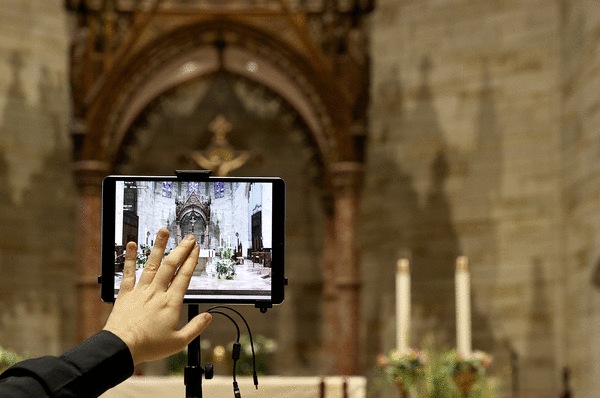
The most important religious revolution of our time isn’t happening in mosques or churches. It’s happening on screens.
For millions of young Muslims around the world, the spiritual life that once flowed through the mosque is now being livestreamed from a bedroom, uploaded to YouTube and shared on TikTok. Twitch preachers, Instagram sheikhs, WhatsApp fatwas — these are often dismissed as symptoms of decline: religion cheapened into memes, centuries of tradition eroded by hashtags.
But look closer, and you may see something else. The rise of what I and other scholars of religions have taken to calling the “Cyber Ummah” — a worldwide Muslim community knit together online, where faith and identity are reshaped through digital connection — is not the death of Islam. It may be its renewal.
From the death of the Prophet Muhammad in the 7th century to the fall of the caliphate in the 20th, Islam has always evolved in response to rupture. Each disruption fractured old certainties and dispersed authority, forcing believers to renegotiate what it means to be Muslim. What we are witnessing online today is merely the latest chapter in this 1,400-year struggle over the meaning and message of the world’s second-largest religion.
Five centuries ago, the printing press tore religious authority away from Europe’s priestly elite. Today, a smartphone in the palm of a young Muslim is doing the same thing to Islam. For centuries, the learned scholars of Al-Azhar and other clerical institutions claimed a monopoly on interpretation. If you wanted a fatwa — an authoritative religious ruling — you went to them. Today, a believer in Jakarta, Indonesia, or Detroit is just as likely to consult a livestreaming influencer or search a fatwa bank online as they are to seek guidance from a seminary-trained cleric.
And Islam is hardly alone. Evangelical Christianity has been transformed by the rise of the “internet church.” TikTok is full of micro-sermons from pastors whose followings rival those of pop stars. Megachurches now put as much time into building community among digital congregations on YouTube as they do for those sliding into physical pews each Sunday.
The COVID-19 pandemic accelerated this shift: Millions of Christians learned that communion could be mediated through a screen, worship streamed, confession FaceTimed. Judaism too has adapted: Rabbis host “Ask Me Anything” sessions on Reddit, and Orthodox women share Torah interpretations on Instagram that would have been excluded from yeshivas just a generation ago.
A 20-year-old in Cairo can now debate Quranic interpretation with a 20-year-old in Los Angeles in real time. A Christian teenager in Seoul can discuss Bible verses with a peer in São Paulo. A Jewish woman in Tehran can bypass her local rabbis and join a global conversation on women’s rights in Judaism. Authority is shifting from the pulpit to the smartphone screen, from the seminary to the message board. That shift is unsettling, but it is also profoundly in line with the past and promise of religious traditions themselves.
These shifts matter far beyond theology. When religious authority moves from clerics to believers, politics and power move with it. The Arab Spring showed how digital platforms could fuel demands for democracy in Muslim societies. QAnon showed how they could breed new forms of fanaticism in Christian ones. Faith online can destabilize governments as easily as it can topple hierarchies of tradition.
Critics warn that this democratization risks chaos: competing theologies, contradictory teachings, extremists thriving alongside progressives. And those risks are real. But disorder has always been the engine of renewal. The Christian Reformation shattered one church into a thousand sects, unleashing both sectarian violence and unprecedented spiritual vitality. Islam’s own history tells a similar story: The flowering of Sufism, the birth of new schools of law and today’s digital revolution — all began as challenges to entrenched authority.
Religious leaders fear fragmentation, and understandably so. But what looks like disorder may actually signal resilience. Faith traditions ossify when their stories and rituals are frozen by gatekeepers. They thrive when believers seize them anew.
Digital religion is messy, contradictory, cacophonous. But that’s what living traditions look like. Religion is not a relic to be shelved in museums or confined to sanctuaries. It is a dynamic force, remade in every generation, belonging not to clerics and states but to believers themselves.
The future of faith won’t be decided by clerics in pulpits. It will be decided by believers on screens.
____
Los Angeles-based writer and scholar Reza Aslan is the author of “Zealot: The Life and Times of Jesus of Nazareth” and “No god but God: The Origins, Evolution and Future of Islam,” available now in a 20th anniversary edition.
_____
©2025 Los Angeles Times. Visit at latimes.com. Distributed by Tribune Content Agency, LLC.




















































Comments