Abby McCloskey: MAHA wants breastfeeding. Its moms should demand paid leave
Published in Op Eds
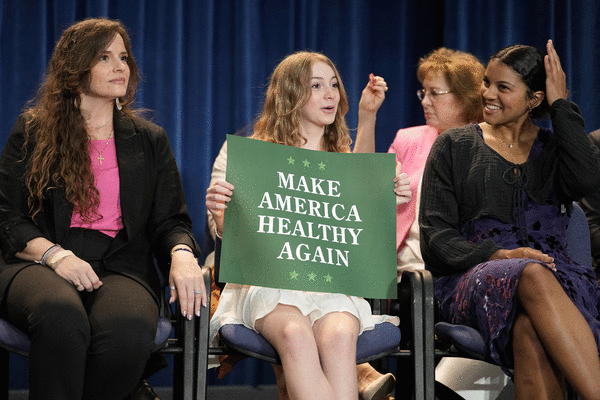
Here’s a big, pressing problem: America’s children are not healthy. Not by any metric of chronic disease, obesity or mental health. It’s more than overdiagnosing and food dyes. It feels deep and systemic and beyond parental control. We’re not really sure what to do about it, for the kids or for ourselves. But the trend lines are moving in the wrong direction.
Given the complexity of the problem, the Make Our Children Healthy Again strategy released in September feels a bit like spaghetti thrown against a wall. The report’s dozens of recommendations range from “promoting innovation in the sunscreen market” to “ensur[ing] flexibility for farms to manage manure.”
But one of the report’s more straightforward recommendations doesn’t require rewiring the medical or food systems. “USDA and HHS will work to increase breastfeeding rates,” the report states, “Whether through the Special Supplemental Nutrition Program for Women, Infants, and Children or other policies that support breastfeeding mothers.”
The American Academy of Pediatrics recommends that infants be exclusively breastfed for the first six months, citing a wide range of benefits, including immune, nutritional, and long-term health benefits for children as well as promoting postpartum healing for mothers.
We are a far distance from that goal. Nearly all mothers breastfeed at least once (usually in the hospital), but the duration and exclusivity of breastmilk is short-lived. According to Centers for Disease Control and Prevention data, only around half of mothers exclusively breastfeed for three months. By about six months, it drops to around 1 in 4. Numbers are even lower for low-income women.
But one of the most significant determinants of breastfeeding is related not to health care but to the labor market: whether or not a mother works. Working mothers are significantly less likely to breastfeed than stay-at-home mothers for obvious reasons such as privacy, milk storage and time — neither feeding a baby nor pumping milk can be rushed, and both need to be done every few hours. Moreover, by exclusively breastfeeding, you are committing to being awake for much of the night to keep up your milk supply. This is simply incompatible with work, especially in the early weeks.
Paid parental leave is a lever for changing this, especially for our most vulnerable mothers. As has been said many times before, the US is the only developed nation without a national paid maternity leave policy. The private sector has made strides toward providing some, but hasn’t picked up all the slack. Less than 1 in 3 mothers has access to paid family leave from their employers. For low-income workers, employer-sponsored paid family leave access drops below 10%.
This shows up in our breastfeeding rates. A recent NIH study found: “Women who return to full-time employment six to twelve weeks postpartum were more than 50% less likely to meet their breastfeeding intentions, and women who return to full-time employment less than six weeks postpartum were more than twice as likely to not meet their breastfeeding intentions, compared to women who do not work.”
An NBER study estimated that paid family leave (PFL) “increases the overall duration of breastfeeding by nearly 18 days, and the likelihood of breastfeeding for at least six months by 5 percentage points. We find substantially larger effects of PFL on breastfeeding duration for some disadvantaged mothers.” In the minutiae of academic research, these are huge impacts to say the least.
MAHA mothers should be all over this. The MAHA movement has mobilized mothers across the political spectrum — from granola moms to sourdough moms — to improve children’s health, read labels and purchase organic food. But some problems are structural and out of their hands.
I remember meeting the lactation consultant in the hospital when I had my first child. She showed me the proper way for a baby to latch (“like they’re eating a hamburger”) and a schedule of how many times a day I should feed. But none of my more significant breastfeeding challenges popped up until leaving the hospital.
We don’t fit family into work. It should be the other way around. The ability to breastfeed your child — and the health benefits it provides — should not be up to your employer. Not to mention that protected time away from work is a necessary foundation for any other breastfeeding support HHS might choose to provide, be it home visits or insurance-covered lactation consultants.
Traditionalists might argue that one way of protecting it is for moms to leave the labor force entirely. But many mothers — dare I say the vast majority — are unlikely or unable to do so. Nor, in my opinion, should they be forced to just because as a country we haven’t prioritized job-protection and financial support for parents and infants.
Most parents agree — with paid family leave garnering upwards of 80% support from people across the political aisle.
The first Trump Administration recognized this, calling for a national six-week paid parental leave policy (the OECD average is 18.5 weeks) and including it in the White House budget. Republicans didn’t jump on board — despite being the “pro-family” party. Neither did Democrats, despite decades of advocating for paid leave. Trump’s second administration has backtracked somewhat; its “big, beautiful bill” offers tax credits to companies that provide paid leave, but not much more.
MAHA moms shouldn’t let them off the hook. Making children healthy again is complicated. This part is not.
_____
This column reflects the personal views of the author and does not necessarily reflect the opinion of the editorial board or Bloomberg LP and its owners.
Abby McCloskey is a columnist, podcast host, and consultant. She directed domestic policy on two presidential campaigns and was director of economic policy at the American Enterprise Institute.
©2025 Bloomberg L.P. Visit bloomberg.com/opinion. Distributed by Tribune Content Agency, LLC.




















































Comments