Matthew Yglesias: Who can save the Democratic Party?
Published in Op Eds
President Donald Trump’s popularity may be on the wane, but he still has a ways to go to match the Democratic Party. Not only that, but voters see Republicans as having a better plan to manage crime, immigration, the economy and — amazingly — corruption.
The left-wing faction of the party is taking advantage of the discrediting of the national leadership to grow its own ranks. Realistically, however, it’s hard to see how becoming even more left-wing will improve the party’s fortunes. A better idea is to revive the once-vibrant moderate wing of the party.
There are encouraging signs that this revival is underway. In just the last few months, there has been the launch of Majority Democrats, an organization of elected officials and aligned operatives dedicated “not just to winning the next election, but ultimately breaking the stalemate that has defined our politics for three decades.” There’s a new magazine, The Argument (I’m a contributor), that is trying to breathe new life into good old-fashioned American liberalism. There’s a new think tank, the Searchlight Institute, that is aiming to develop new policy ideas that will “disrupt rigidity” and “spark a realignment.” Meanwhile, older moderate institutions such as Welcome PAC, the Niskanen Center (I’m a senior fellow) and Third Way have attracted new donor interest. Even pillars of the party establishment, such as the Center for American Progress President Neera Tanden, are talking about the need to “expand the tent” on hot-button issues like abortion.
And yet. In some quarters, this is all dismissed as a reheating of the stale playbook of the Democratic Leadership Council, which was founded in the 1980s and hegemonic when Bill Clinton was president.
From where I sit, such a reheating would be welcome. The DLC and its allied institutions ultimately discredited themselves with enthusiastic support for the misguided invasion of Iraq. But the larger concepts for which it stood — a forceful synthesis of free markets with concern for the poor, mainstream cultural values, and attention to the interests of the consumers of public services rather than the producers — should be at the center of Democratic Party revitalization.
But while the politics remain appealing, the structural conditions have changed.
Four decades ago, US politics were less nationalized and less polarized. President Ronald Reagan won landslide victories, but there were still a lot of downballot moderate Democrats holding office in conservative regions of the country — most notably the South. The core of the DLC project was to start with that group of existing elected officials, people who desperately needed support infrastructure, and to build from there with the goal of making one of their own (perhaps Virginia Governor Chuck Robb or, as it turned out, Clinton) the party’s presidential nominee.
There is no such group of moderate Democrats today.
The reddest states to have Democratic senators are Arizona and Georgia, places that former President Joe Biden won in 2020 and where local Democrats are more interested in a course-correction than a disruptive change. Laura Kelly and Andy Beshear, the governors of Kansas and Kentucky respectively, both seem more concerned with ingratiating themselves with the party establishment than delivering blunt messages about the kind of change that could make Democrats viable nationwide. There are House members like Jared Golden of Maine and Vincente Gonzalez of Texas who are holding down very Trumpy districts, but their preferred approach is to localize their politics rather than articulate a national message.
The limits of the current approach are illustrated by the gubernatorial campaigns of Abigail Spanberger in Virginia and Mikie Sherrill in New Jersey. These women, both Majority Democrats, are both favored to win in blue-leaning states. And they’re running smart, moderate campaigns in the sense that they have eschewed any alarming ideological flights of fancy. But their campaigns are moderate primarily in the sense of being modest. They will probably prevail in states that Kamala Harris won, but they’re not offering disruptive ideas that would meaningfully alter the national image of the party.
Sherrill, for example, heartened education reformers who’ve been hoping Democrats will re-embrace charter schools when she picked Dale Caldwell — who, among other things, has been a successful charter school leader over the course of his career — as her running mate. But the campaign rarely talks about this aspect of Caldwell’s biography, and has not explicitly embraced charters on a policy level or criticized incumbent Governor Phil Murphy’s record of charter skepticism.
So what’s a demoralized Democratic Party to do? There is a model for revitalization, and I am not being completely Swiftian: Donald Trump.
He found a Republican Party that a) was suffering a leadership void and b) featured a huge disconnect between the elite (which was focused on cutting Medicare and Social Security spending) and the base (which was tired of losing elections on this issue and wanted to fight a culture war). And he just kind of waltzed in as an outsider who leveraged his celebrity status and media savvy to get taken seriously despite a total lack of relevant experience.
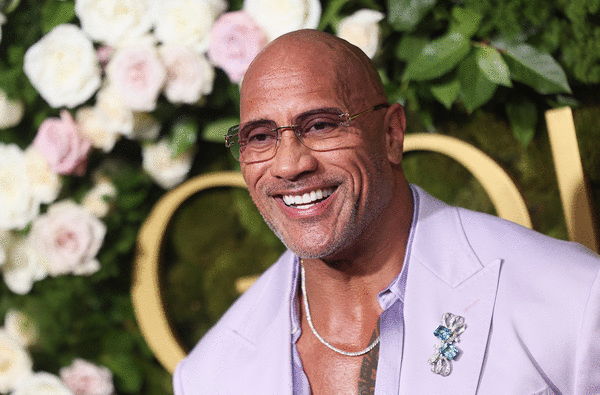
So when people ask me about the possibility of Stephen A. Smith or Mark Cuban or Dwayne “The Rock” Johnson leading the party in 2028, I don’t dismiss it. I would rather see a governor, since I see practical government experience as valuable. But a message of meaningful change and willingness to disrupt the existing coalition is very much needed. And if no current elected official is willing to embrace that message, then there is a clear opportunity for an outsider to give it a shot.
____
This column reflects the personal views of the author and does not necessarily reflect the opinion of the editorial board or Bloomberg LP and its owners.
Matthew Yglesias is a columnist for Bloomberg Opinion. A co-founder of and former columnist for Vox, he writes the Slow Boring blog and newsletter. He is author of “One Billion Americans.”
©2025 Bloomberg L.P. Visit bloomberg.com/opinion. Distributed by Tribune Content Agency, LLC.





















































Comments