Andreas Kluth: Trump has lost credibility worldwide, at huge cost
Published in Op Eds
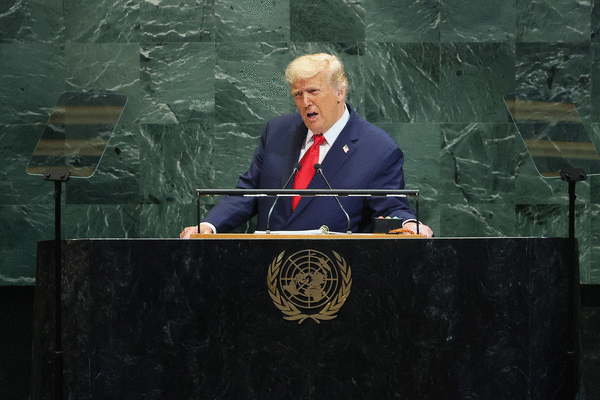
Credibility, like trust and a good reputation, is hard to earn, easy to lose. It’s also ruinously expensive once it’s gone, especially in international relations. So it is no small matter that Donald Trump, eight months into his second term as U.S. president, has squandered whatever credibility America had left in foreign and security policy.
The latest embarrassments occurred last week, when Trump fired off several zingers on the same day, causing world leaders to be by turns shocked, puzzled or — most devastatingly — indifferent verging on bemused. In a rambling speech at the United Nations, Trump offended not only that institution but also individual countries from Brazil to Britain. Later, he ad-libbed his latest reversal on the Russian war of aggression against Ukraine.
Kyiv, he said, could “fight and WIN all of Ukraine back in its original form” because Russia looks like a “paper tiger.” This missive came a month after Trump rolled out, literally, the red carpet for Russian President Vladimir Putin; and after he first set, then shifted, then sheepishly dropped an ultimatum to Putin to enter ceasefire talks. In the months before that, Trump had variously blamed Ukraine for its own invasion and claimed that Kyiv held “no cards” and had to cede territory. And all the while, he has kept asserting that Putin would never have invaded if only he, Trump, had been in the White House in 2022.
A U.S. president, unlike the rest of us, has many audiences, domestic and foreign. The international ones include adversaries, allies and other countries who could go either way. The primary adversary in this context is of course Putin. His KGB-trained mind seems to have concluded long ago that Trump is what the Soviet-era KGB used to call a “useful idiot.”
Since Trump took office this year, Putin has not restrained but intensified his bombing of Ukraine, as well as his “gray-zone” operations against European NATO countries — all without incurring noticeable consequences from Washington. In recent days, Russia even sent drones into Poland and Romania, fighter jets into Estonia, and apparently more drones into Scandinavia. Respect, fear and awe of Trump’s “strength” would look different.
Trump is hardly the first U.S. president in recent history to forfeit America’s credibility. Barack Obama once drew a red line to deter Syria’s Bashar al-Assad from using chemical weapons against his own people, then did nothing when the dictator did exactly that in 2013. Trump also eroded American credibility in his first term, as when he first threatened the North Korean dictator, then “fell in love” with him, then stood by as Kim Jong Un shifted his nuclear program into the highest gear, where it remains. And Trump negotiated a misguided deal with the Taliban to pull U.S. troops out of Afghanistan, which his successor, Joe Biden, then executed with a disastrous withdrawal.
Against this backdrop, anybody watching U.S. policy for the past decade, from friendly Europe to adversarial China, already had reason to doubt U.S. credibility. What Trump has done in his second term is to remove the doubts and confirm the loss. Allies now know they can’t trust America, while adversaries are ganging up and recalculating their plans for mischief or worse.
Scholars have studied credibility in international relations at least since the Munich agreement of 1938. In that infamous gathering, which now stands pejoratively for “appeasement,” Britain and France tried to forestall war with Nazi Germany and Fascist Italy, but brought no credibility to the table — not, that is, from Adolf Hitler’s point of view, which was the one that mattered.
During the Cold War, credibility became the linchpin of the strategies and game theory that aimed to keep the East-West conflict from going nuclear. “Face is one of the few things worth fighting over,” said Thomas Schelling, the doyen among contemporary scholars. Credibility — in this case meaning the assurance of devastating retaliation against any atomic first strike — was and is the quintessence of deterrence.
The fashion among scholars after the Cold War, when the nuclear threat seemed to wane, was to be more skeptical. Did credibility rest on past behavior, or on subjective assessments of the future actions by the current incumbent in the White House? How do cognitive biases skew perceptions?
Keren Yarhi-Milo, the dean of Columbia University’s School of International and Public Affairs, says that many policymakers concluded that “reputation may not be worth fighting for,” especially after the debacles in Iraq and Afghanistan. “Dropping bombs on someone to prove that you’re willing to drop bombs on someone is just about the worst reason to use force,” Obama said in an attempt to explain his failure in Syria — failing to grasp that other foes were now less likely to heed future American red lines.
In 2025, such fads seem passé again, as the deficit in American credibility appears to invite more aggression by geopolitical rivals or rogue nations. What Trump tried to sell as strength through the “madman theory” increasingly looks like weakness through whim, indecision and chaos. Yarhi-Milo and Hillary Clinton (the two co-teach a course at Columbia) argue that he also deludes himself in thinking that personal chemistry (with Putin, say) can replace strategy and expertise in world affairs, and above all genuine resolve.
Inklings of danger are everywhere. America’s partners are becoming more anxious and making alternative arrangements for their security: Saudi Arabia just signed a defensive pact with Pakistan after watching an Israeli strike against its Gulf neighbor Qatar, which is allied to, but got no help from, the United States. America’s adversaries keep testing the resolve of Trump and the West, as Putin is doing in eastern Europe. Or, like Xi Jinping in Beijing and Kim in Pyongyang, they’re recalculating bellicose scenarios in secret. Other countries, like India, are wary of committing to America and keeping all options open, even clutching hands with Moscow and Beijing.
These responses to America’s loss of credibility will raise the risk of global conflict. The danger will go up even more if the U.S., under this or a future president, panics and decides to overcompensate in reestablishing its reputation, with a demonstratively hawkish turn that could tip into war. If America and the whole world are becoming less safe, it’s because Donald Trump’s foreign policy is, literally, in-credible.
____
This column reflects the personal views of the author and does not necessarily reflect the opinion of the editorial board or Bloomberg LP and its owners.
Andreas Kluth is a Bloomberg Opinion columnist covering U.S. diplomacy, national security and geopolitics. Previously, he was editor-in-chief of Handelsblatt Global and a writer for the Economist.
©2025 Bloomberg L.P. Visit bloomberg.com/opinion. Distributed by Tribune Content Agency, LLC.


















































Comments