At US House debate, Begich defends the war in Iran while Hill refuses to say which party he'll caucus with
Published in Political News
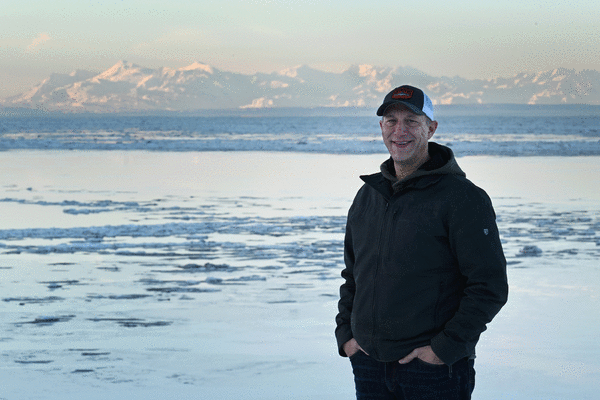
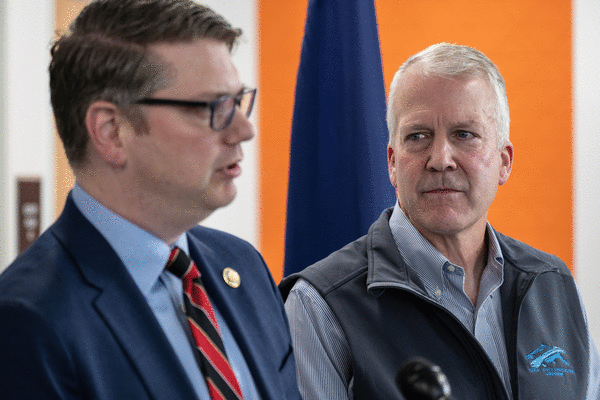


ANCHORAGE, Alaska — In a debate Wednesday for Alaska’s lone U.S. House seat, Rep. Nick Begich and challenger Bill Hill faced off over the cost of living, healthcare and education.
Begich, a Republican vying for his second term, said he’s worked across party lines to get a record number of bills passed into law, and highlighted two instances when he broke ranks with the GOP. He tried to cast Hill as a Democrat-in-hiding.
Hill, an independent candidate, fisherman and retired educator from Southwest Alaska, worked to paint Begich as a reliable GOP vote even when it hurts Alaskans. Hill continued to refuse to say which party he would caucus with if he wins the election.
Begich is seen as the favorite after leading Hill by 12 points in the August primary.
But Begich has closely aligned himself with President Donald Trump, creating a potential liability as the president’s approval ratings fall amid growing pains at the pump and overall inflation due in part to tariffs and the war in Iran.
The race is in the national spotlight as Democrats hope to gain seats in Congress.
Hill has trailed Begich in fundraising, but he’s received strong advertising support from political action committees, including the Wheel Dog PAC, which was created to boost Hill and reports spending more than $5 million.
The debate was hosted by Alaska Public Media, KTOO and Alaska’s News Source.
High prices, the Iran war and tariffs
At the debate, Hill went after Begich for supporting Trump’s “haphazard” tariffs that are “a tax on the American people,” and for backing the war in Iran.
Alaskans are “feeling the pain” of high fuel prices, including for heating fuel — diesel No. 1 — that warms homes but costs more than $15 a gallon in some villages, said Hill, who wore a ballcap and vest during the debate.
“How are people going to survive?” he said.
“These are decisions that have been backed by Congress and my opponent, that are impacting our lives now,” Hill said.
Begich said the Iran war is necessary to deal with “a regime that chants ‘death to America’ in their halls of government, that is the leading worldwide state sponsor of terrorism, and is hell bent on getting a nuclear weapon.”
Tariffs help “ensure that we have free, fair, reciprocal trade,” said Begich, dressed in a suit and tie.
Begich also said he’s working to bring down costs by prioritizing “more energy” production. He successfully fought to create oil drilling opportunities in the National Petroleum Reserve-Alaska and the Arctic National Wildlife Refuge, and boosted the amount of royalty revenue that Alaska will get from oil and gas production on those lands, he said.
“The more we produce, the better our state does,” Begich said. “That means more money for power cost equalization (to lower rural power bills), more money for Permanent Fund dividend checks, and lower costs of living for Alaskans.”
Begich also attacked Hill’s record as superintendent at the Bristol Bay Borough School District, saying reading and math proficiency dropped sharply during his tenure.
Hill, who served in that role for a decade until 2023, alleged that Begich was “cherry-picking” data.
“Take a look at the graduation rates,” Hill said, and the career and technical education program he helped build to provide career opportunities to students. He also pointed to the impacts of the coronavirus pandemic in his rural school district with limited internet connectivity and other factors impacting students outside of the classroom, in response to the criticism.
Hill attacked Begich on healthcare, after the incumbent early this year voted not to extend enhanced healthcare subsidies under the Affordable Care Act.
Hill said one woman he met in Southeast Alaska lost family coverage under the Affordable Care Act after she faced a monthly bill for more than $3,000, up from $400.
“Look, we are working very hard to lower the cost of care, and unfortunately, as part of those subsidies, which about 3% of Alaskans receive, we saw at least 20% if not higher, levels of fraud within that program,” Begich said.
He also said he voted to invest “over $1 billion over the next five years in Alaskan healthcare in our rural communities,” under the Rural Health Transformation Program.
Hills said any problems with the healthcare system should have been fixed before people began losing health insurance.
“I think it’s unconscionable to cut people off from healthcare while you’re coming up with a solution,” Hill said. “That’s not the way we should work. We should ensure that Alaskans, every Alaskan, has good healthcare in this state.”
Begich on party alignment
Responding to a question from a reporter, Begich provided two examples of breaking ranks with the GOP.
One came over a vote involving the Foreign Intelligence Surveillance Act, even though the White House was trying to generate Republican votes. The act, known as FISA, sets rules for gathering foreign intelligence and domestic surveillance.
During the debate, Begich reiterated his support for the Fourth Amendment protecting Americans from unreasonable searches and seizures as a reason to vote against extending FISA earlier this year. Begich said he wanted to ensure “that the government doesn’t have undue access to our communications.”
He said he also helped counter an effort by the Trump administration when it sought to end the building lease for the Alaska Volcano Observatory.
“We sprang into action and made sure that that lease was renewed, and they were able to continue in their core function, making sure that the administration and the rest of Washington knows just how important volcano monitoring is here in the state,” Begich said.
Hill shot back that “working against your party to retain a lease is pretty small when you’re talking about the healthcare of Alaskans, when you’re talking about another never-ending war in the Middle East, when you’re talking about tariffs that are impacting the lives of Alaskans daily.”
Hill on caucusing
Hill, pressed by a reporter at the debate, refused to say which party he would caucus with if he wins the election.
He said he’d like to work with “like-minded individuals who are tired of this party-line partisanship that we see in Congress.”
“I’m going to be working with the people who are going to be bringing healthcare,” good schools and a lower cost of living to Alaskans, Hill said.
He’ll also work with those that want to ensure “that our Congress is a separate but equal branch of government, and to holding people accountable to the law,” he said.
Begich said Hill is aligned with Democrats, and pointed out that he donated to Democratic presidential candidate Kamala Harris; independent U.S. Sen. Bernie Sanders of Vermont, who caucuses with Democrats; and U.S. Rep. Alexandria Ocasio-Cortez, a New York Democrat.
“In Congress, you have a Republicans team and a Democrat team,” Begich said. “The Democrat team has tried to shut our state down. They are funding him to the tune of millions of dollars. The head of the (Democratic Congressional Campaign Committee) is coming to Alaska for a fundraiser for my opponent. So while he’s not willing to commit to you as to who he’s going to caucus with, I think it’s pretty clear.”
_____
©2026 Anchorage Daily News. Visit at adn.com. Distributed by Tribune Content Agency, LLC.


















































Comments