California's 47th Congressional District candidates align on tech issues, differ on offshore drilling
Published in Political News
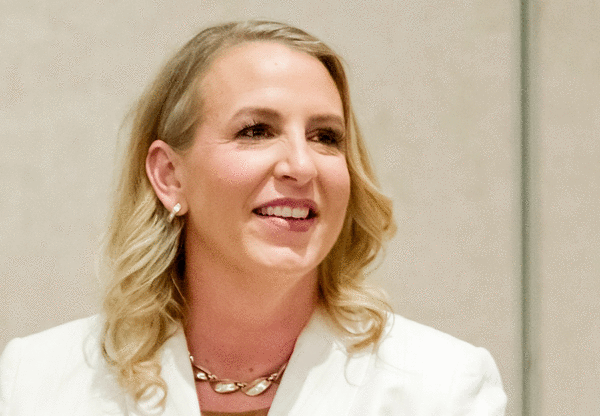
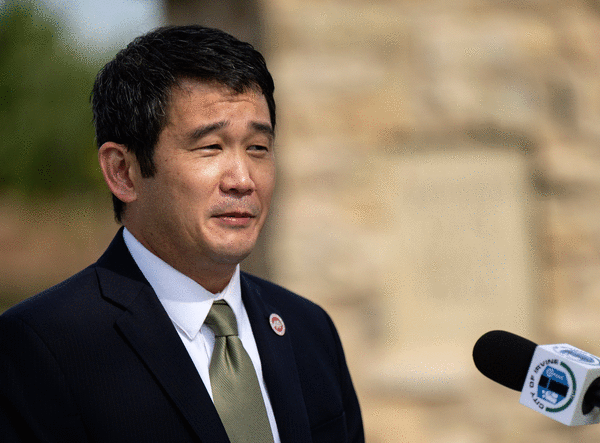

Voters in California’s 47th Congressional District have a choice between Republican Jenny Rae Le Roux and Democratic incumbent Rep. Dave Min.
After last year’s mid-cycle redistricting, the 47th Congressional District includes Aliso Viejo, Dana Point, Irvine, Laguna Beach, Laguna Niguel, Laguna Woods, Lake Forest and Tustin.
Min, 50, and Le Roux, 46, find common ground on how data centers should — and should not — be built in local communities. The two also agree on the need to establish safeguards around surveillance technology to address privacy concerns.
But the candidates differ on other issues, such as whether to expand offshore oil drilling and how to address rising healthcare costs.
When asked how Congress can balance the use of surveillance technology — such as Flock Safety license plate readers — to assist in public safety cases while limiting its infringement on an individual’s right to privacy, Min said Congress needs to ensure that anything captured by these cameras “is protected against misuse, including from potential malfeasance by federal government agencies like ICE.”
“At a bare minimum, we should require that this data be strongly protected against breaches or hacks, and that strong privacy protections are in place to protect against abuse, including requiring judicial warrants before any government agencies are allowed to access any of this data,” said Min, who is seeking a second term in Congress, in response to a questionnaire from the Southern California New Group.
Le Roux, an entrepreneur who serves as director of CAL DOGE — a group inspired by the federal initiative that focuses on identifying ways to “reduce or eliminate the size and scope of state agencies” — said the scales are “tilted too far toward unaccountable data collection.”
And while tools like license plate readers can help track down criminals, everyday citizens “shouldn’t have to choose between safety and being tracked without their knowledge every time they drive to church, a doctor’s appointment, or while taking their kids to soccer practice.”
“Congress must set clear federal guardrails: require a warrant or documented case number before searching historical location data, mandate short data retention windows, and ban the pooling of local camera data into unaccountable nationwide databases that operate without transparency and oversight,” she said. “The answer isn’t to ban useful technology. It is building in real accountability so that technology can’t be turned into a tool weaponized against innocent Americans.”
When it comes to data center development for artificial intelligence, Le Roux said California, being the “hub for innovation” that it is, should not shy away from the development of AI. However, “under no circumstances should data centers and developers receive a blank check.”
Congress needs to develop “AI data center standards” and regulations around their water and power consumption that can be applied in every state, Le Roux said.
“Outside of federal safeguards protecting natural resources, the decision of where and when to build data centers should be left to local communities,” she said. “Officials, stakeholders, and residents must have an open and transparent process when deciding whether building a data center is right for them.”
Min, too, acknowledged that while data centers are vital to the AI industry, they can also be heavily burdensome for the communities they are built within. He said that despite the AI race between the U.S. and China being “a real and urgent one,” Congress can’t allow everyday citizens “to get thrown by the wayside.”
“At a bare minimum, new data centers must be held to a ‘do no harm’ standard, whereby they do not create new nuisances (including noise and heat) or increase the costs or decrease the availability of energy to households,” he said. “If the AI industry sees data centers as critical, it should be willing to invest money into making these data centers net positives for the surrounding communities rather than net negatives.”
Doing no harm is a major reason why Min is “100% opposed” to the Trump administration’s aggressive push to expand offshore drilling and production in California. He said the focus on energy production should be geared toward renewable energy sources, which “will be much cheaper” than fossil fuels in the very near future.
“Just to give some context, offshore oil accounts for less than 1% of the economic activity generated by our beaches and coastal waters. That 1% should not be allowed to threaten the other 99% of our coastal economy,” he said.
Le Roux, however, said expanding offshore drilling would create more supply and “real relief” for struggling families who are only seeing pump prices rise. But offshore drilling wouldn’t be necessary altogether, she said, if California’s Democratic leadership allowed for the expansion of “safe, affordable onshore drilling.”
Another issue where the two candidates don’t have much common ground is how to address healthcare costs.
Min said before any long-term fixes can be put in place, Congress needs to first reverse the cuts to Medicare and Medicaid and ensure that Affordable Care Act subsidies don’t expire. Most of the cuts included in the Big Beautiful Bill, which passed last year, won’t take effect until next year, which Min said will result in a “catastrophe” unless they are reinstated.
“In the longer run, we must do all we can to ensure that every American has access to quality healthcare. Healthcare today should be seen as a basic human right,” Min said. “To ensure this, we must do more to lower costs across the system without dampening the amazing innovation that has enabled us to live longer and treat diseases and conditions once viewed as untreatable.”
Congress must also ensure programs like Medicare remain solvent. To do that, changes must be made to federal tax code so that billionaires don’t pay a lower effective tax rate than most everyday Americans, he said.
Le Roux, however, will take a different approach if she’s elected by voters in November: tackling any fraud or abuse, which she said costs taxpayers billions.
“I’ll push for real audits, data-driven fraud detection, and accountability for criminal networks that exploit these systems. On prescription drugs, I support more transparency and competition. I support cracking down on the insurance middlemen who set drug prices and pad their margins while patients pay more at the pharmacy counter,” she said. “I won’t cut benefits for seniors and families who’ve earned them. But I will not tolerate a system that lets fraudsters drain it dry while honest people wait longer and pay more. Waste is simply enabling theft from the people who need help most.”
In the 47th Congressional District, registered Democrats make up 36.25% of the voters (168,778), according to the latest statistics from the California secretary of state’s office. Registered Republicans account for 31.87% of the voters (148,388), and another 25.47% (118,594) are no party preference.
Ballots have already been sent to every registered voter in California, and voting is underway. Election Day is Nov. 3.
©2026 MediaNews Group, Inc. Visit ocregister.com. Distributed by Tribune Content Agency, LLC.

















































Comments