How Brad Finstad's congressional district fell out from under him
Published in Political News



NEW ULM, Minn. – There are not many Democrats that Brian Krosch cares for.
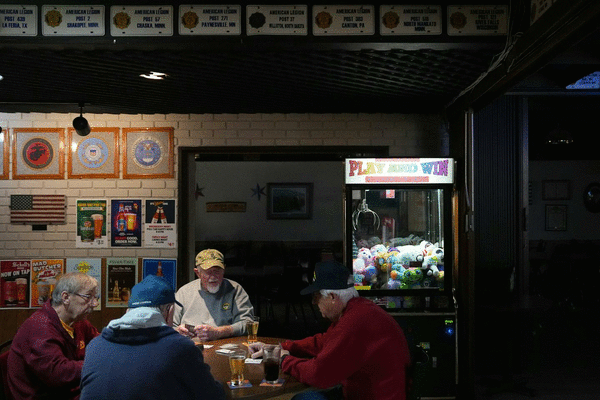
Asked whether any DFL politicians were popular in the New Ulm area, the Army veteran, who volunteers as a bartender at the local American Legion, considered the question.
“They’re all dead,” he said with a shrug, pointing to the Hubert Humphreys of yesteryear.
In this southern Minnesota city of about 14,000, German Catholic traditions have helped shape the local culture and Republican loyalties have endured for generations. In 2024, President Donald Trump carried Brown County, of which New Ulm is the seat, by roughly 35 percentage points.
But the election this month complicated that familiar pattern. Republican U.S. Rep. Brad Finstad, who lives and farms in New Ulm and won his congressional district by more than 17 points two years ago, emerged from Election Day trailing Democrat Jake Johnson by 321 votes. A recount is looming.
Although Republicans still carried New Ulm, Johnson picked up one precinct and came within 21 votes of winning another, as a wave of Democratic victories swept the state and nation.
Beneath New Ulm’s longstanding Republican loyalties, some residents said this week that they are growing less satisfied with the politicians who represent them — and less willing to support a candidate simply because of the party beside the name.
The American Legion’s walls were crowded with photographs of veterans and baseball teams, some in black and white, among neon beer signs and American flags. Three men played cribbage near the bar. Two were veterans and Democrats who said they despised Trump, though neither wanted their name published.
Elsewhere sat an independent who had voted for Ronald Reagan and the Bushes but now considered Trump a disgrace to the Republican Party. Another man, a Republican, worried that newcomers were changing the character of the town. They had different ideas about what was wrong with America, and had learned to live with one another’s answers.
Krosch had his share of complaints. About immigration, gasoline prices, the threat of communism.
But he had little appetite for political arguments. People around New Ulm preferred to talk about other things.
“Horses, cats, dogs,” he said. “We’re just a farming community.”
This was not quite the whole picture.
More than a week after Election Day, the outcome of southern Minnesota’s congressional race remained unsettled. Johnson, a math teacher making his first run for office, had declared victory and begun preparing for Congress. Finstad had not conceded and said he would seek a recount after the state Canvassing Board certifies the results Nov. 19.
Johnson handily won the counties with the largest cities in southern Minnesota — Rochester, Mankato, Austin and Winona — in a major shift from Finstad’s dominance across the district in 2024.
Brown County backed Finstad by 20 percentage points this year. But the congressman won his home county by 44 points two years ago.
The erosion of his support was striking in a place where conservative traditions run deep.
New Ulm wears its history openly, in its German street names, Catholic churches and parochial schools. Signs welcome visitors in German. Others condemn abortion. On one lawn, a large sign offers a theological observation about the country’s political divisions: “God will not be asking Republican or Democrat.”
The town’s politics have not always followed their present lines. Farmers in the surrounding countryside once voted reliably for the Democratic-Farmer-Labor Party. Democrat Tim Walz represented the region in Congress as a Democrat for 12 years before becoming governor.
Chris Rathman remembered those DFL farmers. But the party, he believed, had abandoned them.
Until recently, Rathman, a Republican, rarely bothered voting in midterm elections. He became more politically engaged during Walz’s governorship, frustrated by pandemic restrictions on small businesses and, later, fraud in state programs.
He was also troubled by changes closer to home.
New Ulm’s manufacturers had increasingly recruited workers from outside the community, including immigrants and lower-income residents. Rathman worried about the housing being built to accommodate them.
“Our property tax is enormous in this town, but that also keeps the riffraff out,” he said.
Then came the qualification. “Property taxes are still through the roof, and the riffraff are still here.”
At City Hall, Mayor Kathleen Backer saw the same developments rather differently. New Ulm needed workers, she said, and those workers needed somewhere to live. For years, a shortage of housing had made it difficult for local employers to recruit.
Backer had pushed for zoning changes and new construction, including a 148-unit apartment development whose first units attracted enough interest that the developer decided to complete the project.
Some residents remained suspicious. One praised Backer’s work as mayor, then warned her not to let “those people” into town.
The resident feared subsidized housing. Backer said the development was intended for workers, including teachers and nurses.
“That’s the old guard,” she said. “That’s not the new way of thinking.”
Backer saw little evidence that its residents were abandoning the Republican Party. Other GOP candidates had won comfortably in the area, even as Finstad struggled.
To Backer, the distinction raised a question about the congressman’s relationship with his constituents, rather than a fundamental change in their politics.
Finstad’s campaign did not respond to requests for comment.
Backer had known Finstad since his early political career. But during her four years as mayor, she said, she had little interaction with him, recalling one encounter at a military readiness center ribbon-cutting. Democratic U.S. Sens. Amy Klobuchar and Tina Smith, by comparison, had made more of an effort to maintain contact, she said.
Backer had heard similar complaints from constituents who felt they rarely saw their congressman.
Elected officials, she said, had to be willing to show up and let people “throw the tomatoes at you.”
Johnson, meanwhile, had been difficult to miss.
“He was present everywhere,” she said.
It was a distinction that mattered to Backer, who had never been particularly interested in voting strictly by party. She wanted officials who were accessible, capable and willing to answer difficult questions.
“Is that dynamic related to the two candidates and not the party?” she asked.
She had noticed some changes among her Republican friends. People who had once been steadfast in their support of the party were expressing doubts about Trump, troubled by tariffs, the war in Iran, immigration enforcement and the cost of living.
Their reservations did not necessarily make them Democrats. But they suggested that even longstanding Republican loyalties were not unconditional.
At the Legion, Joe Mauch had his own explanation for the election.
Known around the bar as Chicago Joe, Mauch unzipped his jacket to reveal a royal-blue Chicago Cubs sweatshirt. Then he lifted the sweatshirt to reveal a Cubs T-shirt underneath. His baseball loyalties, at least, were uncomplicated.
His politics required more explanation.
An independent, Mauch had voted for Reagan and the Bushes. But he regarded Trump as a “liar” who had transformed the Republican Party into something he no longer recognized.
Mauch did not think Democrats had necessarily become more appealing. He thought Republicans were finally losing patience with the president.
Joe Stevens, a retired Marine who had stopped in with his son, Ryeland, for a midday birthday drink, suspected New Ulm had more Democrats than outsiders realized.
He had noticed campaign signs for Amy Klobuchar throughout his neighborhood, though he briefly confused the senator with a comedian.
“All my neighbors have Amy Poehler, or whatever, Klobuchar signs up,” he said, laughing.
Such impressions were difficult to reconcile with New Ulm’s election results, which continued to favor Republicans. But they illustrated how little a town’s political reputation could reveal about the individual loyalties beneath it.
Finstad had faced a much closer contest than the region’s Republican history might have suggested.
Like many of her constituents, Backer had once been among his most ardent supporters.
Years earlier, she put a Finstad campaign sign in her yard, to the dismay of her late husband, a Democrat whose father had chaired the Brown County Democratic Party.
“My father will turn over in his grave,” she recalled him saying.
She put the sign up anyway.
_____
©2026 The Minnesota Star Tribune. Visit at startribune.com. Distributed by Tribune Content Agency, LLC.













































Comments