Commentary: Trump's vaccine order will harm public health
Published in Political News
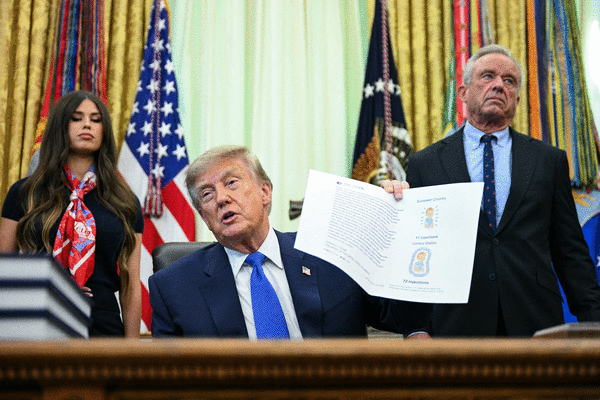
President Donald Trump’s executive order on vaccines, signed August 10, is the latest in his administration’s endless attacks on public health. It recommends that the measles, mumps and rubella vaccine, or MMR, be separated into three individual shots. There is no scientific evidence or public health data to support this decision. Trump has even admitted his decision wasn’t based on facts but “on what I feel.”
Unfortunately, Trump’s feelings seem to largely match the conspiratorial anti-vaccination ideas of U.S. Health and Human Services Secretary Robert F. Kennedy Jr., which threaten to make the United States more susceptible to once-preventable diseases.
Since 1994, the United States’ robust vaccination program has precluded an estimated 508 million cases of disease, kept 32 million people out of the hospital, and prevented 1,129,000 deaths. Moreover, the nation’s erstwhile commitment to vaccinations has saved $540 billion in direct costs and $2.7 trillion in lost wages and missed work.
The MMR vaccine has been available in the United States for more than 50 years and was a major factor in the nation attaining measles elimination status in 2000. Now that status is in jeopardy, pending a Pan American Health Organization review in November 2026, amid the worst U.S. measles outbreak in decades. This loss will be largely the fault of the Trump administration’s casting doubt about the MMR vaccine, which has severely undercut vaccination coverage among kindergartners, as more parents refuse to vaccinate their children.
So what happens if the MMR vaccine is separated into three individual shots? First, the U.S. doesn’t currently produce separate vaccines for measles, mumps and rubella, because they don’t need to be provided separately. This means vaccine makers will have to develop and test new vaccines, wasting hundreds of millions of dollars.
Trump’s executive order is certain to sow confusion and chaos among parents and caregivers. Separating these shots will triple the number of visits to the pediatrician, requiring caregivers to miss more work and increasing costs to families. Healthcare providers will have to keep significantly greater numbers of vaccines on hand, and appointments will become harder to schedule, eroding healthcare access for all.
If parents choose to get the single measles shot first, their child will be unnecessarily vulnerable to mumps and rubella as they await their next appointment. So now, amid an uncontrolled measles outbreak spreading across the country, it will be harder for parents to get their children fully vaccinated.
The impact of these changes will likely be felt most keenly among “out-groups” — immigrants, those with lower incomes or disabilities, and people of color. But having growing unvaccinated populations endangers everyone, especially children too young to be vaccinated, and those for whom vaccinations are less effective.
Another issue is the role of the federal government in vaccine decisions. Already, many states have severed ties with vaccine recommendations from federal organizations, such as the Centers for Disease Control and Prevention, whose vaccine recommendations Kennedy has attempted to undermine. It would once have been unimaginable that the federal government’s vaccine recommendations would be considered untrustworthy, but that is exactly where we are at.
Once upon a time, the U.S. embraced the “gold standard” for vaccination programs. Those days are gone. Now politics have trumped science, and “feelings” have replaced critical thinking. As we contend with measles, rampant foodborne illness and the invasion of screwworm, we aren’t even close to experiencing the full magnitude of the outcomes that the administration’s endless war on public health may bring. Future historians and scientists will study what happened here and why — and the shame and disgrace of this era will be a cautionary tale for generations to come.
____
Elizabeth Jacobs is an epidemiologist and professor emerita at the University of Arizona and a founding member of the advocacy group Defend Public Health. James Alwine is a virologist, a professor emeritus at the University of Pennsylvania, and a fellow of the American Association for the Advancement of Science and the American Academy for Microbiology. This column was produced for Progressive Perspectives, a project of The Progressive magazine, and distributed by Tribune News Service.
_____
©2026 Tribune Content Agency, LLC.




















































Comments