More college students will have access to abortion medication
Published in Political News
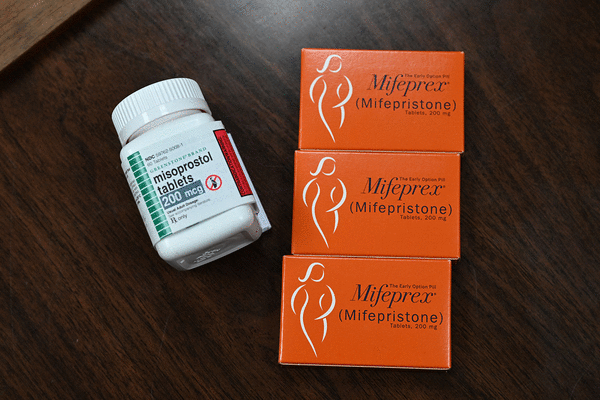
When college students head back to campus for the fall semester, more of them will have guaranteed access to abortion medication.
Colorado recently joined California, Illinois, Massachusetts and New York in requiring public colleges and universities to provide abortion medication to students on campus or arrange to make it available to them through an off-campus provider.
Unlike the other states, Colorado’s new law also applies to private colleges and universities. However, Colorado schools are exempt if offering the medication would be “contrary to the institution’s sincerely held religious beliefs or practices” or if doing so would jeopardize a federal grant. Federal dollars cannot be used to pay for abortions except in limited circumstances.
All five states have enacted laws to expand access to abortion in recent years, both before and after the 2022 U.S. Supreme Court ruling in Dobbs v. Jackson Women’s Health Organization, which cleared the way for states to fully deny abortion access for the first time in 50 years. Since that decision, more than a dozen states have enacted near-total abortion bans.
“In a post-Dobbs era where patients and providers navigate a frightening national landscape, Colorado has stepped up to safeguard reproductive healthcare,” Colorado Democratic state Rep. Kenny Nguyen, who cosponsored the measure in his state, said in a statement. “While abortion is legal, it’s not always accessible, and this law makes it easier for college students to access abortion medication on campus.”
The new Colorado law states that if an institution has an on-campus pharmacy, it must make abortion medication available to enrolled students. If not, health care providers on campus are required to submit a prescription for abortion pills to a pharmacy off campus.
California’s law, which has been in effect since 2023, was the first such measure. It requires every student health clinic on a California State University or University of California campus to offer abortion medication, funded by the state.
California is now considering expanding that law to include community colleges. A proposed bill would require community colleges with health centers to offer access to medication abortion beginning in 2029, if the legislature provides funding.
California campus health center directors have cautioned that many community colleges might not have the money, staff or clinical capacity to provide the service. But the bill’s supporters say offering abortion medication on campus would make it much more accessible to lower-income students who might not have sufficient insurance coverage or a car to procure it elsewhere.
“We are closing a critical gap by ensuring that community college students, one of the most diverse and economically vulnerable populations in our state, have the same access to care as their peers at four-year institutions,” said Democratic Assemblymember Catherine Stefani, the lead author of the bill, during a health committee hearing in April.
Massachusetts, which approved its campus abortion accessibility law in 2022, this week took another step to expand abortion access when Democratic Gov. Maura Healey signed legislation making it the 10th state (plus the District of Columbia) to allow abortion at any point in pregnancy. Most abortions occur in the first trimester; beyond the second trimester, abortions are rare and sometimes related to fetal or maternal health issues.
New York enacted its law requiring public college and university access to abortion medication in 2023, and Illinois started enforcing its mandate on public schools last fall, becoming the first state in the Midwest to do so.
____
Stateline reporter Sofia Resnick can be reached at sresnick@stateline.org.
____
©2026 States Newsroom. Visit at stateline.org. Distributed by Tribune Content Agency, LLC.





















































Comments