Police face new limits on cellphone location searches after Supreme Court ruling
Published in Political News
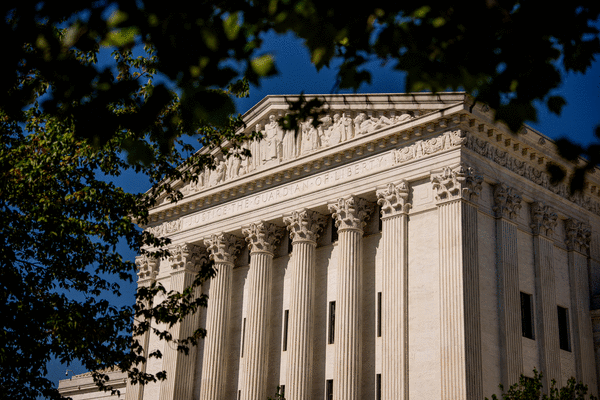
Law enforcement agencies around the country are facing new limits on their ability to sweep up location data from cellphone users near crime scenes, as a recent U.S. Supreme Court ruling in a bank robbery case in Virginia found that so-called geofence searches are bound by constitutional protections against unreasonable search and seizure.
The high-profile decision regarding the government’s ability to gain access to the vast amount of data collected by GPS devices in cellphones to track the movement of everyday citizens around a crime scene — including many who had nothing to do with the crime — is the latest flashpoint in ongoing efforts by the nation’s highest court to grapple with digital advancements, cutting edge law enforcement efforts and constitutional rights.
“There is nothing novel about the technology privacy debate — It is a tale as old as time,” said Matthew S. Adams, a partner at Fox Rothchild, a national law firm. “But, what this court decision signals, is the constitutional protections we hold dear continue to develop with our society.”
Not the final word
The recent Supreme Court decision isn’t expected to be the final word in geofence searches.
The exact details of how to determine whether a geofence warrant complies with the Fourth Amendment were sent back to lower courts to consider. How much that constrains law enforcement’s ability to use such searches remains to be seen.
In the meantime, local law enforcement leaders offered a measured response to the Supreme Court ruling, noting the need to weigh both crime solving and privacy rights.
“Technology advances will always push up against constitutional privacy issues,” Orange County District Attorney Todd Spitzer said in a statement. “I will remain steadfast in my pursuit of protecting privacy rights …
“Geofencing is an important tool to solve crime, and we will always follow legal guidelines,” The DA added.
It isn’t clear how often such searches are conducted locally, where police departments were reticent to discuss geofence searches in light of the Supreme Court ruling.
A ‘fishing expedition’
The vast amount of GPS data collected by tech companies — used to power countless apps and online services — has offered an enticing target for investigators stymied by other law enforcement techniques while raising concerns from privacy rights groups.
By allowing investigators to access a vast amount of information from anyone with an active smartphone who was within a specific geographic location at a specific time, geofence searches can be a tool for detectives who know when and where a crime occurred, but do not have specific suspects in mind.
With a traditional search warrant, investigators start with a specific person, must prove probable cause and when seeking permission from a judge must describe in particular what they expect to seize.
By contrast, geofence searches are “essentially a reverse warrant,” said Adams, who co-chairs his law firm’s white collar criminal defense and government investigations divisions.
“It means anyone whose phone happens to be in an area can have their identity and movements swept up into a criminal investigation without any suspicion at all,” Adams said. “On many levels it is a fishing expedition.”
Expectation of privacy
The criminal investigation that led to the Supreme Court decision — a bank holdup in Virginia where a robber got away without leaving an obvious trace but was later identified through the collection of data from Google about everyone who was near the bank — is a prime example of how law enforcement uses geofence searches.
Writing on behalf of the Supreme Court majority, Justice Elena Kagan explained that an individual “has a reasonable expectation of privacy in records about his cellphone’s location, and police intrude on that constitutionally protected interest when they demand information — even though for only a limited time, and from a third-party tech company.”
The justices sent the case back to lower courts, where judges were directed to consider the evidence in light of Fourth Amendment protections to determine whether the search was “reasonable.”
Yet to be answered
When a geofence warrant that casts a wide net over a given area is in violation of the Fourth Amendment, and exactly how much such searches will be limited, are questions yet to be answered.
Also to be determined is whether tech companies will reconsider their data retention policies in light of the ruling, or whether California state leaders will consider their own laws regarding geofence searches.
“These clashes between privacy, technology and traditional constitutional jurisprudence are going to continue to accelerate as the technologies — including the latest, AI — evolve,” Adams said.
_____
©2026 MediaNews Group, Inc. Visit ocregister.com. Distributed by Tribune Content Agency, LLC.





















































Comments