So far, Trump's midterm campaign schedule slightly behind 2018 pace
Published in Political News
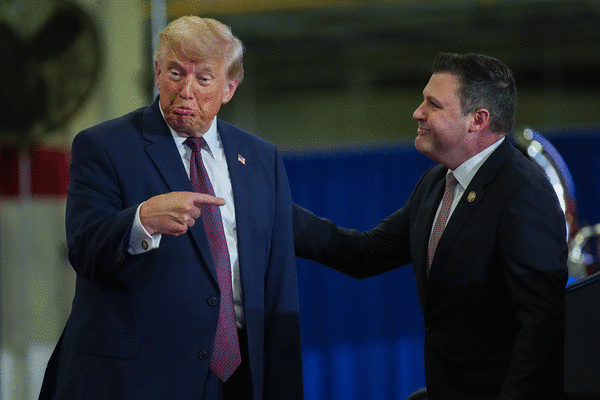
WASHINGTON — President Donald Trump’s midterms campaign schedule has been lighter this year than his pace of hitting the road for Republican candidates during a 2018 midterm elections cycle that saw big Democratic gains.
The GOP campaigner in chief had, between Jan. 1, 2018, and July 7, 2018, held nine road shows to boost Republican congressional hopefuls, according to a CQ Roll Call analysis. This year, Trump has held five events to either help GOP candidates in tight reelection races, or in the case of events in Kentucky and Georgia, make his case to Republican primary voters against Rep. Thomas Massie and weigh in on the primary to replace Marjorie Taylor Greene, who resigned amid a spat with the Trump administration.
White House press secretary Karoline Leavitt has said several times this year that Trump will be an active campaigner heading into the summer and fall midterms homestretch. Susie Wiles, White House chief of staff, said late last year that her plan was for Trump to have a robust midterm campaign schedule.
“Typically in the midterms it’s not about who’s sitting at the White House. You localize the election, and you keep the federal officials out of it. We’re actually going to turn that on its head and put him on the ballot because so many of those low-propensity voters are Trump voters,” Wiles told “The Mom View,” an online talk show, in December.
One GOP strategist, granted anonymity to speak candidly, said pro-Trump “low-propensity voters” — meaning voters who have a history of sitting out elections — would be key come November.
The House map favors Democrats and analysts at the University of Virginia’s Center for Politics recently assessed that there’s a narrow path opening for the party to also take control of the Senate. (That path, however, could have narrowed Monday after new allegations against Maine Democratic Senate candidate Graham Platner).
“In a turnout election, those voters are even more important. They like Trump, but might not like the (Republican) candidate,” the strategist said during a telephone interview. “That’s where the president can help out, getting the ‘low-propensity voters’ out.”
Trump’s last midterms road show came on June 23, when he put his questionable coattails to the test in one of this cycle’s toughest congressional battleground districts. But like during other midterms campaign stops, Trump mostly focused on a slew of other topics, never even uttering the name of GOP Rep. Ryan Mackenzie, who is in a tough reelection fight.
“We’ve got to get a certain very talented congressman reelected,” the president said, initially not name-checking the incumbent. “Where are you? Where are you, Mr. Congressman?”
Trump then veered into his signature speaking style, which he calls “the weave,” before again not dropping Mackenzie’s name. “We’ve got to make sure you vote for our congressman here,” Trump said at a Mack Trucks plant. “I’m not doing this for my health.”
In fact, he did not utter the Republican congressman’s name until the event’s 54th minute — and after another speaker had done so. “We got to get Ryan elected. Run up here, Ryan. Fast. Nobody wants to hear you,” Trump quipped before the lawmaker addressed the crowd of voters for all of 18 seconds.
To be sure, Trump has given most of the candidates for whom he has made 2026 appearances relatively short shrift at his handful of midterms events.
Democratic strategist Brad Bannon said in an email that “Trump, with his monumental ego, can’t even acknowledge the existence of other Republicans, much less speak kindly about them.”
“Republican congressional hopefuls shouldn’t be so eager to enlist Trump for their local rallies if the weak attendance for the president’s Fourth of July celebration on the National Mall is any indication. On the other hand, Democrats should foot the bill for Trump’s campaign travels on Air Qatar to take full advantage of his anemic poll numbers in purple congressional districts,” Bannon added, referring to the 747-8 luxury airliner the Persian Gulf country gifted to Trump last year.
While the president has held three fewer events this year compared to 2018 aimed at specific GOP candidates, he has traveled for a handful of events ostensibly to talk up the party’s 2025 tax and spending law and his administration’s efforts to drive down still-high prices. What’s more, he has headlined several fundraisers for the party and been the keynote speaker at the Republican National Committee’s Spring Retreat and at a high-profile gathering of conservatives in Arizona put on by the influential Turning Point USA organization.
By comparison, Trump in 2018 also was the guest of honor at several party fundraisers and one big-ticket National Republican Senatorial Committee luncheon in Houston. Back then, Trump also was raising money for his own coming 2020 reelection bid. After flirting with a legally dubious bid for a third term, Trump has said several times this year that he has run his last presidential race.
September sojourn
The data examined also revealed that Trump held more midterms campaign events by this time in 2018 despite more foreign travel — though he has had ample time taken up by the conflict with Iran. Trump landed in Ankara, Turkey, on Tuesday for a two-day NATO summit. The White House has not announced any additional campaign-related trips, but has signaled more are coming.
Trump is expected to meet with his Irish counterpart, Micheál Martin, in Dublin in early September, and is expected to visit his Trump International Golf Links & Hotel in Doonbeg, Ireland, during the first part of that global swing. The course is slated to host the 2026 Irish Open, an event put on by the top professional golf league in Europe that typically includes a number of the world’s top golfers, some of whom Trump considers friends.
That expected weeklong trip would come several weeks before some states begin sending out mail-in ballots and less than two months before voters will head to the polls on Nov. 3 to decide control of the House and Senate. Trump in recent months has appeared more interested in things like his White House ballroom and helipad projects, his events around America’s 250th birthday, as well as various projects around Washington.
Trump’s slightly lighter campaign travel rate comes as a number of recent polls have put his approval rating on economic matters below 40%. A Fox News survey conducted in mid-June put his economic approval rating at 31% against a 68% disapproval rating level. And a poll conducted by Reuters and Ipsos had Trump’s approval on those issues at 29%, with 62% disapproving.
But one former White House official said Monday that Trump has been handed a new campaign attack line after several democratic socialists have won Democratic congressional primaries. The president likely will take his anti-communism message into competitive races.
“(T)his has been building for years, but now the Democratic Party isn’t just tolerating socialists, it’s electing them,” Harrison Fields, a former deputy White House press secretary during Trump’s second term, wrote Monday on X. “Openly communist ideas are no longer fringe, they’re on the ballot and winning. That’s not a warning sign. That’s a takeover in progress.”
_____
(Bill Frischling contributed to this report.)
©2026 CQ-Roll Call, Inc., All Rights Reserved. Visit cqrollcall.com. Distributed by Tribune Content Agency, LLC.

















































Comments