Commentary: The Iran gas tax is going to hit American families. But we can change the future
Published in Political News
The next time you fill up your gas tank, you may be paying for President Donald Trump’s war with Iran.
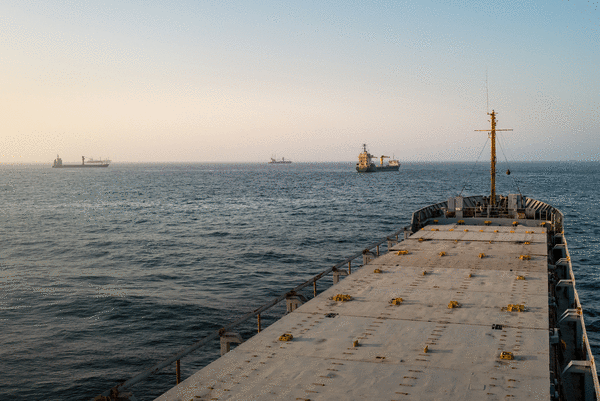
Just days into the new 60-day agreement, Iranian officials began discussing new charges on ships passing through the Strait of Hormuz. The Trump administration says they are not tolls. Iran calls them fees. American families will pay either way.
That is the Iran gas tax.
Trump’s illegal war did not eliminate the threat. It left Iran with leverage over the world’s most important oil transit chokepoint. Roughly 20 million barrels of oil move through the strait every day, representing about 20% of global petroleum consumption and roughly 25% of all seaborne oil trade. Even if every available alternative export route operated at maximum capacity, Goldman Sachs estimated that roughly 16 million barrels per day would still depend on Hormuz.
Analysts warned that a prolonged disruption could create one of the largest energy supply shocks in decades. Tanker insurance costs surged during the conflict, and shipping markets immediately priced in the risk.
The Trump administration says the problem has been solved. The facts on the ground suggest otherwise. Iranian officials continue discussing new fees, asserting authority over shipping routes, insisting that ships coordinate with Iranian authorities and negotiating what they describe as the future administration of the strait itself. What were once threats are now active discussions about fees, routing requirements and expanded Iranian influence over shipping through the strait. Analysts continue warning that Iran’s operational influence over the waterway could raise costs and suppress energy flows long after the shooting stopped.
Trump declared victory over Iran, but Tehran kept its leverage.
Americans do not need to buy a single barrel of Iranian oil to pay the price. Oil is traded in a global market. When supply is threatened or transportation costs rise, prices rise everywhere. Higher shipping costs become higher fuel costs. Higher fuel costs become higher transportation costs. Eventually, those costs show up at the gas pump and the grocery store and in household budgets across America. That is the Iran gas tax.
Whether they call them fees, permits or something else, the result is the same: higher costs moving through a critical global trade route.
The less dependent America is on oil, the less power hostile governments have to raise costs on American families. The good news is that America was already moving in that direction. Last year alone, the United States added 43 gigawatts of new solar capacity, making solar the nation’s leading source of new generating capacity for the fifth straight year. Solar met 61% of America’s growth in electricity demand in 2025. Instead of pulling back, we should be accelerating that progress by manufacturing more energy technologies here at home, strengthening domestic supply chains, modernizing the electric grid and building the infrastructure needed to power the next generation of American industry.
Every new source of homegrown energy makes America stronger and less vulnerable to decisions made half a world away.
Unfortunately, the Trump administration is moving in the opposite direction. More than$22 billion in announced clean-energy investments were canceled or withdrawn during the first half of 2025, affecting more than 38,000 projected jobs and slowing industries that strengthen America’s economic and energy security. We should be restoring those investments and accelerating new ones by building more factories, producing more batteries, strengthening domestic supply chains, modernizing the electric grid and creating more well-paying jobs here at home. Every project that makes America less vulnerable to foreign energy shocks makes America stronger.
That resilience matters because Iran is already discussing new fees and expanded control over shipping through the Strait of Hormuz. As long as hostile governments retain the ability to disrupt critical energy corridors, American families remain exposed to the costs.
Trump says the war is over. But while he declared victory, Iran kept its leverage. American families may end up paying the bill.
____
U.S. Rep. Raja Krishnamoorthi, a Democrat, is co-chair of the bipartisan Congressional Solar Caucus and has represented Illinois’ 8th Congressional District since 2017.
___
©2026 Chicago Tribune. Visit at chicagotribune.com. Distributed by Tribune Content Agency, LLC.




















































Comments