Commentary: The Supreme Court just gave the rich even more political power
Published in Political News
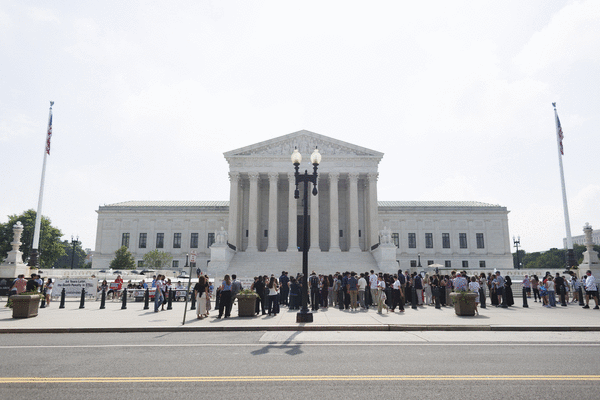
The flow of money into U.S. politics is already harming democracy, and now, it’s about to get worse.
The Supreme Court on Tuesday struck down limits on campaign expenditures by political parties in coordination with candidates in a 6-3 decision that only continues the problematic trend started by Citizen’s United v. FEC. Without these limits, ultra-wealthy donors — and thus, special interests like the firearms and cryptocurrency industries — can essentially buy themselves favorable treatment by elected officials, diminishing the concept of one-person, one-vote so sacred to the U.S. Constitution.
To reach its problematic decision, the court also continued its assault on precedent, overturning a case that had upheld such limits as recently as 2001.
Tuesday’s case, National Republican Senatorial Committee (NRSC) v. Federal Election Commission (FEC), had been brought by Republican groups and individuals, including Vice President JD Vance when he was still a U.S. senator from Ohio. They argued that the Federal Election Campaign Act of 1972, which set the coordination limits, violated the First Amendment’s rights to free speech and free association by preventing national and state political party committees from coordinating advertising messaging with the candidates of their choice.
Existing laws permit national political parties to make large expenditures for individual candidates — up to about $130,000 for candidates for the House of Representatives and more than $4 million for candidates for the Senate. But now, a majority of the justices have said no to any limits on that spending at all.
The Supreme Court has long held that even laws that restrict constitutional rights are permissible so long as they pass what is known as “strict scrutiny,” a standard that requires restrictions to advance a compelling government interest and be narrowly tailored to achieve that interest.
But the 54-year-old campaign finance law failed that test, according to the justices. Writing for the majority, Justice Brett Kavanaugh focused on “the important and traditional role of political parties during campaigns.” He reasoned that coordination limits weren’t permissible because they “impair the party’s traditional forms of communication such as advertisements; preclude parties from amplifying the voice of their adherents; impose additional monetary costs and burdens on political parties; and inflict a stifling effect on the ability of the party to do what it exists to do.”
The NRSC had argued that the purpose of the Federal Election Campaign Act — to reduce the influence of money in politics — was invalid and that the only basis for constitutional restrictions is to prevent quid pro quo corruption, that is, the direct payment of money in exchange for official acts. In fact, the challengers argued that a decision removing the limits on expenditures by political parties would, in fact, provide greater transparency in campaign finance. In their reasoning, large donors would no longer need to funnel their contributions through Super PACs, which are not required to disclose their donor lists, and instead make contributions to parties, which are.
Since Citizen’s United v. FEC in 2010, which recognized political spending by cooperations and unions as a form of free speech, large donors have enjoyed outsized influence on American elections. In 2024, for example, Super PACs spent more than $2.6 billion on elections. Tech CEO Elon Musk alone donated more than $240 million to pro-Trump Super PACs. The idea that corruption is the only compelling government interest that is legally permissible is an overreach by the Supreme Court into the province of the legislative branch.
The Democratic National Committee (DNC), as an intervening party to the case, had oppositely argued that unlimited coordinated spending would effectively erode limits on contributions. Because money is fungible, by paying a candidate’s bills, a party is essentially handing him cash, undermining any limits on contributions.
In Justice Elena Kagan’s dissent, joined by Justices Sonia Sotomayor and Ketanji Brown Jackson, she agreed that the court was opening the door to the very kind of corruption the statute was meant to prevent: that striking down the law would allow donors to circumvent donor limits. “[A] candidate could ask a donor to make a substantial contribution to the party so as to finance his own campaign expenses,” Kagan wrote. “The donor could give far more to the party than to the candidate directly, understanding that the money would be passed through to the candidate.”
The writing appeared to be on the wall when the justices accepted the case for consideration last year. The lower courts had rejected the challenge, citing the high court’s 2001 decision in FEC v. Colorado Federal Republican Campaign Committee, which had upheld the limits. And there’s no need for the high court to take up a case just to follow precedent. Instead, they overturned it.
With the Federal Election Campaign Act in 1972, Congress had sought to reduce the amount of money in politics to protect ordinary voters from being overshadowed by the influence of wealthy donors. After the gutting of a key provision, however, those with the means can now flood the airwaves with their support of a candidate, even if their interests are out of step with the American people.
By refusing to permit even reasonable limits on coordinated expenditures in campaign financing, is it any surprise that U.S. politics skew in favor of the wealthy and the powerful?
____
This column reflects the personal views of the author and does not necessarily reflect the opinion of the editorial board or Bloomberg LP and its owners.
Barbara McQuade is a professor at the University of Michigan Law school, a former U.S. attorney and author of the forthcoming book, "The Fix: Saving America from the Corruption of a Mob-Style Government."
©2026 Bloomberg L.P. Visit bloomberg.com/opinion. Distributed by Tribune Content Agency, LLC.


















































Comments