Tribunal rejects vote challenge in Peru, clearing path for Fujimori victory
Published in Political News
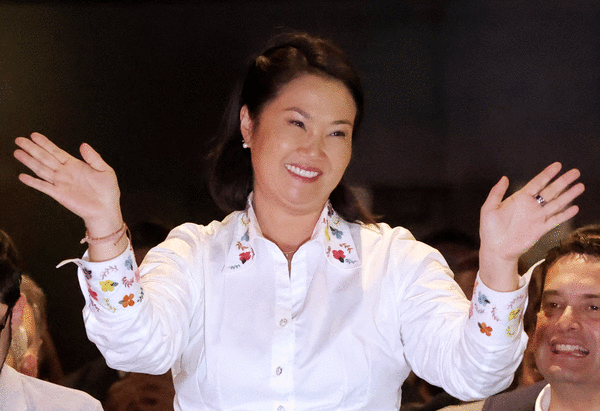
Right-wing candidate Keiko Fujimori moved significantly closer to becoming Peru’s next president after an electoral tribunal on Tuesday rejected a challenge seeking to annul overseas votes, while new vote counts showed her lead over leftist rival Roberto Sánchez had grown beyond the number of ballots remaining to be counted.
With 99.79% of ballots counted in Peru’s presidential runoff, Fujimori held 50.11% of valid votes, compared with 49.88% for Sánchez, according to the latest figures from Peru’s electoral authorities.
The margin between the two candidates stood at roughly 42,000 votes, while only about 38,200 ballots remained outstanding, making the result statistically irreversible unless pending legal challenges succeed.
The development came after the Lima Centro 2 Special Electoral Jury rejected a request by Sánchez’s party, Juntos por el Perú, to annul votes cast abroad — a move that, if approved, could have reversed the outcome and handed him the presidency.
According to a statement from the National Jury of Elections (JNE), Peru’s top electoral authority, the tribunal ruled the petition inadmissible because it was filed after the legal deadline and without payment of the required electoral fee.
The petition sought to invalidate ballots cast at polling stations managed by Peruvian consulates in Africa, North America, Central America and the Caribbean, South America, Asia and the Middle East, Europe and Oceania.
Electoral authorities also dismissed a separate challenge filed by a private citizen seeking to annul votes cast in cities across the United States, France and Spain, citing similar procedural deficiencies, including lack of standing, late filing and nonpayment of fees.
The ruling marks a major setback for Sánchez, who has increasingly questioned the integrity of the electoral process and alleged — without presenting evidence of fraud — that the overseas vote may have been compromised.
Sánchez argues that ballots cast by Peruvians abroad should be invalidated because the government, at the request of the Foreign Ministry, eliminated digital transmission of runoff results, requiring tally sheets to be physically transported to Lima. His campaign says that process lacked sufficient safeguards to guarantee ballot integrity.
If the overseas vote were excluded, the result would flip. Under that scenario, Sánchez would receive 50.11% of valid domestic votes, leading Fujimori by roughly 39,000 ballots, while Fujimori would fall to 49.88%.
The leftist candidate has intensified his rhetoric in recent days, saying he would not recognize a Fujimori administration if electoral authorities reject his objections and warning that supporters could take to the streets in protest.
Fujimori, despite her increasingly secure lead, has stopped short of declaring victory, instead criticizing her opponent’s efforts to challenge the votes of Peruvians living abroad.
Her likely victory would mark one of the most consequential political comebacks in recent Peruvian history.
Running for president for the fourth consecutive time, Fujimori appears poised to finally win after losing runoff elections in 2011, 2016 and 2021. If confirmed, she would become Peru’s first woman elected president by direct vote and would return Fujimorismo to power 26 years after her father, former President Alberto Fujimori, resigned by fax from Japan amid a massive corruption scandal involving his intelligence chief, Vladimiro Montesinos.
Keiko Fujimori’s political identity remains inseparable from the legacy of her father, one of the most consequential and polarizing leaders in modern Peruvian history. Alberto Fujimori, who governed Peru from 1990 to 2000, is credited by supporters with rescuing the country from economic collapse, taming hyperinflation and defeating the brutal Maoist Shining Path insurgency, which had terrorized Peru for years. Under his administration, Peru embraced market-oriented reforms that helped stabilize the economy and restore investor confidence.
But his decade in power was also marked by authoritarian rule, corruption and grave human rights abuses. In 1992, Fujimori carried out a self-coup, dissolving Congress and suspending democratic institutions in a move he argued was necessary to restore order. Critics saw it as a direct assault on democracy. His government was later implicated in widespread corruption, illegal surveillance and extrajudicial killings carried out by security forces.
Alberto Fujimori eventually fled Peru and sought refuge in Japan before being extradited from Chile. In 2009, he was convicted on charges including human rights violations and corruption and sentenced to 25 years in prison, cementing his legacy as both the architect of modern Peru’s economic model and one of the country’s most controversial authoritarian figures.
That legacy continues to divide Peru. For supporters, Keiko Fujimori represents a return to order, economic discipline and stronger governance after a decade of chaos. For critics, her rise revives fears of renewed authoritarianism and the return of a political movement associated with democratic backsliding.
Keiko Fujimori’s expected victory comes after a decade of severe political instability in which Peru cycled through eight presidents, largely due to repeated impeachment battles and confrontations between the executive branch and Congress.
If officially certified, Fujimori will begin a five-year term on July 28.
©2026 Miami Herald. Visit at miamiherald.com. Distributed by Tribune Content Agency, LLC.


















































Comments