4 Maryland election laws voters should know before the June 23 primary
Published in Political News
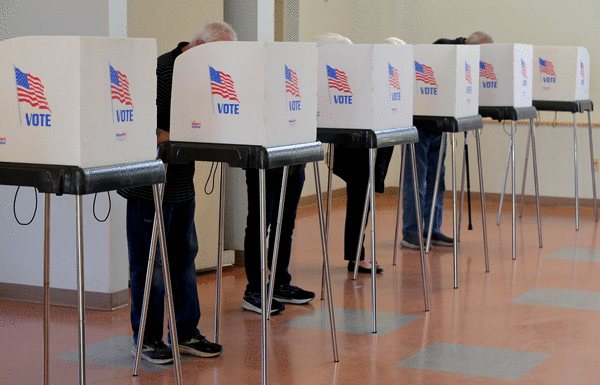
When Maryland voters head to the polls on June 23, they will be casting ballots under some election rules that did not exist during the state’s last gubernatorial primary four years ago.
Since 2022, state lawmakers have approved a series of election-related changes affecting polling place operations, election materials, voter protections and campaign conduct. The changes come after years of national disputes over election administration, concerns about voter access and growing reports of threats directed at election workers.
The June 23 primary will be the first major statewide test of some of those changes, especially those passed during the 2026 legislative session.
Among the most visible is a new law giving election officials clearer authority to respond to disruptions at polling places and ballot-counting centers.
Taken together, the measures represent one of Maryland’s most significant election administration overhauls in recent years. While many voters may not notice the changes, election officials will be watching closely to see how the new laws work in practice.
Here’s a look at several election laws that could affect voting in Maryland:
Poll authority changes
A new law expands the authority of Maryland election officials to maintain order at polling places, early voting centers and ballot-counting facilities.
The measure gives the state elections administrator and local election directors authority to address disruptions, protect designated challengers and watchers, and direct law enforcement action when individuals interfere with voting operations or attempt to intimidate voters.
Supporters said the legislation was needed after years of heightened tensions at polling places across the country and growing concerns about threats against election workers.
Critics argued the law could create confusion if election officials are given broad authority without sufficient safeguards to ensure transparency.
For most voters, election officials say, the law is unlikely to be noticeable unless a disruption occurs.
AI enters Maryland election law
As artificial intelligence becomes increasingly common in political campaigns, Maryland lawmakers approved new rules governing AI-generated election content.
The law establishes disclosure requirements and enforcement mechanisms for certain manipulated political media and election-related misinformation. It comes as campaigns nationwide grapple with the rapid spread of AI-generated images, videos and audio that can blur the line between authentic and fabricated political content.
The measure gives Maryland’s chief elections official new tools to combat election misinformation, including the ability to seek court orders requiring online platforms to remove false election information and to pursue legal action against those responsible. Violators may face misdemeanor penalties of up to $5,000 in fines, five years in prison, or both.
Ballot questions must use plain language
Maryland voters will see clearer explanations of ballot questions under a new law aimed at making election materials easier to understand.
The legislation requires summaries of proposed ballot measures to be written in plain language and requires election officials to provide more information about ballot questions before elections.
Supporters say the changes will help voters make informed decisions by reducing confusing legal and technical language that often appears on ballots and petitions.
State voter protections
One of the most consequential election laws approved since 2022 may have little visible impact on voters this year.
The Maryland Voting Rights Act creates state-level protections against certain forms of vote dilution and election practices that disadvantage minority voters.
The law took effect in April after lawmakers approved it as emergency legislation.
Supporters said the measure provides protections regardless of future changes to federal voting-rights law. Maryland joins several other states, including New York, Connecticut and Virginia, that have enacted their own voting-rights protections.
The legislation was introduced multiple times before winning final approval from the General Assembly.
The law could shape future legal challenges involving local election systems, district boundaries and voting practices across Maryland.
_____
©2026 Baltimore Sun. Visit baltimoresun.com. Distributed by Tribune Content Agency, LLC.

















































Comments