Administration sticks with Congress on Medicaid work mandate exemptions
Published in Political News
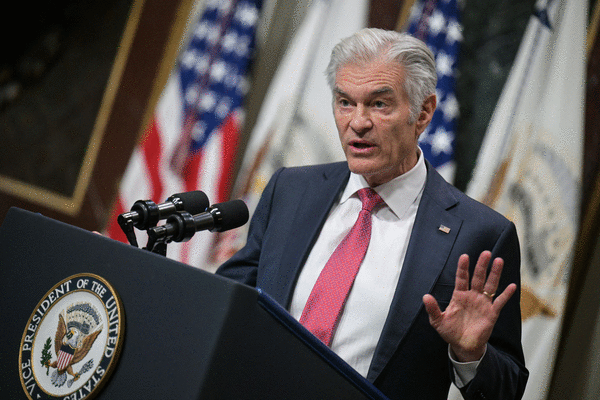
WASHINGTON — The Centers for Medicare and Medicaid Services on Monday outlined states’ obligations to implement upcoming Medicaid work requirements, issuing a rule that closely adheres to a list of exemptions already found in federal law.
The work requirements, passed as part of the Republican 2025 reconciliation law, are set to take effect in January.
The law requires certain adults in the Medicaid expansion population work, volunteer, or go to school to obtain and maintain coverage, while exempting those unable to comply due to illness or other circumstances. The rule issued Monday by CMS says individuals can qualify for an exemption if they have a condition that “significantly impairs” their ability to live their daily lives.
But CMS did not go further than the exemptions laid out by Congress, which said someone must be “medically frail.” Beneficiaries may also meet other exemptions, such as being pregnant, postpartum or a parent of a child under age 14.
Since the law was enacted a year ago, states have sought clarification about how much flexibility they will have to determine whether someone is frail enough to be exempt from the work requirements. In particular, state officials have wondered whether homeless people could be exempt.
The rule stipulates that states cannot add exemptions to the list and that homelessness “is not a medical condition,” though the agency noted that many people who are homeless may have health conditions that would exempt them, like a substance use disorder.
“We are concerned that there may be more of an incentive for some States to include individuals who would not reasonably be considered medically frail, if we provided States with the option to add additional categories of people to the community engagement medically frail definition,” the rule states.
Adding more exemptions beyond what is in the law could “create burden for both CMS and states,” the rule states.
In determining whether someone is exempt based on a medical issue, states are expected to review medical claims data for certain diagnoses and procedure codes.
But states will have wide latitude for the program’s first year to accept self-attestations that someone is too sick to comply. That’s partly because the state won’t have that information for people who are new to Medicaid or have not seen a doctor. States may also need more time to build out their systems, CMS said.
But beginning in 2028, self-attestation will be available one time only under penalty of perjury. After that, a person would have to provide documentation proving they should be exempt if the state doesn’t have data available.
“We want that beneficiary to engage with their doctor and get the help that they need,” Daniel Brillman, CMS deputy administrator and director of Medicaid and CHIP Services, said in a call with reporters Monday.
Beneficiaries who are not exempt must work 80 hours a month, with states verifying compliance by looking at employment history. Individuals can also volunteer or attend school to meet the requirements. Self-attestations for those requirements is also an option until 2028.
Nebraska on May 1 became the first state to implement work requirements.
Public health experts and Democrats have worried that work requirements will lead some to lose access to Medicaid, even if they meet the requirements or qualify for an exemption. They point to the thousands of people who lost Medicaid coverage under Arkansas’ short-lived work requirement program in 2019. Many of those people met the requirements but didn’t fill out paperwork. The changes made by Congress are significant changes to Medicaid, with the Congressional Budget Office projecting that work requirements will increase the number of people without health insurance by 4.8 million in 2034.
©2026 CQ-Roll Call, Inc., All Rights Reserved. Visit cqrollcall.com. Distributed by Tribune Content Agency, LLC.



















































Comments