Before Cherfilus-McCormick resigned, candidates were raising money to replace her. Who's ahead?
Published in Political News
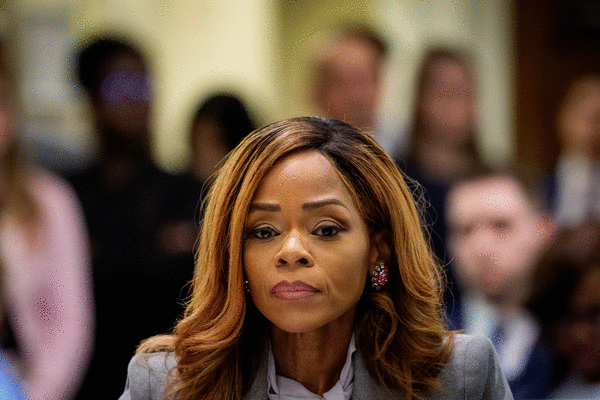
FORT LAUDERDALE, Fla. — As Sheila Cherfilus-McCormick’s time in Congress was nearing an end, she depleted almost all her campaign cash — to pay legal fees to her criminal defense attorney.
Combined with anemic fundraising, payment to the attorney left the Broward-Palm Beach County Democrat with just $11,000 in cash just three weeks before she resigned, according to her April filing with the Federal Election Commission.
That amount of cash amounts to pocket change for a congressional campaign. The former congresswoman’s campaign committee is also deeply in debt, including six figures in unpaid bills owed to other law firms.
Cherfilus-McCormick resigned Tuesday, minutes before the House Ethics Committee was about to convene to decide if it would recommend her expulsion from Congress, an outcome that was widely expected.
As her career-ending troubles mounted — she was indicted on criminal charges in November and a bipartisan House ethics subcommittee said in January it found “substantial evidence” of misconduct — a slew of other candidates stepped forward.
The Democratic candidates seeking their party’s nomination in the 20th Congressional District reported mixed financial results in their quarterly reports, which were due on April 15.
The filings show a wide range of positions: robust fundraising paired with heavy spending, soft fundraising, loans from candidates to their campaigns. One candidate raised nothing, but reported spending more than $185,000 in the first quarter — after putting $300,000 of his own money into his campaign coffers.
Republican candidates running in what is, for now, the state’s most heavily Democratic district reported little or no money raised in the quarter.
As the campaign enters a new phase, without the incumbent, with less than four months until the Aug. 18 primaries, many unknowns remain.
Among them: just what the 20th District looks like after Republicans who control state government pursue an unusual mid-decade redistricting, whether there will be a special election to fill the rest of Cherfilus-McCormick’s term, and even whether the former congresswoman will run in an attempt to regain her former seat.
Campbell
Luther Campbell, who announced his candidacy in February, may have the best name recognition of any of the candidates with a broad swath of the population.
As leader of the rap group 2 Live Crew, Campbell — known as Luke Skyywalker and later Uncle Luke — was acquitted of obscenity charges by a Broward County jury in 1990, a battle that helped make him a pivotal player in First Amendment rights of artists. More recently he’s been a free-speech advocate, civic activist, podcaster and successful youth football coach.
In 2011, he ran for mayor of Miami-Dade County, finishing in fourth place with 11% of the vote. He considered challenging Cherfilus-McCormick in 2024, but opted not to make the race.
On the day he announced his candidacy, Campbell told WPLG-Ch. 10 that his celebrity and his national profile could help him raise money for the campaign. “I’m going to have a lot of money,” he said, adding that, “Every artist, every artist that I produce, and every artist by creating Southern hip-hop will be donating to this campaign.”
His first campaign report shows modest fundraising. And on his podcast in recent days, he offered a more modest pitch “if you want to make a campaign donation,” adding that “our campaign is about $5. Just (a) $5 grassroots campaign, that’s what it’s all about.”
He raised $29,278 during the quarter and lent $7,850 of his own money to the campaign on March 31.
Campbell spent $11,068 and had $26,060 in the bank on March 31.
Holness
Dale Holness knows the ins and outs of a 20th District Democratic primary campaign better than anyone else.
In the 2021 special primary to pick a nominee to succeed the late longtime U.S. Rep. Alcee Hastings, Holness lost to Cherfilus-McCormick by just 5 votes out of 49,082 cast in the 11-candidate field. He unsuccessfully challenged her in the August 2022 Democratic primary.
Holness, who was a Broward County commissioner from November 2012 through January 2022 served a term as county mayor during that time and is a former Lauderhill city commissioner.
Holness quietly filed paperwork in August to run again. His campaign reports show he’s running a lean operation.
“I learned from past elections. I’m not hiring a whole bunch of high-paying consultants. I’ve been on the phone. Most of that money that I raised is from phone calls. I’m not spending money to make money,” he said.
Holness had $199,639 in his campaign account on Jan. 1. He raised $92,575 during the quarter and spent just $8,328.
He had $312,672 in the bank on March 31, almost as much as the three other candidates combined.
Some of his cash balance reflects loans he’s made to his own campaign: $28,000 on March 31 and $43,000 on Dec. 31. He has $90,000 in outstanding loans to his committee from previous congressional campaigns.
Holness had more in his campaign account on March 31 than any of the other candidates, but said he’s not letting up the pace. “We’re doing OK. I wouldn’t say I’m comfortable. I still think we need to get more in. It’s below where I want to be. But we still continue to make some phone calls and we’ll probably start doing some digital push from here on out,” he said Friday.
Manley
Elijah Manley was the first candidate to announce he was seeking the Democratic nomination, in February 2025, and he quickly became a fundraising juggernaut.
In the first quarter of 2025, he raised more than 18 times the amount incumbent Cherfilus-McCormick took in.
As is often the case with candidates who aren’t well known, he spent heavily to raise money, with much of the spending going to activities related to fundraising expenses. For the entire campaign, he has raised $767,000 and spent $741,000.
Manley had $6,021 in cash in his campaign account on Jan. 1. He raised $101,710 during the quarter and spent $84,863.
He had $22,868 in the bank on March 31. The campaign also had unpaid bills totaling $41,751.
Manley has unsuccessfully run for office several times before. He ran for Broward School Board in 2018, receiving 18.6% of the vote. He’s also run three times in Democratic primaries for state representative: in August 2020 (30.1% of the vote), January 2022 (25.1%), and August 2022 (29.2%).
Moise
Rudolph Moise formally announced his candidacy for the 20th District in February. He’d earlier filed paperwork as a congressional candidate, but not in the 20th District.
Moise is a physician, a lawyer and retired Air Force colonel, who emigrated to the United States from Haiti at age 17.
He has run for Congress before. In 2010, he finished second in a nine-candidate primary in a different congressional district, in South Broward and Miami-Dade County. Frederica Wilson won that primary and the general election, and is still serving in the House. In 2012, he ran against Wilson again and lost.
Moise reported no cash in his campaign account on Jan. 1.
He raised no money, but spent $184,531. He was able to do that because he lent $300,000 of his own money to the campaign, which left him with a balance of $115,469 in cash on March 31.
Redistricting
The 20th Congressional District, which currently includes most of the African American and Caribbean American communities in Broward and Palm Beach counties, is the most heavily Democratic in the state and one of the most Democratic in the nation.
But no one knows what it will look like later this year.
Gov. Ron DeSantis has ordered the Republican-controlled Legislature into a special session starting Tuesday to change the boundaries of Florida’s congressional districts. It’s part of a nationwide move demanded by President Donald Trump to change congressional district boundaries in an attempt to elect more Republicans and fewer Democrats in the November elections.
DeSantis has repeatedly cited the 20th District as one he wants changed.
Republicans
The Republican Party organization responsible for helping the party’s candidates win U.S. House races has been outspoken about Cherfilus-McCormick — primarily to make other Democrats look bad.
But the party doesn’t have major candidates, and those who are in the race so far haven’t been raising much money.
Rod Joseph began the quarter with $2,192, took in $6,806 and spent $11,274. He also reported a negative cash balance of $2,275. The report, which didn’t list loans to himself or unpaid bills, didn’t show how he could have a negative cash balance.
His spending included giving $3,950 to the Broward Republican Party and $1,069 to the Palm Beach County Republican Party. He also spent $1,095 for registration for a Conservative Political Action Committee conference.
Joseph came in fourth in the Democratic primary for U.S. Senate in 2024. He soon switched parties and endorsed U.S. Sen. Rick Scott, R-Fla., for reelection.
The Federal Election Commission website doesn’t show reports for two other Republicans, Sendra Dorce, and Lateresa Jones. At the end of 2025, Dorce reported $6,551 in her campaign account and $1,357 in outstanding loans.
Special election
The seat could remain vacant until the new Congress is sworn in on Jan. 3, following the midterm elections in November.
Or a special primary and special general election could be held to fill the final months of Cherfilus-McCormick’s term. A special election is up to Gov. Ron DeSantis.
Several candidates who were running before she resigned have said they want a special election. So has Broward Supervisor of Elections Joe Scott.
On Wednesday, Scott asked the governor to set a quick special election calendar, and outlined an ambitious schedule that would have voters pick a replacement on Aug. 18, the same day Florida is already holding elections for nonpartisan offices and primaries to nominate candidates to run in November.
The governor’s office didn’t respond to a request for comment about the proposal. Scott’s office said late Friday afternoon he had not received a response from the governor’s office or the Secretary of State’s Office.
All four Democratic candidates responded to Cherfilus-McCormick’s resignation with calls for a special election.
Given the narrow Republican majority in the U.S. House, Holness said he doesn’t expect the Republican governor to set a special election in a Democratic district. “Considering the state of the political affairs in our country, the Republicans are going to want to have the seat as empty as long as they can.”
Manley issued an ultimatum to the governor. “I am giving Ron DeSantis a special election,” Manley wrote Wednesday night on social media, adding that he would go to court if DeSantis doesn’t comply.
Cherfilus-McCormick
A bipartisan adjudicatory subcommittee of the House ethics committee found last month that she had committed 25 ethics violations, including breaking campaign finance laws.
Many of the findings stem from Cherfilus-McCormick’s receipt of millions of dollars from her family’s health care business after Florida overpaid the firm $5 million in federal COVID relief funds, with the subcommittee determining much of that money helped fund her first two successful political campaigns, in 2021 and 2022.
The former congresswoman has consistently denied any wrongdoing, and has entered a not guilty plea to federal criminal charges, some of which overlap with the House ethics case.
Cherfilus-McCormick, who technically remains a candidate, hasn’t stated political intentions. In a defiant resignation statement, she said, “I choose to step away so that I can devote my time to fighting for my neighbors in Florida’s 20th district.” On April 17, four days before Cherfilus-McCormick resigned, she filed a copy of a document with the Florida Division of Elections stating she was a candidate for reelection.
Neither the former congresswoman nor her chief of staff responded to emailed questions about her intentions.
Candidates have until mid-June to officially qualify for the ballot. And the amount of cash in her campaign account is just enough to cover the $10,440 qualifying fee for a congressional candidate who doesn’t get on the ballot by gathering voters’ signatures.
Raising money would be a challenge. After she was indicted in November, her fundraising almost entirely dried up, her fourth quarter 2025 and first quarter 2026 reports show.
Cherfilus-McCormick had $106,699 in her campaign account on Jan. 1.
She raised $10,785 during the quarter and spent $106,403, and had $11,081 in the bank on March 31.
Most of her spending was a $98,000 payment to her Miami criminal defense attorney, David Oscar Markus, who later was replaced by a different attorney. In November, five days after she was indicted on federal criminal charges, her campaign paid Markus $100,000.
The campaign also had debts totaling $4.39 million. The debt includes $3.7 million she lent to the campaign, mostly for her 2021 special primary election and 2022 special general election.
She had $729,210 in other unpaid bills mostly to law firms, mainly to the Elias Law Group, a prominent Democratic election law firm based in Washington, D.C.
©2026 South Florida Sun Sentinel. Visit sun-sentinel.com. Distributed by Tribune Content Agency, LLC.



















































Comments