US Supreme Court sends energy pipeline case back to Michigan court
Published in Political News
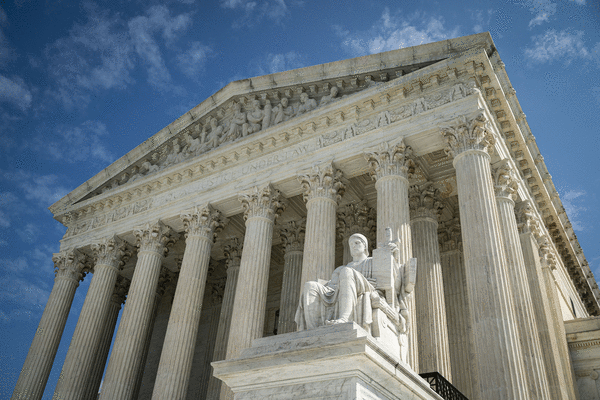
LANSING, Mich. — Enbridge Energy waited too long to move a state case to federal court, challenging its continued operation of an oil pipeline in the Straits of Mackinac and federal courts lack the discretion to excuse that delay for reasons not expressly outlined in law, the U.S. Supreme Court ruled Wednesday.
The unanimous decision will keep the case in Michigan's state-level court system.
Enbridge Energy had a 30-day window to move Attorney General Dana Nessel's lawsuit to federal court in 2019; instead, the Canadian company waited 887 days before seeking to change venue, only doing so after a separate state case challenging its Line 5 pipeline was dismissed.
If the court were to grant Enbridge some flexibility to that 30-day window, Justice Sonia Sotomayor ruled in the unanimous opinion, it "would undermine Congress’s manifest interest in resolving threshold removal questions early and conclusively" and generate "uncertainty and risking significant waste of resources."
Enbridge, the justice added, "cannot identify any sensible reason why Congress would have adopted so many express, equitable exceptions" to the removal timeline, if it also believed courts had ample discretion to extend the timeline for parties like Enbridge.
"The Court of Appeals therefore correctly held that Enbridge’s notice of removal was untimely and that this action must be remanded to the Michigan state court," Sotomayor wrote.
Enbridge noted in a statement Wednesday that the case at issue, a 2019 lawsuit filed by Nessel, has been stayed in state court while Gov. Gretchen Whitmer appeals a federal court ruling in a separate suit that upheld the continued operation of Line 5. Still, the decision issued Wednesday will add further delays to the state case, the company argued.
"Enbridge is disappointed by the U.S. Supreme Court’s decision, which extends more than six years of litigation initiated by the Attorney General to shut down Line 5 based on what remain unfounded safety concerns," said Ryan Duffy, a spokesman for Enbridge Energy.
The ruling reinforces that "corporations cannot evade state environmental enforcement suits by waiting, testing the waters in one forum, and then trying for a friendlier court later," said Caroline Flynn, who serves as Supreme Court counsel for the environmental group Earthjustice.
"The ruling will help Michigan continue its state-law case, in the forum it chose, to address a deteriorating Canadian oil pipeline before disaster strikes in the heart of the Great Lakes," Flynn said.
Oil & Water Don't Mix, a group that advocated for the shutdown of Enbridge's twin, 20-inch-wide underwater oil pipelines in the Straits of Mackinac, called the decision a "clear and pivotal win" for Nessel's defense of the Great Lakes and the "best possible news" to receive on Earth Day.
“Now, this case will head back to state court, where it belongs," said Sean McBrearty, campaign coordinator for Oil & Water Don't Mix.
A seven-year legal battle
The debate over the case filed by Nessel in 2019 stems from Enbridge’s decision to remove the case to federal court more than two years after it was filed, instead of within the 30-day window for removal.
On the surface, the high court's decision deals with a narrow and technical issue about how flexible the courts can be with a procedural deadline for case removals. But, practically, the justices' decision now clears the way for Nessel to pursue the case in state court, where state-level arguments against Line 5 are likely to be better received.
A separate case brought by Enbridge in federal court already has resulted in a decision in favor of the continued operation of Line 5, with a judge ruling last year that federal regulations take precedent over state efforts to close the line.
The more than 70-year-old twin span beneath the Straits of Mackinac transports about 540,000 barrels of light crude oil and natural gas liquids a day, and has long been a cause for concern among environmental groups and some government officials, who fear the catastrophic effects of an oil spill at the nexus of Lakes Michigan and Huron. Supporters of the pipeline have warned against closing the line out of concern for potential natural gas and oil shortages in Canada and the Midwest.
Nessel and Whitmer both campaigned in 2018 on promises to shutter the line even as Republican former Gov. Rick Snyder, as he was leaving office, entered a deal with Enbridge requiring the Calgary, Alberta-based company to build a $500 million tunnel beneath the straits to house a new section of the pipeline.
In 2019, after taking office, Nessel filed suit in state court trying to shut down the pipeline. In late 2020, Whitmer revoked the easement allowing the pipeline to rest on the lake bottom and filed suit in state court to uphold that revocation.
Enbridge filed its own countersuit in federal court, Canada invoked a transnational pipeline treaty to stop Whitmer's lawsuit and Enbridge removed Whitmer's case to federal court within the 30-day window for doing so. When a judge upheld Enbridge's removal of the Whitmer case to federal court, the governor dismissed her case and threw her support behind Nessel's 2019 effort, at which point Enbridge tried to remove Nessel's case to federal court.
But by that point — more than two years after Nessel initially filed — Enbridge had missed the 30-day window for removal. A U.S. District Court judge waived the 30-day window, given the federal issues at play and the alleged venue gamesmanship, but the Sixth Circuit Court of Appeals reversed the decision in June 2024, arguing there was no wiggle room on the 30-day rule. Enbridge then brought the case to the U.S. Supreme Court, which upheld the Court of Appeals decision on Wednesday.
Congress has allowed specific exceptions to the 30-day rule, Sotomayor wrote Wednesday, and those explicit exemptions would not have been necessary if it believed courts retained the discretion to pause that timeline or grant delays to it through a process called "equitable tolling".
The removal process, Sotomayor added, "has an obvious concern with efficiency" that would preclude delayed attempts for removal.
"Under the rule Enbridge favors, to the contrary, the possibility of a late removal would hang over a case, generating uncertainty and risking significant waste of resources in one forum before a possible belated removal to another," Sotomayor wrote.
_____
—Staff Writer Melissa Nann Burke contributed.
©2026 www.detroitnews.com. Visit at detroitnews.com. Distributed by Tribune Content Agency, LLC.





















































Comments