Trump $2.2 trillion budget pairs defense boost, agency cuts
Published in Political News
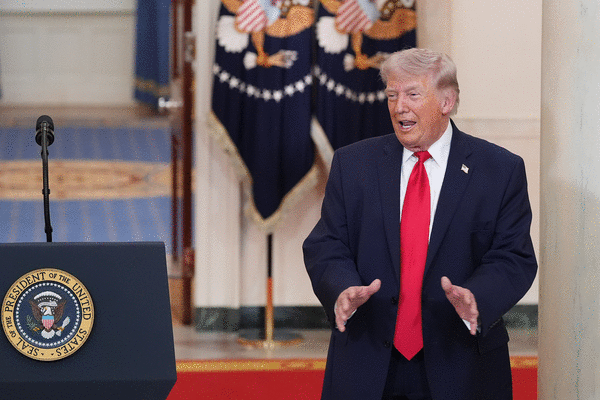
WASHINGTON — President Donald Trump asked Congress to enact a $2.2 trillion budget for discretionary programs, seeking a massive increase in defense spending, while also renewing his push for steep cuts to domestic agencies.
The 2027 budget proposal released Friday requests $1.5 trillion for defense, a significant increase over the $1 trillion sought for fiscal year 2026. The new figure includes $1.1 trillion in base discretionary spending for the Department of Defense and another $350 billion in mandatory spending. The Office of Management and Budget is also still reviewing a potential $200 billion Pentagon supplemental package for the current fiscal year that would be on top of Friday’s request as the U.S. carries out its war in Iran.
Discretionary nondefense spending would be cut 10%, or about $73 billion, according to the White House.
“President Trump promised to reinvest in America’s national security infrastructure, to make sure our Nation is safe in a dangerous world,” White House Budget Director Russell Vought said in a message accompanying the blueprint. “The 2027 Budget upholds this promise and would ensure that the United States continues to maintain the world’s most powerful and capable military.”
The president’s decision to seek a dramatic rise in the Pentagon’s budget — the largest single-year increase since World War II — comes as polls indicate he’s struggling to convince many Americans of the wisdom of the war in Iran.
The proposal also puts Trump’s Capitol Hill allies on the spot, after lawmakers failed to enact the full scope of reductions he sought in his first year back in office, and amid some voter backlash to his slash-and-burn efforts to trim the bureaucracy. Taken as a whole, the budget sets up a fierce debate over policies and priorities ahead of November’s critical midterm elections.
“Donald Trump’s budget is rotten to the core, and Democrats will make sure it never passes,” Senate Democratic Leader Chuck Schumer said in a statement. “If Republicans choose to go along with this budget, they will be like Thelma and Louise and follow Donald Trump’s political fortunes off the same cliff.”
The overall discretionary spending increase Trump has proposed would likely exacerbate an already large U.S. annual budget deficit. In a departure from decades of practice, the budget did not include 10-year projections for the spending plan’s impact on future deficits, leaving those to an obscure release later in the year. That’s in part because the budget doesn’t account for entitlement spending like Social Security, Medicare and Medicaid — the three biggest drivers of future deficits.
The White House budget includes $65.8 billion for shipbuilding, 85 new F-35 fighter jets from Lockheed Martin Corp., and a pay raise for troops. Enlisted personnel up to the rank of an Army staff sergeant would get a 7% raise, while top officers would get a 5% increase.
The Trump budget accomplishes that through $350 billion in mandatory spending next year, as it continues its attempt to shift more defense spending from the annual discretionary budget to mandatory spending. That maneuver could help get the additional spending get through Congress via its budget reconciliation process, forestalling a Democratic filibuster in the Senate.
Domestic Cuts
On the domestic side, the budget seeks a $28.5 billion increase for immigration enforcement, $4.7 billion more for the Department of Justice, and $10 billion for beautification projects in the nation’s capital.
But most domestic agencies would face steep cuts under Trump’s plan. Three departments — Interior, Housing and Urban Development, and Health and Human Services — would see cuts of around 13% each. And the Department of Education would take a 2.9% cut in what the budget calls “a path to elimination.”
The budget would continue Trump’s attempts to dismantle much of his predecessor’s environmental agenda, canceling $15 billion in renewable energy and clean air programs — and redirecting much of it to building fossil fuel infrastructure and energy-hungry artificial intelligence supercomputers for the Department of Energy.
Also proposed are large cuts to programs aimed at the poor like homeless assistance grants and home heating aid as well as to medical research.
Despite a Supreme Court decision in February striking down Trump’s use of emergency powers to impose global tariffs, the budget estimates $464 billion in tariff revenue in 2027 — a 138% increase from last year.
The budget is silent on a $2,000 “tariff dividend” Trump had floated for individual taxpayers, leaving its fate uncertain.
Economic Forecasts
Economic assumptions submitted with the budget forecast the U.S. economy to pick up steam in 2026, as growth accelerates and the unemployment rate declines. The budget assumes economic activity will increase 3.1% this year, a trend the administration anticipates will continue throughout the rest of the president’s term.
The unemployment rate, which unexpectedly fell to 4.3% in March in Friday’s jobs report, is seen dropping to a historically low 3.7% in the fourth quarter.
And the budget also assumes a key gauge of inflation will slow. The administration sees the consumer price index advancing 2.3% in the fourth quarter compared to the same period a year earlier. The CPI stood at 2.4% in February — but economists now broadly expect that pace to accelerate as a result of the Iran war.
White House forecasters are also projecting a significant drop in interest rates over the next five years. They see the 10-year Treasury yield declining to an average of 3.7% this year and down to 3.3% in 2030. The 10-year yield topped 4% during most of 2025 and has surged in the past month after the war in Iran raised concerns about inflation. The yield currently stands at about 4.3%, close to where it was when Trump was elected in November 2024.
The Congressional Budget Office, using tax and spending levels set by current law and assuming average growth of 1.8% over 10 years, projects that budget deficits will increase to more than $3 trillion by 2036 — at which point the national debt would be 120% of gross domestic product. That is before Trump’s new defense spending increases are enacted.
But Trump claimed Friday that an effort to crack down on fraud in federal programs, an initiative led by Vice President JD Vance, could close that gap.
“The numbers are so large that, if successful, we would literally be able to balance our American Budget,” Trump said in a post on his social networking site. “Good Luck JD!”
Improper payments identified by federal agencies in 2025 — a rough proxy for fraudulent activity — totaled $186 billion. That’s about one-tenth of the $1.8 trillion budget deficit that same year.
_____
(With assistance from Adrienne Tong, Steven T. Dennis, Justin Sink, Reade Pickert, Cécile Daurat, Tony Capaccio and Michelle Jamrisko.)
©2026 Bloomberg L.P. Visit bloomberg.com. Distributed by Tribune Content Agency, LLC.





















































Comments