Editorial: The Pentagon needs to give better answers on its 'Golden Dome'
Published in Political News
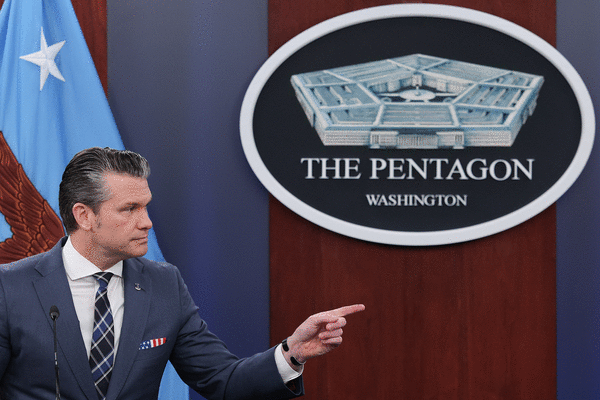
Frustrated legislators tucked an unusual provision into the recently passed $839 billion defense appropriations bill, demanding answers from the Pentagon on its proposed “Golden Dome” missile defense project. Defense officials were given until early April to detail planned expenditures over the next two years and must report annually thereafter.
If White House officials want this program to succeed, they shouldn’t just accept the need for greater transparency; they should embrace it.
Currently, the administration risks becoming a victim of its own hype. Since announcing the program in May, the president has boasted that it will shield all of the U.S. from enemy missiles, for less than $200 billion, within three years. Pentagon officials insist the technology and the timeline are viable, but they have declared they can’t say more for fear of leaks. The lack of detail has angered lawmakers and strengthened critics, who warn that building a comprehensive space-based shield against incoming ballistic missiles would cost orders of magnitude more than the White House says, even if technological hurdles could be overcome.
The reality may well be more modest and less controversial. The U.S. confronts a range of new threats — not just the nuclear-armed intercontinental ballistic missiles familiar from the Cold War, but conventional long-range and cruise missiles, hypersonic glide vehicles, and all manner of attack drones. Ramping up production of existing missile defenses, layering them and integrating them with new battle-management systems to protect key areas could be worthwhile. So could investments in space-based sensors and research into new interceptors, which might yield useful insights even if they’re ultimately not deployed.
If that’s the plan, however, Congress deserves to know. Appropriators, who allocated nearly $25 billion to Golden Dome in last year’s reconciliation bill, have rightly complained that they can’t “effectively assess resources available” or “conduct oversight of planned programs and projects” without more information. To justify new funding, not to mention build support so the program isn’t scrapped by the next administration, the Pentagon needs to do more to convince members of both parties of its feasibility and worth.
Others are owed clarity as well. While the Pentagon recently laid out in broad terms how it hopes to spend the money from last year’s reconciliation bill, most details remain classified. American taxpayers deserve more information if they’re going to continue to provide billions to fund the program. Defense companies have been clamoring for more specifics and long-term contracts: They can’t be expected to invest huge sums in developing new products, or even scale up production of existing technologies such as air defense systems, without a better sense of the commercial potential.
Allies have advanced capabilities they could bring to bear if included in the discussions. And if the president is convinced the U.S. needs greater access to friendly territory such as Greenland to make the system work, he needs to explain why.
Concerns about revealing too much are understandable. But the U.S. has been more open about past defense initiatives — including former President Ronald Reagan’s aborted “Star Wars” program — without undermining operational security. Indeed, the U.S. could dangle the possibility of discussing Golden Dome in more detail with China and Russia as part of talks over their nuclear arsenals and investments in worrying new weapons.
Undue secrecy over the program risks raising both expectations and fears unnecessarily. The White House should welcome this opportunity to lower both.
____
The Editorial Board publishes the views of the editors across a range of national and global affairs.
©2026 Bloomberg L.P. Visit bloomberg.com/opinion. Distributed by Tribune Content Agency, LLC.




















































Comments