Cook County Commissioner Donna Miller wins Illinois' 2nd District over comeback effort by former Rep. Jesse Jackson Jr.
Published in Political News
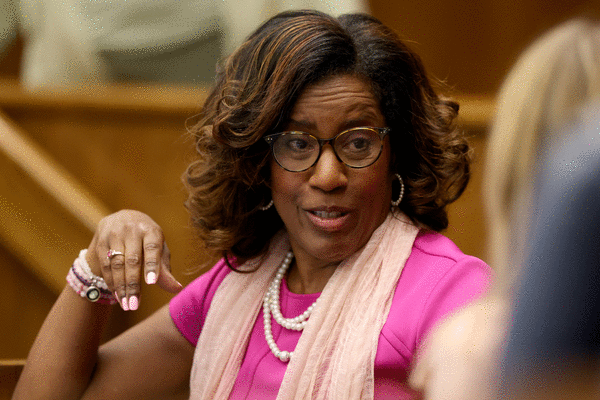
Cook County Commissioner Donna Miller won the Democratic primary in Illinois’ 2nd Congressional District Tuesday as voters rejected a comeback effort by former Rep. Jesse Jackson Jr.
Miller, who ran a campaign focused on health care, had 40.7% of the reported vote at 8:16 p.m. Tuesday evening when the Associated Press called the race.
Jackson, behind her at 28.8%, ran to win back the seat he once held for 17 years, but resigned in 2012 amid a campaign finance misuse investigation that landed him in prison.
The primary winner is all but guaranteed the seat in the heavily Democratic district that stretches along the lakefront on the South Side and includes suburbs like Harvey, Dolton and Pontiac. Outgoing Rep. Robin Kelly, who has held the seat for 13 years since winning a special election following Jackson’s resignation, is running for U.S. Senate instead of seeking reelection.
Kelly had 19.3% of the reported vote with over half of expected results in Tuesday evening, a distant third to the race’s two leaders.
Excitement had building all evening at Miller’s Chicago Heights watch party as initial returns showed her jumping out to an early lead that never shrank. A squad of youth cheerleaders wore green-and-gold shirts with the refrain made famous in the district because of the massive spending that backed her: “Go Donna Go!”
Miller’s campaign manager, veteran political strategist Delmarie Cobb, pinned the victory Tuesday night on the optimistic tone the candidate sought to strike as opponents made attacks.
“We decided to stay positive, keep our heads high and just let the chips fall where they may,” Cobb said. “I think it worked for us.”
Cobb said Miller’s campaign targeted older Black women.
“That’s who comes out, that’s who votes in record numbers,” Cobb said.
Miller, first elected to the Cook County Board in 2018, carved out a moderate lane in the crowded field of 10 candidates vying to replace Kelly.
Throughout the congressional campaign, other candidates slammed Miller for the money she raised and the outside spending that supported her. The opponents alleged the money stemmed from the American Israel Public Affairs Committee, which advocates for Israel’s interests and supports both Democrats and Republicans.
About two-thirds of the $2 million she raised through late February came from people who had recently contributed to AIPAC or AIPAC-affiliated groups. The dark-money super PAC Affordable Chicago Now, which opponents described as an AIPAC shell group, spent $4.4 million to support her. Altogether, the money made her campaign one of the most financially well-supported Democratic primary campaigns Chicago has ever seen.
She zeroed in on improving health care a her top priority on the campaign trail and insisted that her record as a commissioner, including securing $3 million for a Cook County Health doula program and expanding CPR training, shows she can deliver results.
“We have to get back to data and science and focus on results, and we need to quit chasing headlines,” she said during her campaign.
A lifelong resident of the district, she said she is part of its “woven fabric,” an apparent effort to distinguish herself from Jackson, who spent time in D.C.; Peters, who lives several blocks outside its Hyde Park boundaries; and Preston, who lives outside the district in Auburn Gresham.
“You can’t just come to a district to pop in and out,” she said. “People know me, they see me. … I walk the block.”
Though all in the field promise to forcefully fight President Donald Trump and would likely make similar votes, the leading candidates differ sharply in style and priorities.
Jackson, who held the seat for 17 years before stepping down amid an investigation into campaign finance fraud that landed him in prison, argued he deserves a second chance after completing his sentence. He urged voters to instead weigh his experience, promising “no learning curve” if he wins once again.
The former congressman says he would push for a constitutional amendment enshrining a right to health care and focus on landing a long-considered south suburban airport near Peotone if elected.
Miller made the airport a similar priority while staking out several more moderate positions than other top contenders in the left-leaning field. A health care consultant who served as board chair for Planned Parenthood of Illinois, Miller promised to bring health expertise to Washington, D.C., while pushing for maternal health programs and a return at the federal level to evidence-based medicine.
Peters pitched himself as the most progressive candidate in the contest while citing his close connections to Chicago organizers and endorsements from the likes of Sens. Bernie Sanders of Vermont and Elizabeth Warren of Massachusetts. He argued that health care companies should be broken up with anti-monopoly laws and taxes on America’s wealthiest people should be raised.
Brown touted progressive bona fides of her own while zeroing in on environmental justice as a key agenda item. She said she will make infrastructure investments a top focus if elected, citing experience responding to flooding as Water Reclamation District commissioner.
State Sen. Willie Preston described himself as a “butt-kicker” ready to take on Trump, a label he has proved by regularly criticizing opponents during town halls. He pointed to his own experience being stabbed to call for more investment in South Side and south suburban medical trauma centers and mental health care.
The race was in part shaped by over $7 million in spending by outside groups, an amount on par with other competitive Chicago primaries this year, but far above past races.
Two super PACs that oppose restrictive regulations for cryptocurrency and artificial intelligence spent $1.4 million to support Jackson and over $800,000 to oppose Peters.
Miller raised nearly $1 million in direct contributions through a late February filing deadline, while Peters raised $1.1 million. Jackson raised $206,000, Preston raised $138,000 and Brown raised $107,000.
The death of the Rev. Jesse Jackson also cast a shadow over the race. Since the death of the civil rights leader who called the district home, few opponents have targeted his son — the best-known figure in the field — with direct attacks.
Jackson has been thrust into a national spotlight as every politician in the city and even three former U.S. presidents attended memorial services honoring his father.
_____
©2026 Chicago Tribune. Visit chicagotribune.com. Distributed by Tribune Content Agency, LLC.




















































Comments