Senate Democrats seek to prevent military action against Cuba
Published in Political News
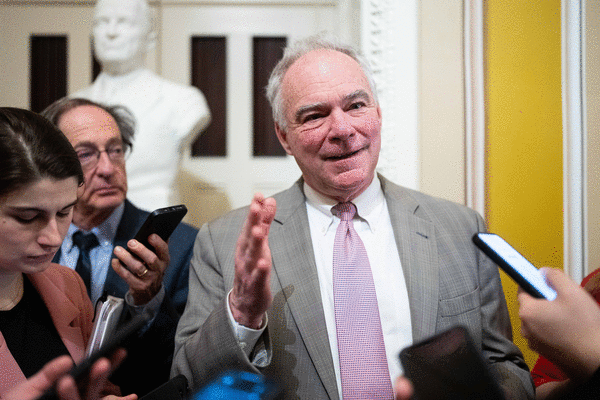
WASHINGTON — Amid concerns that Cuba could be President Donald Trump’s next target for military action, a trio of Senate Democrats has introduced legislation aimed at blocking him from doing so.
The war powers resolution from Democratic Sens. Ruben Gallego of Arizona, Tim Kaine of Virginia and Adam B. Schiff of California would direct the president to “remove the United States Armed Forces from hostilities within or against Cuba,” according to text released Friday.
“As if the disaster of the Iran War and the resulting spike in oil prices weren’t enough, Trump is now threatening to intervene in Cuba as well,” Gallego said in a news release announcing the joint resolution. “He ran on America First, but now it’s clear he’s become a puppet of the war hawks in his party.”
The measure is the latest effort from Senate Democrats to constrain Trump’s military interventions, following similar measures on Venezuela and Iran.
While those past efforts fell short, and there are no signs a Cuba measure would fare differently, supporters of the measures argue they are still important exercises in getting lawmakers on record, forcing a public debate about the use of military force and sending a message to Trump about Congress’ authority in matters of war.
“Only Congress has the power to declare war under the Constitution, but he operates with the belief that the U.S. military is a palace guard, ordering military action in the Caribbean, Venezuela, and Iran without Congress’ authorization or any explanation for his actions to the American people,” Kaine said in a statement Friday.
Kaine and Schiff are also among a group of six Democratic senators who recently introduced several more Iran war powers resolutions in an effort to force public hearings on the Iran war.
Cuba was one of several countries Trump threatened at the beginning of the year after the U.S. military raid in Venezuela. After he ordered military action against Iran, speculation has swirled that Cuba could be next.
Sen. Lindsey Graham, R-S.C., a close Trump ally who campaigned for military action against Iran, said on Fox News last week that “the liberation of Cuba is upon us. It’s just a matter of time.”
A couple days earlier, Trump told CNN in an interview that “Cuba is gonna fall pretty soon.”
Since January, the United States has imposed a blockade of oil shipments to Cuba, causing fuel shortages on the island that have led to lengthy blackouts and aggravated an economic crisis.
Amid the U.S. pressure campaign, Cuban President Miguel Díaz-Canel on Friday acknowledged for the first time that his government has held talks with U.S. officials. The talks, he said in a speech, “were aimed at finding solutions through dialogue to the bilateral differences between our two nations,” according to The Associated Press.
Under the 1973 War Powers Resolution, Gallego, Kaine and Schiff will be able to force an initial procedural vote on their Cuba measure after 10 days of introduction. The measure was introduced on Thursday.
“The president’s saber rattling toward Cuba makes clear where his sights are next,” Schiff said in a statement. “Congress must make its voice heard, or we risk involvement in another risky war of choice and losing our constitutionally granted authorities forever.”
Even if the measure were to be passed by the Senate, it would face an uncertain future in the GOP-controlled House since the War Powers Resolution does not prescribe expedited procedures for consideration of such a joint resolution in that chamber. And it would almost certainly be vetoed if it did reach the president’s desk.
©2026 CQ-Roll Call, Inc., All Rights Reserved. Visit cqrollcall.com. Distributed by Tribune Content Agency, LLC.





















































Comments