Orban's election campaign turns to Russia for help in final stretch
Published in Political News
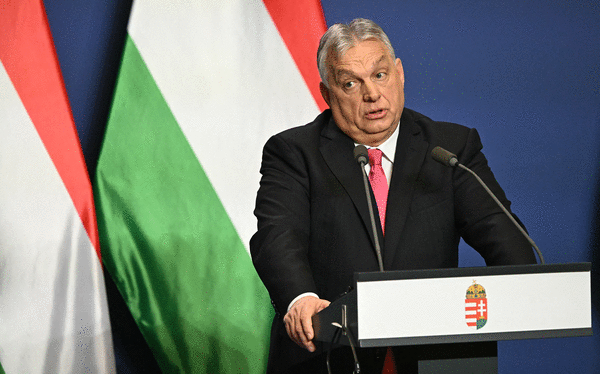
A surprise guest appeared at a recent campaign rally for Viktor Orban’s party in eastern Hungary: a Ukrainian prisoner of war freed from Moscow’s captivity.
How he got there illustrates the way in which Russian President Vladimir Putin has tried to help the Hungarian prime minister survive next month’s election.
Orban has frequently sought to obstruct the European Union’s efforts to support Ukraine and punish Moscow for its invasion. Most polls now suggest that Putin’s closest ally in the EU could lose power after 16 years in office.
Prisoners of war held in Russia are not ordinarily allowed to contact loved ones back home, let alone film appeals to politicians to come to their aid.
That made it more remarkable when in late December pro-government Hungarian Facebook groups started featuring high-quality clips of ethnic Hungarian soldiers praising their Russian captors for humane treatment and asking the prime minister to help free them.
By February, some of those videos had been shared by Russian government accounts, then broadcast by Hungarian public TV, before being posted by Hungarian officials. Following a visit in Moscow by Hungarian Foreign Minister Peter Szijjarto earlier this month, Russia released two of the captives — including the one who appeared at the event in Debrecen last week.
Two sources with knowledge of the situation said that the EU hasn’t yet taken steps to probe the actions of Hungarian authorities during the campaign, nor reports of possible foreign interference, due to concerns about alienating Orban in case he’s reelected.
The videos are “the clearest evidence so far of Russian interference,” said Andras Racz, a Hungarian analyst who studies the war in Ukraine for the German Council on Foreign Relations. The fact they had been filmed from captivity demonstrated that Moscow was helping Orban’s election campaign, he argues.
That wouldn’t be unheard of. The authorities in Romania and Moldova alleged massive attempts by Moscow to influence the outcome of two key elections last year. Russia has denied that charge, but governments across Europe’s eastern flank remain wary of further efforts to support populist and anti-EU forces, for whom Orban is a role model.
The prime minister’s Fidesz party has built an election campaign which neatly aligns with Kremlin talking points on Ukraine. It’s cast Kyiv as an “enemy” which would embroil Hungary’s soldiers in a war if opposition leader Peter Magyar wins on April 12.
Earlier this year, Orban accused Ukrainian President Volodymyr Zelenskyy of deliberately choking off Hungary’s energy supplies, making no mention of the fact that flows had been interrupted by a Russian drone attack on a crucial pipeline. Ukraine denied that accusation, saying swift repairs weren’t possible.
And last week, Hungarian anti-terror police seized a routine consignment of cash in transit from Austria to Ukraine. Budapest alleged that tens of millions of dollars might have been used for nefarious ends — a suggestion rejected by Austrian and Ukrainian officials.
“This election is about whether Zelenskyy gets to form a government, or me,” Orban said at a campaign event this week. Fidesz campaign posters urge voters “don’t let Zelenskyy get the last laugh.”
The campaign took a fresh turn on Wednesday when Orban was filmed responding to a heavily edited video that appeared to show a long-retired Ukrainian politician threatening the premier and his family.
“The Ukrainians are threatening not just me, but you and the grandchildren,” Orban said while appearing to phone three of his daughters in turn, to a soft piano soundtrack. “It’s serious but there’s no need to be scared.”
Last week, the investigative portal VSquare reported that the Kremlin had begun contributing advice and messaging strategies to Orban’s campaign — an assertion that both the Kremlin and the Hungarian government denied.
But Magyar had no doubts. He called on Orban in a social media post on Tuesday “to halt the planned election fraud and order Russian agents out of Hungary.”
There are signs the relentless flood of negative messaging is having an impact: a recent 21 Kutatokozpont poll showed Magyar’s lead had shrunk by two points over February to 14 percentage points.
Fidesz has also long outspent other European countries in online advertising.
In September, Hungarian political spending on Meta platforms, dominated by Fidesz, hit 3.4 million euros ($3.9 million) — more than 500,000 euros more than was spent in Germany, with eight times the population, according to research by the Centre for Euro-Atlantic Integration and Democracy, a think-tank.
“Allegations of Russian operational involvement add an external interference dimension rarely seen at this scale in EU campaigns,” a report by the CEID said.
Daniel Fazekas, chief executive of the social intelligence agency Bakamo, pointed to a surge in recently created accounts which attempted to disrupt pro-opposition groups on Facebook.
While it’s all but impossible to pinpoint the exact origin of such undercover social media campaigns, their methods and narratives align with those used by the Kremlin, meaning a “high degree of certainty” of some Russian involvement, he said.
———
(With assistance from Andras Gergely, Alberto Nardelli and Victoria Cagol.)
©2026 Bloomberg L.P. Visit bloomberg.com. Distributed by Tribune Content Agency, LLC.


















































Comments