Trump faces tough legal landscape to oppose tariff refunds
Published in Political News
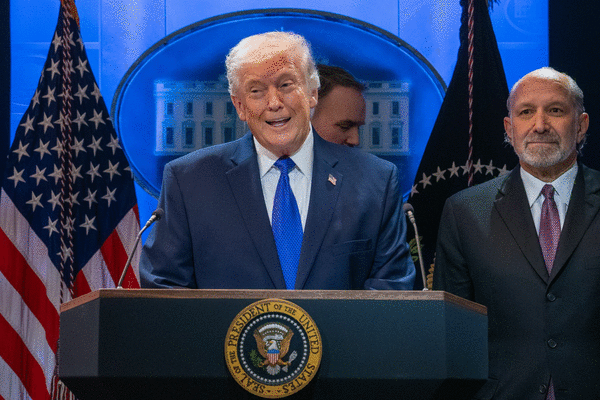
WASHINGTON — The Trump administration is likely to face legal obstacles if it argues against refunds for the tariffs struck down by the U.S. Supreme Court — thanks to statements by Justice Department lawyers.
In a 6-3 decision last week, the justices declared President Donald Trump’s use of an economic emergency powers law illegal. The majority was silent on whether the companies that paid more than $170 billion in contested duties will get their money back, sending the issue to lower court to sort out. Justice Brett Kavanaugh warned in a dissent that a refund process was “likely to be a ‘mess.’”
Trump immediately signaled his administration might oppose payouts, saying, “I guess it has to get litigated for the next two years.”
Legal wrangling over refunds won’t play out on a clean slate, however. Over the past year, the Justice Department took positions before the U.S. Court of International Trade that narrowed its paths to object going forward.
After the trade court initially declared the tariffs unlawful last May, the administration cited the availability of refunds as a reason for judges to let officials keep collecting tariffs for months amid the legal fight.
Government lawyers wrote in court filings last summer that plaintiffs whose cases went to the Supreme Court “will assuredly receive payment on their refund with interest” if they won. The Justice Department hasn’t used the same definitive language in later cases, but trade lawyers said judges are likely to hold the administration to those promises.
“The government has the incentive to make whatever argument it can to decrease the financial liability here, but I think it’s going to be difficult for there to be a refund for the actual plaintiffs themselves and no refund for other importers who have paid up to this point,” said Joyce Adetutu, a partner at Vinson & Elkins.
Trump didn’t elaborate on the administration’s refund strategy and the Justice Department hasn’t offered details in court yet about how it intends to proceed. Under its standard practice, the Supreme Court doesn’t formally return a case to the federal appeals court until 32 days after the opinion is released. The waiting period is designed in part to let the losing side ask the court to reconsider a ruling, something the justices almost never do.
A Justice Department spokesperson declined to comment and a White House spokesperson did not respond to a request for comment on Monday.
More than 1,500 tariff refund lawsuits are pending so far, most of which were filed after the Supreme Court heard arguments in November, according to Bloomberg News analysis. That’s a fraction of the total number of companies that could demand refunds. More than 300,000 importers had paid the challenged tariffs by the end of 2025, according to the government.
The Justice Department has staked out positions in newer tariff cases that took potential arguments against refunds off the table. In written filings, the government said it would not oppose the trade court’s authority to order officials to recalculate tariffs — and refund the difference — after key deadlines in the customs process had passed.
A three-judge panel of the trade court made clear in a December ruling that it would hold the administration to its word. The judges denied a request by companies to pause the customs process until the Supreme Court ruled, explaining that they didn’t need to intervene given the government’s assurances.
The government couldn’t take “a contrary position” after it had “convinced” the trade court to accept that importers “will be able to receive refunds” even if their tariff obligations became final, the panel wrote. A legal principle known as “judicial estoppel would prevent the government from taking an inconsistent approach,” the judges said.
Trade lawyers have warned that the government didn’t completely rule out the possibility of refund fights, however.
The Justice Department told the trade court in recent months that it reserved “our right to challenge specific complaints” for repayment even if it lost before the Supreme Court. Siddartha Rao, a partner at Hoguet Newman Regal & Kenney, said the government could argue to limit eligibility for refunds or push for a “labyrinthine” and time-consuming claims process.
“That could function as a denial for importers who need money now,” Rao said.
The Justice Department conditioned its endorsement of the trade court’s authority to order recalculations on the existence of “a final and unappealable decision” that the government must pay refunds. That wording also caught some trade lawyers’ attention.
Erik Smithweiss, a partner at Grunfeld, Desiderio, Lebowitz, Silverman & Klestadt who is pursuing refund cases, said he wasn’t sure what legal grounds the government could offer to oppose returning money that the justices found was unlawfully taken. However, he said the inclusion of the “final and unappealable” language gave the Justice Department an opening to consider all options.
Smithweiss said he remained “cautiously optimistic” that the Trump administration would agree to a refund process, but that Trump’s prediction of litigation gave him pause.
“It can only be litigated because the government wants to fight it,” he said.
_____
With assistance from Greg Stohr.
_____
©2026 Bloomberg L.P. Visit bloomberg.com. Distributed by Tribune Content Agency, LLC.















































Comments