This week: DHS faces possible shutdown ahead of congressional recess
Published in Political News
WASHINGTON — Another week, another appropriations deadline for lawmakers on Capitol Hill.
While 11 of the 12 annual spending bills have become law for fiscal 2026, the Homeland Security Department’s funding will expire on Friday.
With no signs of tangible progress in negotiations over changes to immigration enforcement policies, the main question may be whether House members and senators can muster the votes needed for another short-term funding extension just for DHS.
Both chambers of Congress are expected to be on recess next week for Presidents Day. The holiday weekend overlaps with the annual Munich Security Conference, which runs Feb. 13-15 and typically attracts a large congressional delegation.
Senate Majority Leader John Thune, R-S.D., who is not traveling to Munich this week, suggested the Senate may need to be in session if the Homeland Security funding is not resolved.
“If … we get to the end of next week and we’re in a shutdown posture,” Thune said on Feb. 5, “I think the the idea of people going on trips, no matter how justified or well intended they are, it seems like that ought to be a nonstarter.”
While the discussions continue, Thune will start the week seeking to confirm President Donald Trump’s nomination of Daniel E. Burrows to be an assistant attorney general.
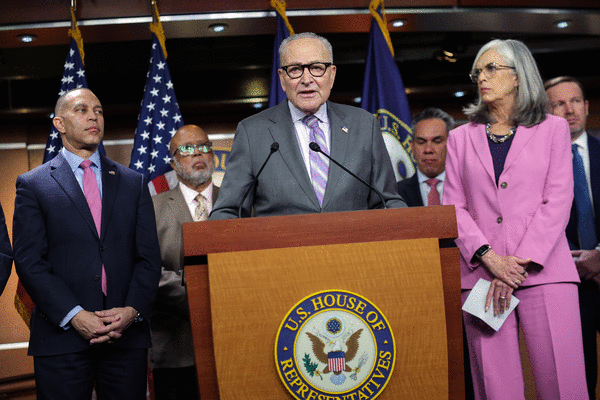
Senate Minority Leader Charles E. Schumer and House Minority Leader Hakeem Jeffries, both New York Democrats, last week outlined their demands for overhauling immigration enforcement policy as part of the negotiations over DHS funding. But there was little reason to believe that either Trump or congressional Republicans would agree to some of the Democratic proposals.
Voter ID bill
In the meantime, the House plans to take up a bill this week that would require American voters to bring photo ID to the polls and provide proof of U.S. citizenship when registering to vote.
The requirements aren’t quite as stringent as in past versions of the bill. For instance, the measure no longer specifically requests that voters show a photo ID that indicates citizenship before casting a ballot. That would have required a passport or an “enhanced” driver’s license, which is offered by just a handful of states.
The latest version of the bill, released Feb. 6, would require only a photo ID. Voters would also need to be notified in advance of the need to bring their identification. And the effective date of the new photo requirement would be pushed back to elections starting in 2027, rather than immediately upon enactment.
Rep. Anna Paulina Luna, R-Fla., and others had threatened to hold up unrelated action on the House floor if the Senate doesn’t act on a voter ID bill.
Procedurally, the House intends to consider the legislation, known as the SAVE America Act, as an amendment to an unrelated Senate-passed bill. That provides some procedural advantages in the Senate, and it effectively means the Democrats cannot filibuster a motion to proceed.
The first major agenda item for the House this week is a broad bipartisan housing bill slated to come up under suspension of the rules, an expedited process requiring a two-thirds majority vote to pass. The bill is intended to increase housing supply, make it less expensive and boost local lending.
There are also some significant hearings this week. The Senate Commerce, Science and Transportation Committee has a hearing scheduled for Tuesday on broadcast media consolidation. The hearing comes after Trump called on regulators to back the effort by Nexstar to acquire rival local television station operator Tegna.
--------
—Aris Folley contributed to this report.
©2026 CQ-Roll Call, Inc., All Rights Reserved. Visit cqrollcall.com. Distributed by Tribune Content Agency, LLC.





















































Comments