Trump warns Iran that time is running out as ships enter region
Published in Political News
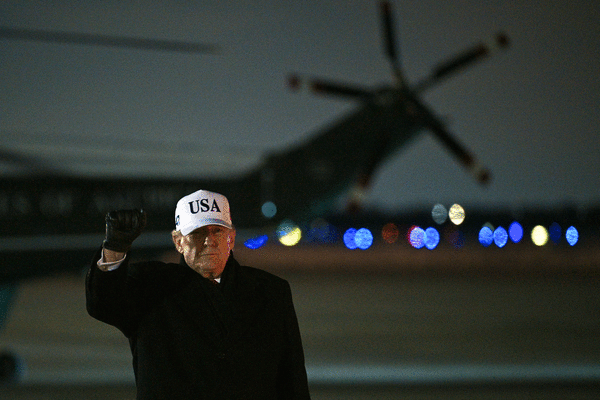
President Donald Trump warned Iran to make a nuclear deal with the U.S. or face military strikes far worse than the attack he ordered last June, increasing pressure on the regime and propelling oil prices higher.
In a social-media post on Wednesday, Trump said the fleet of U.S. ships he’d ordered to the region, led by the USS Abraham Lincoln aircraft carrier, is “ready, willing, and able to rapidly fulfill its mission, with speed and violence, if necessary.”
“Hopefully Iran will quickly ‘Come to the Table’ and negotiate a fair and equitable deal - NO NUCLEAR WEAPONS - one that is good for all parties,” Trump wrote.
In response, Iran said it stands ready for dialogue based on mutual respect and interests but warned that “IF PUSHED, IT WILL DEFEND ITSELF AND RESPOND LIKE NEVER BEFORE,” the country’s mission to the United Nations said in a post on X. Foreign Minister Abbas Araghchi held a series of calls with top regional officials to discuss the escalating situation.
Trump has repeatedly warned Iran that the U.S. might launch another attack, but those threats have recently been linked to Tehran’s deadly crackdown on protests rather than its atomic activities. The U.S. leader has previously said Iran’s nuclear program was “obliterated” in the strikes last June that targeted three facilities across the country.
Iran has long said it doesn’t want to develop nuclear weapons. Notably, in his latest post, Trump didn’t demand that Iran end uranium enrichment, its ballistic-missile program or its funding of anti-U.S. proxy militias, all conditions Iran has balked at previously.
Trump said this month that Iranian officials had reached out to resume negotiations over a deal, which in the past have focused on limits to the country’s nuclear development in exchange for sanctions relief. Signs have emerged in recent months that Iran could restart the program if it wanted. Rafael Mariano Grossi, the director of the United Nations’ nuclear watchdog, said in an interview last week that the country retains its stockpile of highly-enriched uranium.
Trump’s latest remarks sent oil to a fresh four-month high. Brent futures reached $68.19 a barrel after Trump’s post, the highest level since the end of September, extending a 3% jump in the previous session.
Trump has gone back and forth in recent days over whether the U.S. would strike Iran again. He had previously suggested he was less likely to attack after claiming that Iran had agreed not to execute some of the people arrested during the demonstrations.
“We think strikes on Iran are likely, unless the Iranians accept Trump’s extensive demands to decommission their nuclear program — which doesn’t look likely,” Bloomberg Economics analysts Becca Wasser and Dina Esfandiary wrote.
Adding to Iran’s problems, the rial’s slide restarted after stabilizing over the past two weeks. The currency fell to a fresh record of around 1.6 million per dollar on Wednesday, according to bonbast.com, a site that tracks its value on the black market. The rial’s collapse in December was what triggered the protests.
Diplomacy Flurry
Iran has stepped up diplomacy with key powers in the Middle East as it looks to head off more conflict with the U.S. Araghchi held calls on Wednesday with Qatari Prime Minister, Sheikh Mohammed bin Abdulrahman Al Thani and Egypt’s top diplomat, Badr Abdelatty. Araghchi also spoke with his Turkish counterpart, Hakan Fidan, the semi-official Tasnim agency reported, citing an official statement.
Abdelatty separately spoke to U.S. Special Envoy Steve Witkoff about Iran and “creating conditions for the resumption of dialogue between Washington and Tehran,” the semi-official Iranian Students’ News Agency reported, citing an official statement.
The Qatari prime minister also spoke with Ali Larijani, the secretary of Iran’s Supreme National Security Council. Saudi Arabia’s Crown Prince Mohammed bin Salman said Tuesday he won’t allow any of the kingdom’s territories or airspace to be used to carry out military strikes against Iran.
Witkoff and Araghchi led the negotiations over Iran’s nuclear program until the talks were suspended in the wake of the strikes by Israel and the U.S.
Iran’s latest wave of protests erupted on Dec. 28, initially because of a sudden drop in the value of the currency, before evolving nationwide into the strongest rebuke of the Islamic Republic in its history. A subsequent crackdown has killed almost 6,000 civilians, according to the latest data collected by U.S.-based Human Rights Activists Network.
--------
—With assistance from Arsalan Shahla.
©2026 Bloomberg L.P. Visit bloomberg.com. Distributed by Tribune Content Agency, LLC.

















































Comments