After his unexpected death, what will happen to Rep. Doug LaMalfa's district?
Published in Political News
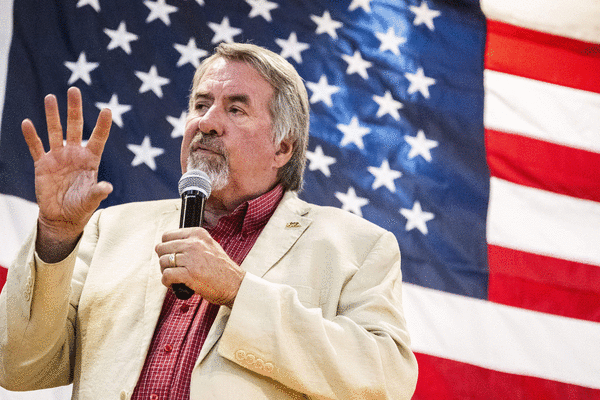
SACRAMENTO, Calif. — Gov. Gavin Newsom must call for a special election in the next two weeks following the unexpected passing of Rep. Doug LaMalfa, R-Calif., early Tuesday morning.
LaMalfa, a fourth-generation rice farmer who had served in the House since 2012, died during surgery after he suffered a medical emergency on Monday night, according to the Butte County Sheriff’s Office.
The conservative legislator’s death creates an opening in the House, where Republicans now maintain a razor-thin 218-213 majority over Democrats after Georgia Rep. Marjorie Taylor Greene resigned Monday.
Under state law, Newsom must now call a special election in the next two weeks. After he issues that proclamation, a special election must take place no later than 140 days after to determine a successor who will serve out the remainder of LaMalfa’s current term, which ends in January 2027.
That means a special election will likely take place in late May or early June, around the time of the June 2 gubernatorial primary election.
In November, voters passed Proposition 50, which redrew California’s congressional lines to shore up Democratic districts starting with the November 2026 midterm cycle.
Under that initiative, LaMalfa’s district was shifted south to include more liberal Bay Area residents, starting in the November 2026 midterms.
LaMalfa represented the state’s 1st congressional district, which spans much of the north state up to the Oregon border, a reliably conservative and mostly rural agrarian area.
Under state law, because the district representative vacated before those new lines went into effect, the successor will be elected to represent the current district, according to redistricting expert Paul Mitchell.
A handful of candidates have declared their intention to run for the new district, like previous LaMalfa opponent Audrey Denney and Sen. Mike McGuire, D-Healdsburg.
In addition to the special primary election for LaMalfa’s successor, another election will take place for someone to represent the newly drawn 1st District, which will include voters from more liberal-leaning Sonoma and Napa counties, Mitchell said.
“The most likely scenario will be that Newsom will call a special election concurrent with the June primary, with a runoff election to take place in November,” Mitchell wrote online.
“This means that the very likely Republican replacement won’t be seated until December and be a member of Congress for a month” following the election of a more liberal successor to serve the newly redrawn 1st congressional district, he said.
House Republicans have struggled all year to cobble together majorities to pass Trump’s agenda. LaMalfa’s death, coming at the same time Taylor Greene resigned, makes the task even more difficult.
“Rep. LaMalfa’s unexpected passing along with Rep. Marjorie Taylor Greene’s resignation will make it much harder for Republican Speaker Mike Johnson to govern,” said Christian Grose, academic director of the University of Southern California Schwarzenegger Institute. “Johnson has already had trouble managing his narrow Republican majority, and this reduction in the U.S. House margin will only make it harder for him.”
The GOP’s thin majority, combined with another Democrat’s expected swearing-in next month, means Speaker Mike Johnson, R-La., can afford to lose only one vote since legislation loses on a tie.
Getting Republican legislation is therefore going to get even tougher. On two key issues recently, Johnson lost just enough Republicans to force votes on matters Trump has not supported.
Enough Republicans joined all Democrats to force a vote on releasing Justice Department files on convicted sex trafficker Jeffrey Epstein. And enough Republicans backed a Democratic-led effort to extend enhanced health care subsidies so that the House is likely to vote on a three-year extension on Thursday.
“The speaker has had very few votes to spare even at full strength,” said Kyle Kondik, managing editor of Stabato’s Crystal Ball, which analyzes congressional races.
The next big battle could involve government spending. Much of the government’s funding is due to end January 30. The last time that happened, it triggered a 43-day shutdown that ended in November.
The difference this year is that it’s an election year. And Inside Elections, a nonpartisan organization that analyzes congressional races, rates eight Republican congressmen as very vulnerable.
“With Trump’s unpopularity and the widening divides with the GOP House majority, Johnson will have a lot of trouble,” Grose said. Expect more gridlock and more efforts pushed by Democrats that attract just enough Republicans to win.
“Speaker Johnson is in serious trouble in terms of his ability to govern given these incredibly narrow majorities not seen in many years in U.S. history,” he said.
©2026 The Sacramento Bee. Visit sacbee.com. Distributed by Tribune Content Agency, LLC.


















































Comments