Commentary: Donald Trump is conducting a secret war
Published in Political News
Covert operations are nothing new for the United States. Throughout its history, the U.S. has overthrown governments it didn’t like, supported insurgencies to complicate the goals of its adversaries and organized coups to subvert politicians perceived as being hostile to American interests.
The list of examples is long: to name just a few, the 1953 coup in Iran, the 1954 coup in Guatemala, the 1961 Bay of Pigs operation in Cuba and the attempt in 1970 to block Salvador Allende from becoming Chile’s president.
Yet it’s rare when the United States wages a war without providing the American people with basic information. Even the 2003 war in Iraq, rightly maligned as one of the biggest U.S. foreign policy catastrophes in history, was a relatively transparent affair. Public debate about whether to invade Iraq was sparked almost immediately after the 9/11 attacks and continued until the military campaign began in March 2003. Despite the false intelligence, baseless assumptions and disinformation peddled by the George W. Bush administration — the most prominent being that Iraqi dictator Saddam Hussein had a strategic alliance with Osama bin Laden’s al-Qaida and a huge chemical weapons program — there were numerous public hearings in which lawmakers were able to grill U.S. officials. T he Bush administration made its case to Congress.
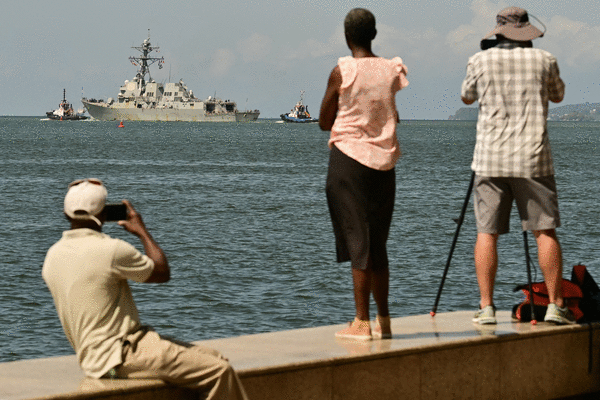
Twenty-two years later, the United States is engaged in another war, this time supposedly against drug traffickers in the Western Hemisphere. Venezuelan dictator Nicolás Maduro has taken Hussein’s place as the reviled dictator. The Trump administration alleges he is the head of a grand conspiracy to flood the United States with cocaine and criminals. Though Trump has yet to give orders to bomb Venezuelan military targets or cocaine transit points on land, preferring to stick with attacking boats and killing its occupants whom the White House claims are trafficking drugs. Still, the build-up of U.S. naval assets off Venezuela’s coast, as well as the beginning of a campaign to seize Venezuelan oil tankers on the high seas, means military escalation is not off the table.
All of this is occurring without the most basic accountability. In fact, Trump hasn’t even bothered to make a coherent case to the American people about why U.S. military action off Venezuela’s coast — and perhaps inside Venezuela — is in our national interest. To the extent Americans have been given any information at all, it generally has been limited to Pentagon-produced videos of boats being blown up and assertions, many unsubstantiated, from Trump about Maduro emptying Venezuela’s prisons and partnering with the Tren de Aragua gang.
According to a CBS poll conducted last month, only 24% of Americans believe the Trump administration has clearly explained its position on military action in Venezuela. To be frank, Trump is lucky to have even this support because there are so many questions, including the legal justification for the ongoing boat strikes, which have killed nearly 90 people over the last three months. The Department of Justice’s Office of Legal Counsel asserts that because the cartels are selling drugs that can kill Americans, they are in effect attacking the United States and are therefore legitimate targets. Those are substantial legal claims without precedent, and the legal memo outlining the theory remains under lock and key somewhere in the executive branch. Senior lawmakers have been briefed on the memo’s contents, yet the Trump administration refuses to release a summary of the legal arguments, let alone the full document. American citizens are the ultimate losers here; their government is waging a war in their name based on a rationale they have to swallow without scrutiny.
In addition, the White House claims that designating cartels and other gangs in Latin America as foreign terrorist organizations provides Trump with the power to target them militarily. That is not at all what the law says: A foreign terrorist organization designation permits the Treasury Department to freeze the group’s assets, and group members can be subjected to hefty fines and a 20-year prison sentence if convicted in a court of law. But that is practically brushed under the carpet as inconsequential. Again, Trump’s basis for making this extra-legal determination is kept out of the public domain. The full list of foreign terrorist organizations in Latin America now ripe for U.S. targeting is treated as a state secret.
Unfortunately, the U.S. strikes on the boats are happening with regularity, and Americans are pretty much in the dark on this as well. The Trump administration argues all of the people on these boats are drug smugglers, but no actual evidence has been disclosed to support this assertion. We’re told the boats are bringing cocaine to the United States, but the White House hasn’t bothered to publicize evidence of this either. The rules of engagement are vague too. For instance, if there are survivors after a U.S. strike, what is the U.S. military supposed to do? It appears the Pentagon is making it up as the campaign goes along. In one case, Adm. Frank “Mitch” Bradley, head of U.S. Special Operations Command, ordered a follow-up strike to kill two people who survived a first attack. In other cases, survivors were rescued survivors and repatriated to their home countries.
The lack of transparency thus far is stunning. The ongoing war against narcotraffickers in the Western Hemisphere is one of the most secret military campaigns the United States has ever conducted.
____
Daniel DePetris is a fellow at Defense Priorities and a foreign affairs columnist for the Chicago Tribune.
___
©2025 Chicago Tribune. Visit at chicagotribune.com. Distributed by Tribune Content Agency, LLC.

















































Comments