Supreme Court sounds ready to void state 'conversion therapy' ban
Published in Political News
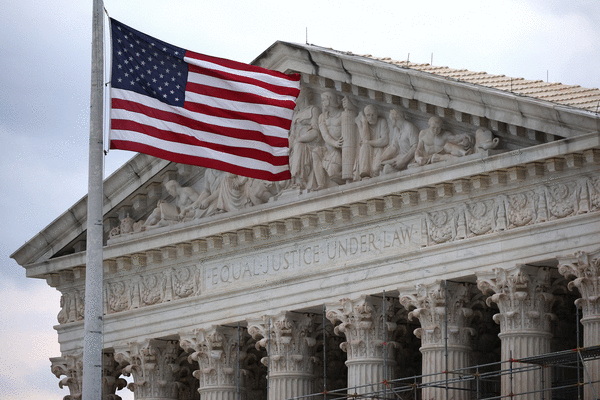
WASHINGTON — The Supreme Court appeared ready Tuesday to rule against a Colorado law that bans so-called “conversion therapy” for minors in counseling, with several justices during oral arguments expressing concerns that it limits free speech.
Licensed counselor Kaley Chiles appealed a decision by the U.S. Court of Appeals for the 10th Circuit that upheld the Colorado law as a regulation on professional conduct by medical professionals, rather than just a limit on what can be said to patients.
The law prohibits any practice that “attempts or purports to change an individual’s sexual orientation or gender identity.” More than two dozen states nationwide have similar laws, and the Trump administration also weighed in, asking the justices to curtail the law.
Justice Samuel A. Alito Jr. pressed an attorney for Colorado about whether the law unlawfully punishes a particular belief about conversion therapy. “It’s like blatant viewpoint discrimination,” Alito said.
Several conservative members of the court, including Chief Justice John G. Roberts Jr., asked questions that differentiated between advice given by a medical professional and the actual conduct of a medical professional, saying the former may have greater legal protections.
Experts and the parties have said the case turns on whether the justices decide the law restricts the speech of Chiles, or both her speech and professional conduct. If it’s only the speech, the law must pass a more rigorous legal standard, known as strict scrutiny, that could doom it.
An attorney for Chiles, James A. Campbell, argued that the ban violates her free speech rights, and she should be able to counsel patients about their desired sexual preferences regardless of the state law regulating counselors’ practices.
Campbell argued that upholding Colorado’s law would allow states to ban all sorts of viewpoints from counselors.
“That would allow states to silence all kinds of speech in the counseling room, such as disfavored views on divorce or abortion. If heightened scrutiny doesn’t apply, states can transform counselors into the mouthpieces for the government,” Campbell said.
Justice Neil M. Gorsuch also pointed out that the rationale for Colorado’s law would also allow a state to ban therapy that supported homosexuality or gender transition.
The Trump administration also argued in favor of Chiles, claiming that the Colorado law violated her free speech rights. Hashim Mooppan, arguing for the Justice Department, said the law doesn’t get a free speech exemption just because it is dealing with licensed professionals.
Justice Amy Coney Barrett also questioned several times whether the justices should apply the higher legal standard on their own or send it back to the lower court to do so. Both Campbell and Mooppan urged the justices to apply the test and strike down the law rather than let the case continue.
An attorney for Colorado argued the law falls within state authority to regulate professions whose jobs involve talking with clients, and that research has shown conversion therapy is ineffective.
Shannon W. Stevenson, Colorado’s solicitor general, said the state should be able to regulate what is considered proper medical care.
“People have been trying to do conversion therapy for 100 years with no record of success. There is no study, despite the fact that people tried to advance this practice, that has ever shown that it has any chance of being efficacious,” Stevenson said.
Stevenson said the law only applies to licensed, professional counselors who have a fiduciary responsibility to their clients — and does not apply to people like religious ministers and life coaches.
Justice Sonia Sotomayor, one of the court’s Democratic appointees, said it “gives her pause” that Colorado has tried to justify its law while not presenting studies that show talk conversion therapy specifically is harmful, rather than conversion therapy more broadly.
Justice Ketanji Brown Jackson compared the case to a dispute last term, in which the justices upheld a Tennessee law banning gender affirming care for minors in a case called U.S. v. Skrmetti.
“It just seems odd to me that we might have a different result,” if the court overturned Colorado’s law, but upheld Tennessee’s, Jackson said.
The case is the latest in a series of clashes between state laws protecting LGBTQ populations and free speech rights that have reached the Supreme Court in recent years. Two years ago, the court decided in favor of a website designer who argued that Colorado anti-discrimination law would have violated her free speech rights in 303 Creative v. Elenis.
The justices will likely issue a decision in the case before the conclusion of the court’s term at the end of June.
The case is Kaley Chiles v. Patty Salazar in Her Official Capacity as Executive Director of the Colorado Department of Regulatory Agencies, et al.
©2025 CQ-Roll Call, Inc., All Rights Reserved. Visit cqrollcall.com. Distributed by Tribune Content Agency, LLC.



















































Comments