Tariffs and birthright citizenship will test whether Trump's power has limits
Published in Political News
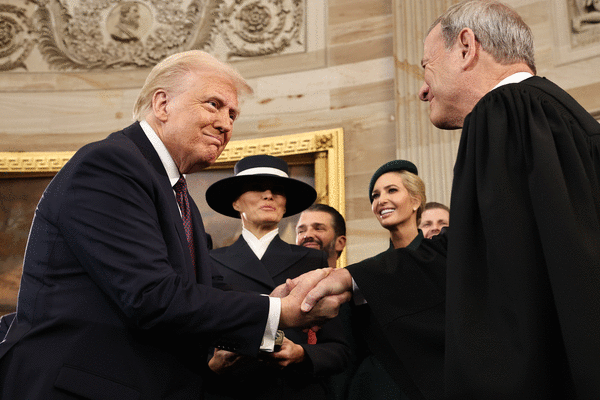
Supreme Court justices like to talk about the Constitution's separation of powers and how it limits the exercise of official authority.
But Chief Justice John G. Roberts and his conservative colleagues have given no sign so far they will check President Trump's one-man governance by executive order.
To the contrary, the conservative justices have repeatedly ruled for Trump on fast-track appeals and overturned federal judges who said the president had exceeded his authority.
The court's new term opens on Monday, and the justices will begin hearing arguments.
But those regularly scheduled cases have been overshadowed by Trump's relentless drive to remake the government, to punish his political enemies, including universities, law firms, TV networks and prominent Democrats, and to send troops to patrol U.S. cities.
The overriding question has become: Are there any legal limits on the president's power? The Supreme Court itself has raised the doubts.
A year ago, as Trump ran to reclaim the White House, the justices blocked a felony criminal indictment against him related to his role in the Jan. 6, 2021, mob attack on the Capitol as Congress met to certify Trump's defeat in the 2020 election, for which Trump was impeached.
Led by Roberts, the court ruled for Trump and declared for the first time that presidents were immune from being prosecuted for their official actions in the White House.
Not surprisingly, Trump saw this as a "BIG WIN" and proof there is no legal check on his power.
This year, Trump's lawyers have confidently gone to Supreme Court with emergency appeals when lower-court judges have stood in their way. With few exceptions, they have won, often over dissents from the court's three liberal Democrats.
Many court scholars say they are disappointed but not surprised by the court's response so far to Trump's aggressive use of executive power.
The Supreme Court "has been a rubber stamp approving Trump's actions," said UC Berkeley law Dean Erwin Chemerinsky. "I hope very much that the court will be a check on Trump. There isn't any other. But so far, it has not played that role."
Roberts "had been seen as a Republican but not a Trump Republican. But he doesn't seem interested or willing to put any limits on him," said UCLA law professor Adam Winkler. "Maybe they think they're saving their credibility for when it really counts."
Acting on his own, Trump moved quickly to reshape the federal government. He ordered cuts in spending and staffing at federal agencies and fired inspectors general and officials of independent agencies who had fixed terms set by Congress. He stepped up arrests and deportations of immigrants who are here illegally.
But the court's decisions on those fronts are in keeping with the long-standing views of the conservatives on the bench.
Long before Trump ran for office, Roberts had argued that the Constitution gives the president broad executive authority to control federal agencies, including the power to fire officials who disagree with him.
The court's conservatives also think the president has the authority to enforce — or not enforce — immigration laws.
That's also why many legal experts think the year ahead will provide a better test of the Supreme Court and Trump's challenge to the constitutional order.
"Overall, my reaction is that it's too soon to tell," said William Baude, a University of Chicago law professor and a former clerk for Roberts. "In the next year, we will likely see decisions about tariffs, birthright citizenship, alien enemies and perhaps more, and we'll know a lot more."
In early September, Trump administration lawyers rushed the tariffs case to the Supreme Court because they believed it was better to lose sooner rather than later.
Treasury Secretary Scott Bessent said the government could face up to a $1-trillion problem if the court delayed a decision until next summer and then ruled the tariffs were illegal.
"Unwinding them could cause significant disruption," he told the court.
The Constitution says tariffs, taxes and raising revenue are matters for Congress to decide. Through most of American history, tariffs funded much of the federal government. That began to change after 1913 when the 16th Amendment was adopted to authorize "taxes on incomes."
Trump has said he would like to return to an earlier era when import taxes funded the government.
"I always say 'tariffs' is the most beautiful word to me in the dictionary," he said at a rally after his inauguration in January. "Because tariffs are going to make us rich as hell. It's going to bring our country's businesses back that left us."
While he could have gone to the Republican-controlled Congress to get approval, he imposed several rounds of large and worldwide tariffs acting on his own.
Several small businesses sued and described the tariffs as "the largest peacetime tax increase in American history."
As for legal justification, the president's lawyers pointed to the International Emergency Economic Powers Act of 1977. It authorizes the president to "deal with any unusual or extraordinary threat ... to the national security, foreign policy or economy of the United States."
The law did not mention tariffs, taxes or duties but said the president could "regulate" the "importation" of products.
Trump administration lawyers argue that the "power to 'regulate importation' plainly encompasses the power to impose tariffs." They also say the court should defer to the president because tariffs involve foreign affairs and national security.
They said the president invoked the tariffs not to raise revenue but to "rectify America's country-killing trade deficits and to stem the flood of fentanyl and other lethal drugs across our borders."
In response to lawsuits from small businesses and several states, judges who handle international trade cases ruled the tariffs were illegal. However, they agreed to keep them in place to allow for appeals.
Their opinion relied in part on recent Supreme Court's decisions which struck down potentially far-reaching regulations from Democratic presidents on climate change, student loan debt and COVID-19 vaccine requirements. In each of the decisions, Roberts said Congress had not clearly authorized the disputed regulations.
Citing that principle, the federal circuit court said it "seems unlikely that Congress intended to ... grant the president unlimited authority to impose tariffs."
Trump said that decision, if allowed to stand, "could literally destroy the United States of America." The court agreed to hear arguments in the tariffs case on Nov. 5.
A victory for Trump would be "viewed as a dramatic expansion of presidential power," said Washington attorney Stephanie Connor, who works on tariff cases. Trump and future presidents could sidestep Congress to impose tariffs simply by citing an emergency, she said.
But the decision itself may have a limited impact because the administration has announced new tariffs last week that were based on other national security laws.
Last month, Trump administration lawyers asked the Supreme Court to rule during the upcoming term on the birthright citizenship promised by the 14th Amendment of 1868.
They did not seek a fast-track ruling, however. Instead, they said the court should grant review and hear arguments on the regular schedule early next year. If so, a decision would be handed down by late June.
The amendment says: "All persons born or naturalized in the United States and subject to the jurisdiction thereof are citizens of the United States."
And in the past, both Congress and the Supreme Court have agreed that rule applies broadly to all children who are born here, except if their parents are foreign ambassadors or diplomats who are not subject to U.S. laws.
But Trump Solicitor Gen. D. John Sauer said that interpretation is mistaken. He said the post-Civil War amendment was "adopted to grant citizenship to freed slaves and their children, not to the children of illegal aliens, birth tourists and temporary visitors."
Judges in three regions of the country have rejected Trump's limits on the citizenship rule and blocked it from taking effect nationwide while the litigation continues.
_____
©2025 Los Angeles Times. Visit latimes.com. Distributed by Tribune Content Agency, LLC.


















































Comments