Seattle mayoral debate: Bruce Harrell, Katie Wilson spar on top issues
Published in Political News
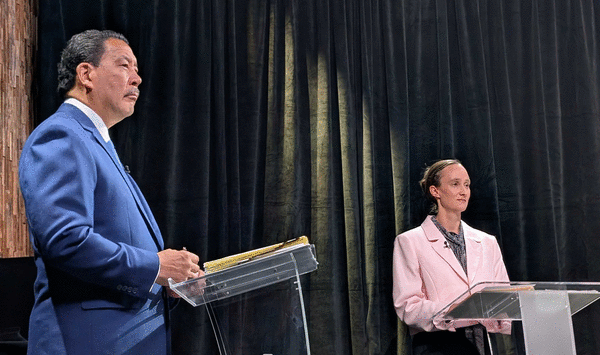
SEATTLE — Seattle Mayor Bruce Harrell and challenger Katie Wilson sparred over Harrell’s tenure and Wilson’s activism in a bruising debate Friday night as their contest to lead Washington’s biggest city entered its final month.
Harrell and Wilson also tackled questions about affordability, policing and homelessness in the live debate hosted by The Seattle Times and KING 5, which included intense exchanges between the candidates.
Harell repeatedly accused Wilson of lacking managerial experience, saying she “has never hired one employee,” while Wilson knocked Harrell for making inadequate progress on crime and homelessness, saying voters can look with their “own eyes and see what we’re doing right now is not working.”
The debate played out at a crucial time for Harrell and Wilson, who are racing head-to-head toward the Nov. 4 general election. Ballots will be mailed Oct. 17, giving the candidates just a couple more weeks to campaign before voters start making decisions about where to steer the city.
Harrell is trying to rebound from a weak Aug. 5 primary, which saw left-lane challengers in several Seattle contests outperform centrist opponents.
The incumbent, a business-backed former City Council member, garnered 41% of the vote in the eight-candidate primary, while Wilson notched 51%. The challenger, a progressive advocate and policy wonk seeking elected office for the first time, is working to build on her momentum from the primary.
Their mayoral matchup pits a longtime politician with deep local roots against a community organizer with an urbanist bent, and those significant contrasts began to sharpen almost immediately as Friday’s debate began.
Asked to explain why voters who want a “change agent” should stick with a multidecade politician like Harrell, the current mayor mentioned civil rights policies he helped pass as a council member and his work as mayor to move the Seattle Police Department past federal court oversight.
“If you want change, that’s been my life story,” he said.
Pressed to explain why voters should put their trust in Wilson, who didn’t complete college and has only managed a small nonprofit, the challenger said she’s spent 14 years building support from the outside for policies like a corporate tax that's plugged Seattle's budget holes and funded more housing and social services.
That experience has given her a window into “how City Hall works and how, too often, it fails to work,” Wilson said.
Seattle is one of the country’s most expensive cities, partly because housing costs are so high. Harrell cited macroeconomic conditions as responsible and said his administration has budgeted significant funding for subsidized housing. Wilson slammed the mayor’s stance on a recent “social housing” ballot measure and said he should be pushing for more new apartments off busy arterial roads.
The challenger said more housing in the city would help small-business owners retain employees who currently have to commute long distances, and she said Harrell’s ramped-up homeless encampment removals are hurting business owners by pushing people from doorstep to doorstep.
We know what works," Wilson said, saying people on the streets need more support than they are getting.
Harrell defended his administration’s efforts to assist business owners and shelter homeless people, while arguing other regional cities must do more to help.
Coming into the debate, Harrell’s task was to remind voters why they picked him before and persuade them he’s made progress at City Hall. Wilson needed to expand her reach and stand her ground against Harrell’s broadsides.
Harrell, 66, worked as an attorney before serving as a council member for a decade, pushing for policies like police body cameras and providing swing votes. His choice to leave the council in 2019 meant he was gone in 2020 as bitter disagreements over pandemic cuts and police funding roiled City Hall.
Those conditions paved the way for Harrell’s successful 2021 campaign, which vowed to clean up Seattle’s streets and restore public order while also touting the candidate’s multiracial heritage and college football stardom.
Supporters argue he’s made good on his core promise, describing downtown Seattle, especially, as cleaner and safer. Critics say he’s allowed the city’s affordability woes to worsen, among other things.
Wilson, 43, moved to Seattle in 2004 and, after working a series of other jobs, started a progressive nonprofit called the Transit Riders Union.
Better known in political and activist circles than as a public figure, she gained a reputation as a coalition builder in ensuing years, with her organization pushing leaders in Seattle and nearby suburbs to bolster bus service, tax the wealthy and pass renter protections.
Boosters say she’ll represent working people better than Harrell, who they describe as beholden to corporate interests, and compare her to anti-establishment New York City mayoral candidate Zohran Mamdani. Now that Wilson is stepping into the spotlight, critics are casting her as an idealistic and untested lightweight.
In Friday's debate, Wilson slammed Harrell’s Seattle Police Department, where discrimination lawsuits and leadership changes have caused turmoil in recent years, saying Harrell stood by then-Chief Adrian Diaz for “far too long” after misdeed allegations emerged.
Harrell went after Wilson for supporting police defunding proposals amid racial justice protests in 2020, saying crime is decreasing under his watch because his administration has worked to improve officer hiring and morale.
Wilson said she’s learned a lot since 2020 and supports a police department “that is adequately staffed, responsive and accountable.
Wilson has made new taxes central to her campaign, arguing Seattle must ask large corporations and wealthy individuals to help close the city’s recurring budget gap and address social issues. On Friday, Harrell touted an upcoming ballot measure to reform the city’s business tax and raise additional funds, which Wilson called “a couple years too late.”
A tense moment came when Wilson, as she criticized Harrell for irresponsible spending and doling out dollars during an election year, said the mayor “wants to give his people things.” Harrell bristled at that, saying he hoped Wilson wasn’t referring to a reparations fund for Black residents aimed at countering racist historical practices like redlining. In a brief interview after the debate, Wilson said her point was that she thinks Harrell has been using government decisions to maintain a reelection coalition rather than to advance a vision for the city.
Just this week, President Donald Trump announced he wants to deploy the National Guard in Portland, Oregon, to protect U.S. Immigration and Customs Enforcement facilities, and it’s possible that Seattle’s mayor could face a similar scenario.
Responding to that possibility, Wilson said she would move in lock step with other Washington state leaders to keep Seattle’s most vulnerable residents safe. Harrell called that a “strong answer” but argued he could better stand up to Trump, noting his Japanese American mother was incarcerated during World War II.
Wilson then mentioned an expansion of police video surveillance in Seattle that Harrell recently helped pass, warning the Trump administration could use that data to target people here. Harrell dismissed the idea that Trump could access the video, saying the city would, in an emergency case, “shut it down.”
Before signing off, Wilson cast the race as a “choice between the status quo and someone who will fight for change.” Harrell said voters will be choosing between “someone who advocated for police defunding or someone who knows how to build” a safer system.
Harrell is endorsed by many Washington politicians, including Gov. Bob Ferguson and Attorney General Nick Brown, and by unions that represent long-term care and construction workers. He also recently snagged an endorsement from Pete Buttigieg, the former U.S. transportation secretary.
Wilson is supported by a slew of local Democratic Party groups and has added prominent endorsers since her strong showing in the August primary, including unions that represent grocery and city workers. On Friday, U.S. Rep. Pramila Jayapal, who previously endorsed Harrell, also endorsed Wilson.
© 2025 The Seattle Times. Visit www.seattletimes.com. Distributed by Tribune Content Agency, LLC.




















































Comments