Trump-Democrats meeting drama fuels risk of shutdown
Published in Political News
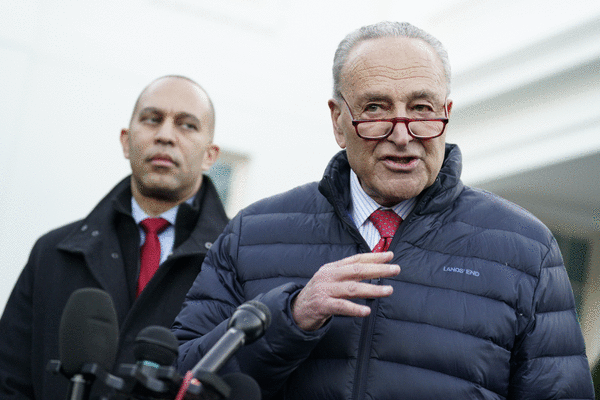
WASHINGTON — President Donald Trump’s abrupt decision to cancel a planned meeting with top Democratic leaders is only the latest twist in a funding standoff that threatens to trigger a partial government shutdown next week.
As Republicans push for a “clean,” seven-week funding extension to avoid a shutdown, Democrats are determined to use their leverage on that bill by demanding a fix for expiring health insurance subsidies that could swell the ranks of the uninsured.
And with neither side willing to blink so far, the tit-for-tat verbal jousting playing out on social media may be inching the country closer to a shutdown that neither party claims to want.
Less than 24 hours after agreeing to sit down with Senate Minority Leader Charles E. Schumer, D-N.Y., and House Minority Leader Hakeem Jeffries, D-N.Y., the president reversed course, saying there was nothing to discuss until Democrats abandon their demands for massive spending and other “radical” policies.
“After reviewing the details of the unserious and ridiculous demands being made by the Minority Radical Left Democrats in return for their Votes to keep our thriving Country open, I have decided that no meeting with their Congressional Leaders could possibly be productive,” Trump wrote on his Truth Social media platform.
“There are consequences to losing Elections but, based on their letter to me, the Democrats haven’t figured that out yet,” he said in rejecting the request for a meeting Democrats made over the weekend.
Democratic response
Jeffries and Schumer wasted no time in firing back Tuesday, issuing a fusillade of tweets and statements before holding separate news conferences in New York denouncing the decision.
“Donald Trump has now chickened out and cancelled the meeting,” Jeffries wrote in a letter to his Democratic caucus. “Clearly, GOP extremists want to shut down the government because they are unwilling to address the Republican healthcare crisis that is devastating America.”
Jeffries also announced plans to hold a caucus conference call on Friday “to discuss the path forward,” along with a second caucus meeting in Washington on Sept. 29, even though the House is no longer scheduled to be in session that week.
House Republicans have frowned on opening talks with Democrats after the chamber passed a seven-week funding extension last week in a party-line vote. In hopes of increasing pressure on the Senate to clear that measure, House leaders canceled the two days they were scheduled to be in session next week before the Sept. 30 deadline, when current funding is set to expire.
Before news of the meeting’s cancellation broke, Speaker Mike Johnson, R-La., told reporters that he would attend the White House session if it occurs. “But I’m not certain that the meeting is necessary,” he said.
Shutdown countdown
Scratching the meeting increases the likelihood that a partial shutdown will be triggered when the new fiscal year begins on Oct. 1. The Senate rejected the House-passed continuing resolution last week as well as a Democratic alternative that sought to extend expiring health insurance subsidies.
“Donald Trump can’t even negotiate a budget bill with Democrats, this great negotiator,” Schumer said sarcastically at a Brooklyn news conference late Tuesday. “He’s not up to this job, plain and simple.”
Even before the flare-up over health subsidies, however, Democrats had grown irritated by Trump administration moves to claw back previously approved funding that they said threatened to undermine the congressional power of the purse. Over Democratic objections, Congress passed a White House rescissions request to claw back $9 billion in foreign aid and public broadcasting funding in July.
White House budget director Russ Vought then upped the ante by notifying Congress last month of plans to claw back another $4.9 billion in foreign aid in the closing days of this fiscal year without any congressional approval through a “pocket rescission” that has already triggered court challenges.
“None of us should want to hand the pen over to Russ Vought and give him or Trump or anyone else at the White House any more power over federal spending,” Senate Appropriations ranking Democrat Patty Murray of Washington said on the floor last week, urging the Senate to reject the GOP’s short-term funding patch.
In announcing his sudden reversal, Trump railed against Democrats for pushing “over $1 trillion in new spending” for health care, opening the country’s borders to undocumented migrants and “essentially create Transgender operations for everybody.”
“To the Leaders of the Democrat Party, the ball is in your court,” Trump wrote. “I look forward to meeting with you when you become realistic about the things that our Country stands for. DO THE RIGHT THING!”
But Democrats showed no sign of yielding ground. “All Trump does is break promises and make working Americans’ lives worse,” said Democratic National Committee Chairman Ken Martin, in a statement. “Trump owns this shutdown.”
Health insurance
At the heart of the dispute is how to address the expiration of health insurance subsidies, a politically fraught issue for vulnerable Republicans ahead of the 2026 midterms. Roughly 2.2 million individuals with marketplace coverage could face higher monthly premiums absent an extension, and the Congressional Budget Office predicts 4.2 million would lose their health insurance over the next 10 years because of rising costs.
While GOP leaders have expressed a willingness to consider an extension, they say it must come with tighter income limits and guardrails against fraud. And they have repeatedly rejected the idea of negotiating a compromise as part of the short-term stopgap spending bill. Johnson has said the health subsidies question is “a December policy issue, not a September funding issue.”
But Democrats and insurers say an extension is necessary before the exchanges’ open enrollment period begins on Nov. 1. Health insurers typically send final rate notices for 2026 premiums out by the end of September. This year, the Centers for Medicare and Medicaid Services had required plans for final rates to be submitted by Sept. 19 because of ongoing litigation.
GOP moderates in both chambers have been seeking a middle ground in hopes of ending the impasse. Sen. Lisa Murkowski, R-Alaska, introduced legislation that would extend the expiring health tax credits until Jan. 1, 2028, instead of the permanent extension sought by Democrats.
But her bill would not change the current income thresholds that Republican leaders argue benefit too many upper-income households. Prior to changes Democrats made in 2021, eligibility for the premium tax credits was capped at 400% of the poverty level.
And in the House, Rep. Jen Kiggans, R-Va., led 12 Republican co-sponsors on legislation that would extend the expanded subsidies for one year. Nine Democrats have signed on as co-sponsors.
At a Brooklyn news conference Tuesday, Jeffries told reporters that Democrats were open to negotiate whenever GOP leaders wanted. “Leader Schumer and I are ready to meet with anyone, anytime, at any place to discuss the issues that matter to the American people and avoid a painful Republican-caused government shutdown,” he said.
And Trump, who is known to change his mind, left himself room to reverse course again. “I look forward to meeting with them if they get serious about the future of our Nation,” the president wrote.
---------
—John T. Bennett and Ariel Cohen contributed to this report.
©2025 CQ-Roll Call, Inc., All Rights Reserved. Visit cqrollcall.com. Distributed by Tribune Content Agency, LLC.



















































Comments