'Extremely chaotic.' Tech industry rattled by Trump's $100,000 H-1B visa fee
Published in Political News
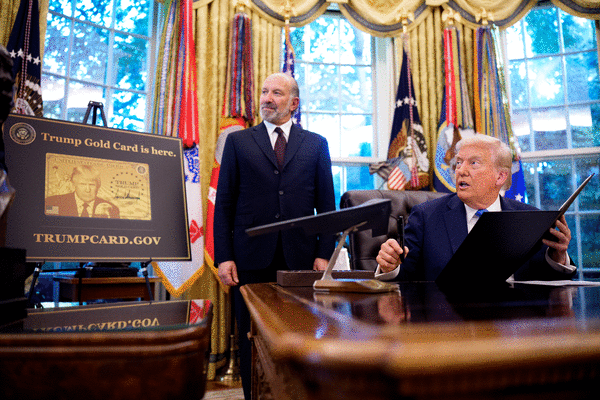
President Donald Trump’s new sky-high visa fees have shaken Silicon Valley’s tech giants as they contemplate a surge in the cost of hiring global talent and a new tactic the White House can use to keep Silicon Valley in line.
The tech industry was already navigating an economy with higher and unpredictable tariffs, when last week the Trump administration threw another curveball aimed directly at its bottom line: a $100,000 fee for the visas used to hire certain skilled foreign workers. The industry relies heavily on the H-1B visa program to bring in a wide range of engineers, coders, and other top talent to the United States.
The rollout has sparked confusion among businesses, immigration lawyers and current H-1B visa holders.
Over the weekend, the Trump administration clarified that the new fee will apply to new visas, isn’t annual and doesn’t prevent current H-1B visa holders from traveling in and outside of the country. Companies would have to pay the fee with any new H-1B visa petitions submitted after a specific time on Sept. 21, the White House said.
On Monday, the Trump administration also clarified that certain professions, such as doctors, may be exempt from the fee. Some observers are concerned that a selective application of the fee could be a way the White House can reward its friends and punish its detractors.
Meta, Apple, Google, Amazon and Microsoft have been strengthening their ties with the Trump administration by committing to invest hundreds of billions of dollars in the United States.
Still, immigration has long been a contentious issue between the Trump administration and tech executives, some of whom were on a H-1B visa before they co-founded or led some of the world’s largest tech companies.
One of the most vocal supporters of the H-1B visas: Elon Musk, who backed Trump but has publicly sparred with him after he led the federal government’s efforts to slash spending. Musk, who runs multiple companies, including Tesla, SpaceX and xAI, is a naturalized U.S. citizen born in South Africa and has held an H-1B visa.
Tech executives have said the H-1B visa program has been crucial for hiring skilled workers. Competition to attract the world’s best talent has been intensifying since the popularity of OpenAI’s ChatGPT sparked a fierce race to rapidly advance artificial intelligence.
The new fee could slow California’s development and the United States’ position in the AI race by making it tougher for companies — especially startups with less money — to bring in international employees, experts said.
So far this fiscal year, more than 7,500 companies in California have applied for H-1B visas and 61,841 have been approved, data from the U.S. Citizenship and Immigration Services shows.
Tech companies use the visa program to hire computer scientists and engineers because the U.S. isn’t producing enough workers with the skills needed, said Darrell West, a senior fellow in the Center for Technology Innovation at the Brookings Institution.
Trump “likes to talk tough on immigration, but he fails to recognize how important immigrants are to our economy,” he said. “Companies in technology, agriculture, hotels, restaurants and construction rely heavily on immigrants, and slowing that flow is going to be devastating for companies in those areas.”
In his executive order, the Trump administration noted that some companies, such as information technology firms, have allegedly misused the program, citing mass layoffs in the tech industry and the difficulty young college graduates face in landing jobs.
“President Trump promised to put American workers first, and this commonsense action does just that by discouraging companies from spamming the system and driving down American wages,” Taylor Rogers, a White House spokesperson, said in a statement.
Economists and tech executives, though, have pointed to other factors affecting hiring, including economic uncertainty from tariffs, a shift in investments and the rise of AI tools that could complete tasks typically filled by entry-level workers.
California’s unemployment rate of 5.5% in August was higher than the U.S. unemployment rate of 4.3%, according to the U.S. Bureau of Labor Statistics.
The rollout of the new changes has been “extremely chaotic,” and while the White House has tried to clear up some of the confusion, tech companies still have a lot of questions about how the fee would work, said Adam Kovacevich, chief executive of the Chamber of Progress, a center-left tech industry policy coalition.
“You never know what you’re gonna end up with the final policy in Trump world,” he said. “Somebody within the administration drives an announcement, there’s blowback, and then they end up modifying their plans.”
Tech companies have been trying to navigate a fine line in their relationship with Trump.
During Trump’s first term, high-profile tech executives, including those from Meta, Amazon, Google and Apple, spoke out about his administration’s order to restrict travel from several majority-Muslim countries. But in his second term, those same executives have cozied up to the Trump administration as they seek to influence AI policy and strike lucrative partnerships with the government.
They’ve contributed to his inauguration fund, appeared at high-profile press events, and attended a White House dinner, where Trump asked them how much they’re investing in the United States.
Microsoft declined to comment. Meta, Google and Apple didn’t immediately respond to a request for comment.
Changes to the H-1B program could also worsen relations with other countries, such as India, that send skilled tech workers to the U.S., experts said.
Indian nationals are the largest beneficiaries of the H-1B visa program, accounting for 71% of approved petitions, followed by those from China, at approximately 12%.
Some Indian venture capitalists and research institutes see a silver lining in this murky future. On social media, some have posted that the uncertainty surrounding H-1B visa rules could encourage talented engineers to return home to build startups, thereby fueling India’s tech sector. That would mean more competition for U.S. tech companies.
Kunal Bahl, an Indian tech investor and entrepreneur, posted “Come, build in India!” on social media. His firm, Titan Capital, launched a seed funding and mentorship program aimed at attracting students and professionals rethinking their future in the U.S. after the visa troubles.
Global tech companies might also consider opening more centers abroad where workers can work remotely and not have to move to the U.S., said Phil Fersht, the founder and chief executive of HFS Research.
“The more the U.S. makes itself a less attractive place to bring in talent,” he said, “the more it is going to harm its economy.”
______
©2025 Los Angeles Times. Visit at latimes.com. Distributed by Tribune Content Agency, LLC.





















































Comments