How to find climate data and science the Trump administration doesn’t want you to see
Published in Political News



Information on the internet might seem like it’s there forever, but it’s only as permanent as people choose to make it.
That’s apparent as the second Trump administration “floods the zone” with efforts to dismantle science agencies and the data and websites they use to communicate with the public. The targets range from public health and demographics to climate science.
We are a research librarian and policy scholar who belong to a network called the Public Environmental Data Partners, a coalition of nonprofits, archivists and researchers who rely on federal data in our analysis, advocacy and litigation and are working to ensure that data remains available to the public.
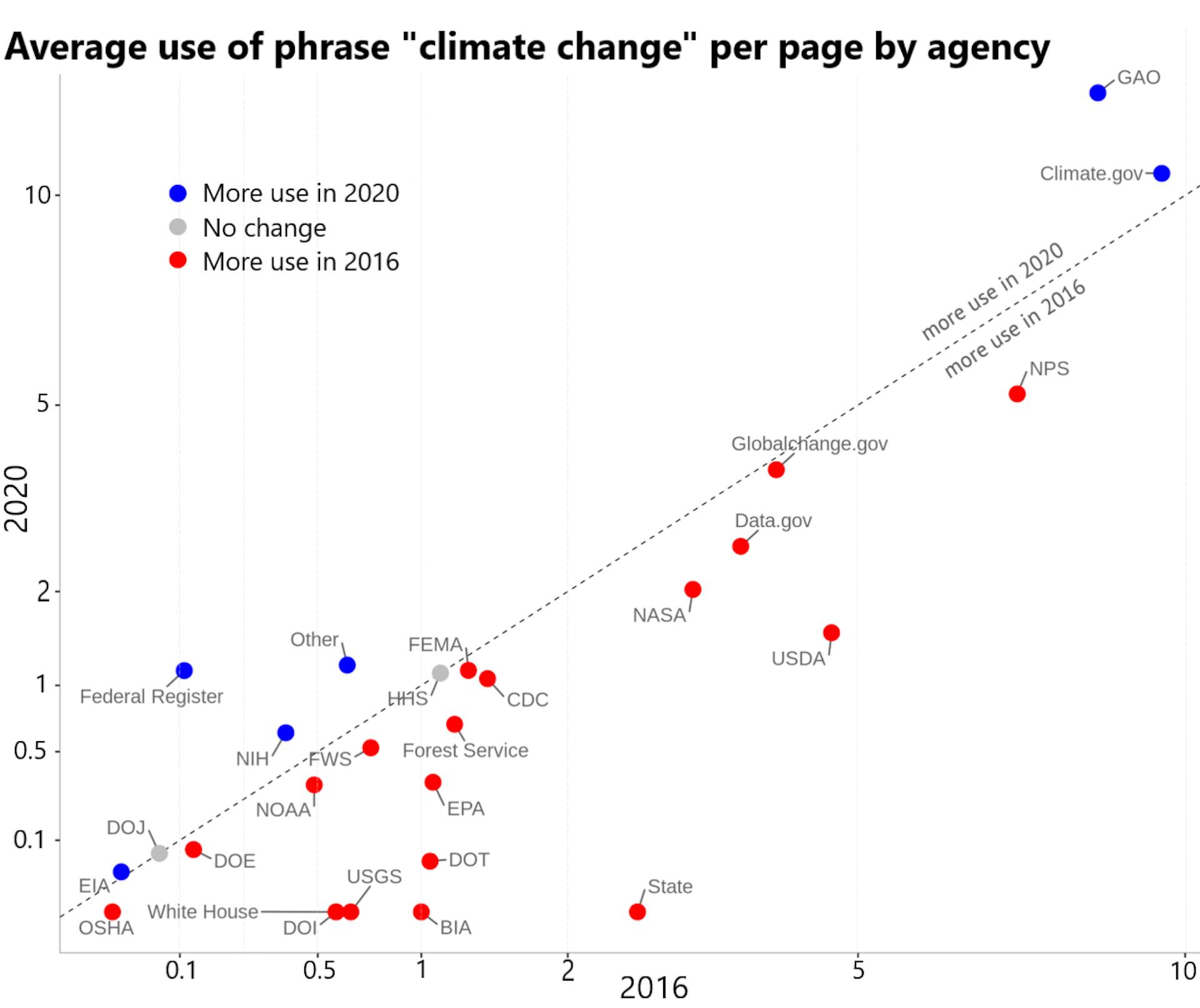
In just the first three weeks of Trump’s term, we saw agencies remove access to at least a dozen climate and environmental justice analysis tools. The new administration also scrubbed the phrase “climate change” from government websites, as well as terms like “resilience.”
Here’s why and how Public Environmental Data Partners and others are making sure that the climate science the public depends on is available forever:
The internet and the availability of data are necessary for innovation, research and daily life.
Climate scientists analyze NASA satellite observations and National Oceanic and Atmospheric Administration weather records to understand changes underway in the Earth system, what’s causing them and how to protect the climates that economies were built on. Other researchers use these sources alongside Census Bureau data to understand who is most affected by climate change. And every day, people around the world log onto the Environmental Protection Agency’s website to learn how to protect themselves from hazards — and to find out what the government is or isn’t doing to help.
If the data and tools used to understand complex data are abruptly taken off the internet, the work of scientists, civil society organizations and government officials themselves can grind to a halt. The generation of scientific data and analysis by government scientists is also crucial. Many state governments run environmental protection and public health programs that depend on science and data collected by federal agencies.
Removing information from government websites also makes it harder for the public to effectively participate in key processes of democracy, including changes to regulations. When an agency proposes to repeal a rule, for example, it is required to solicit comments from the public, who often depend on government websites to find information relevant to the rule.
And when web resources are altered or taken offline, it breeds mistrust in both government and science. Government agencies have collected climate data, conducted complex analyses, provided funding and hosted data in a publicly accessible manner for years. People around the word understand climate change in large part because of U.S. federal data. Removing it deprives everyone of important information about their world.
The first Trump administration removed discussions of climate change and climate policies widely across government websites. However, in our research with the Environmental Data and Governance Initiative over those first four years, we didn’t find evidence that datasets had been permanently deleted.
The second Trump administration seems different, with more rapid and pervasive removal of information.
In response, groups involved in Public Environmental Data Partners have been archiving climate datasets our community has prioritized, uploading copies to public repositories and cataloging where and how to find them if they go missing from government websites.
As of Feb. 13, 2025, we hadn’t seen the destruction of climate science records. Many of these data collection programs, such as those at NOAA or EPA’s Greenhouse Gas Reporting Program, are required by Congress. However, the administration had limited or eliminated access to a lot of data.
We’ve seen a targeted effort to systematically remove tools like dashboards that summarize and visualize the social dimensions of climate change. For instance, the Climate and Economic Justice Screening Tool mapped low-income and other marginalized communities that are expected to experience severe climate changes, such as crop losses and wildfires. The mapping tool was taken offline shortly after Trump’s first set of executive orders.
Most of the original data behind the mapping tool, like the wildfire risk predictions, is still available, but is now harder to find and access. But because the mapping tool was developed as an open-source project, we were able to recreate it.
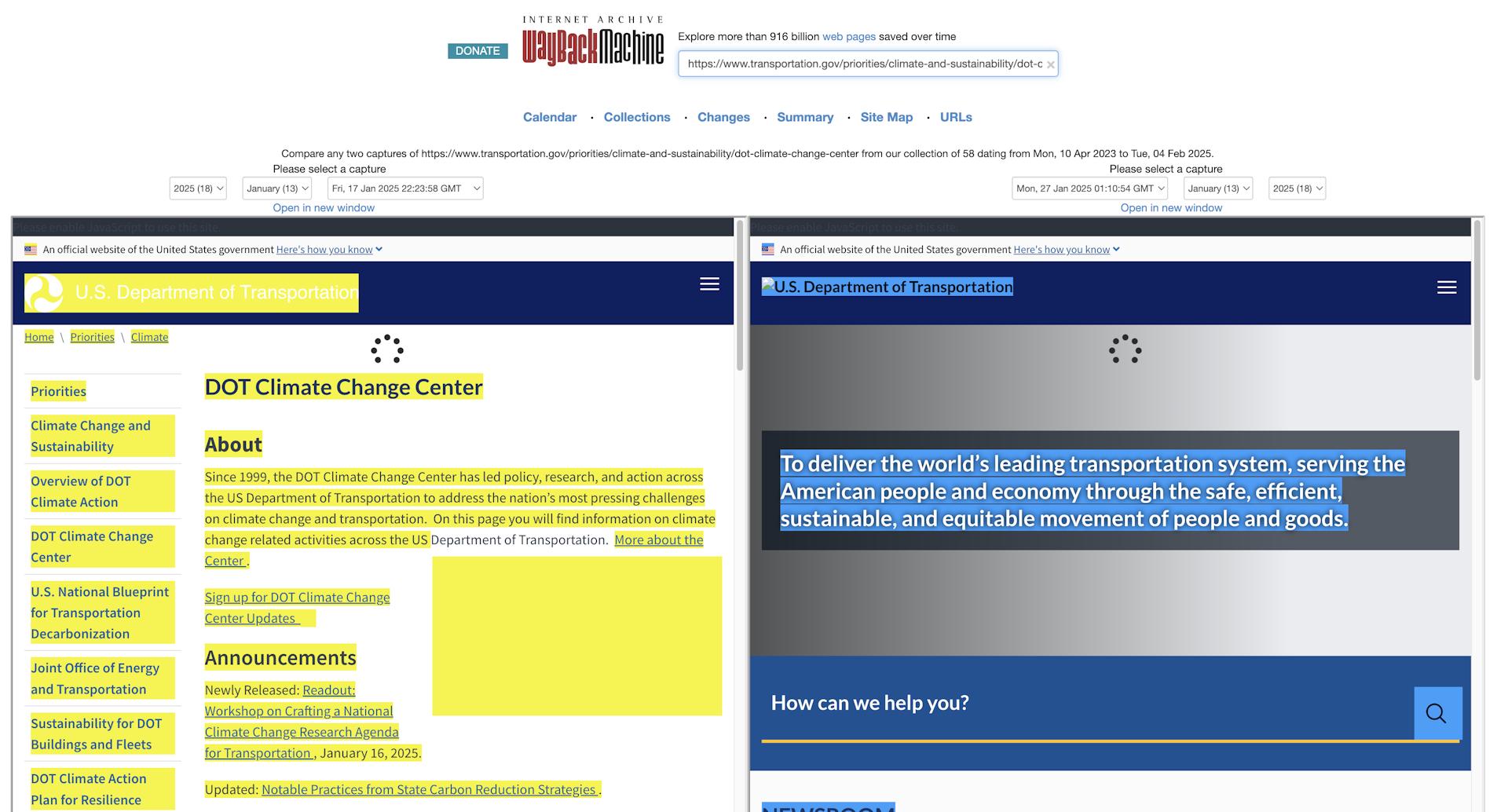
In some cases, entire webpages are offline. For instance, the page for the 25-year-old Climate Change Center at the Department of Transportation doesn’t exist anymore. The link just sends visitors back to the department’s homepage.
Other pages have limited access. For instance, EPA hasn’t yet removed its climate change pages, but it has removed “climate change” from its navigation menu, making it harder to find those pages.
Fortunately, our partners at the End of Term Web Archive have captured snapshots of millions of government webpages and made them accessible through the Internet Archive’s Wayback Machine. The group has done this after each administration since 2008.
If you’re looking at a webpage and you think it should include a discussion of climate change, use the “changes” tool“ in the Wayback Machine to check if the language has been altered over time, or navigate to the site’s snapshots of the page before Trump’s inauguration.
You can also find archived climate and environmental justice datasets and tools on the Public Environmental Data Partners website. Other groups are archiving datasets linked in the Data.gov data portal and making them findable in other locations.
Individual researchers are also uploading datasets in searchable repositories like OSF, run by the Center for Open Science.
If you are worried that certain data currently still available might disappear, consult this checklist from MIT Libraries. It provides steps for how you can help safeguard federal data.
What’s unclear is how far the administration will push its attempts to remove, block or hide climate data and science, and how successful it will be.
Already, a federal district court judge has ruled that the Centers for Disease Control and Prevention’s removal of access to public health resources that doctors rely on was harmful and arbitrary. These were put back online thanks to that ruling.
We worry that more data and information removals will narrow public understanding of climate change, leaving people, communities and economies unprepared and at greater risk. While data archiving efforts can stem the tide of removals to some extent, there is no replacement for the government research infrastructures that produce and share climate data.
This article is republished from The Conversation, a nonprofit, independent news organization bringing you facts and trustworthy analysis to help you make sense of our complex world. It was written by: Eric Nost, University of Guelph and Alejandro Paz, Massachusetts Institute of Technology (MIT)
Read more:
How the oil industry and growing political divides turned climate change into a partisan issue
3 ways Trump’s EPA could use the language of science to weaken pollution controls
What Big Oil knew about climate change, in its own words
Eric Nost is affiliated with the Environmental Data and Governance Initiative and the Public Environmental Data Partners, which have received funding for some of the work reviewed in this piece from Bloomberg Philanthropies, the Sustainable Cities Fund, and the David and Lucile Packard Foundation.
Alejandro Paz is affiliated with the Environmental Data and Governance Initiative.





















































Comments