What the US Supreme Court will consider when it rules on gender-affirming care for trans children
Published in Political News
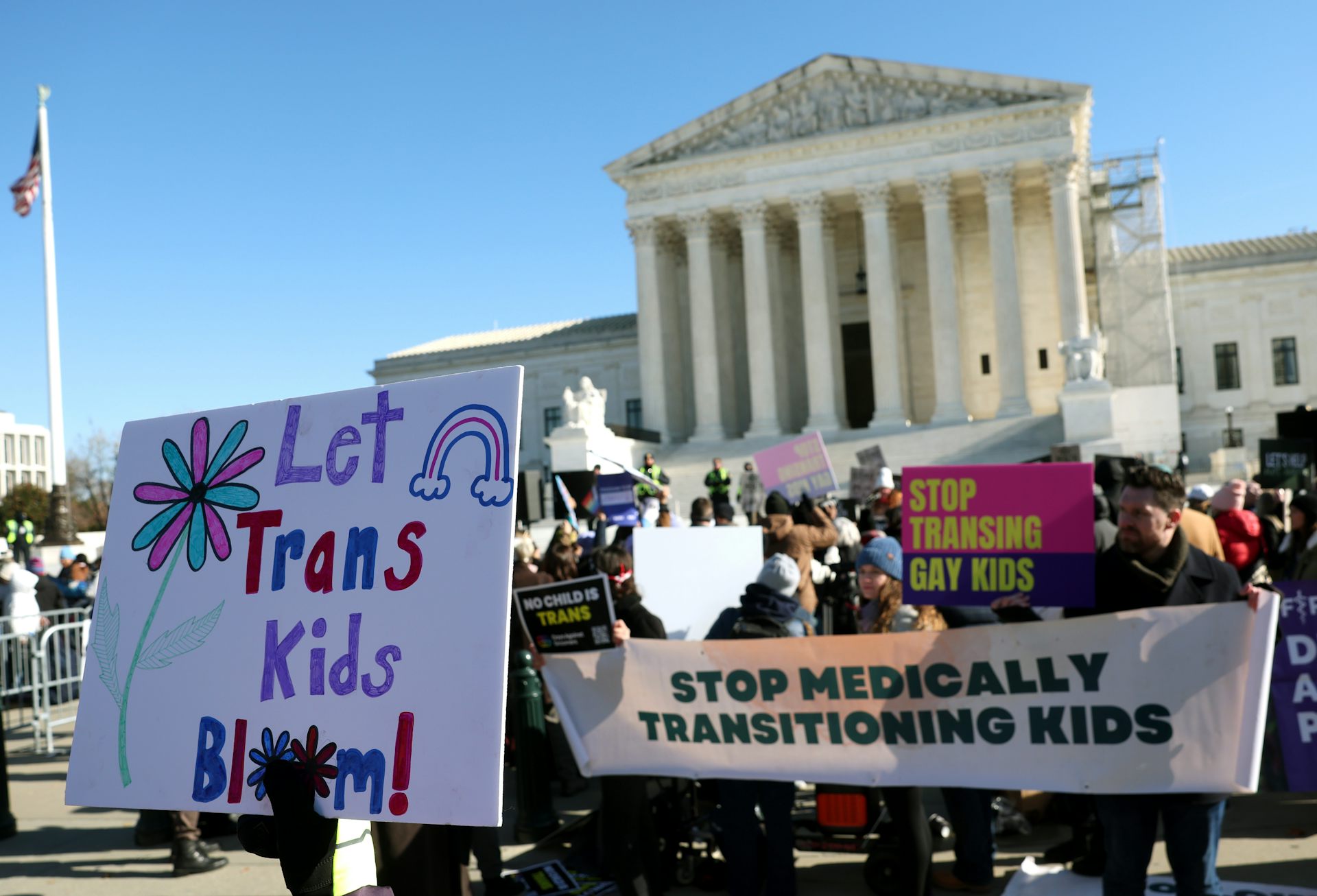





A case recently argued in the U.S. Supreme Court will likely determine for the foreseeable future how difficult it will be for trans people to win constitutional challenges to laws that discriminate against them.
The case, United States v. Skrmetti, concerns whether a Tennessee law banning gender-affirming medical care for trans youth violates the equal protection clause of the U.S. Constitution’s 14th Amendment.
As a constitutional law scholar, I see United States v. Skrmetti, which was argued before the justices on Dec. 4, 2024, as a very important case. This is because the court’s decision in Skrmetti requires the justices to determine how strongly the equal protection clause protects trans people.
The equal protection clause is one of the key parts of the U.S. Constitution used to protect civil rights. The court decisions declaring school segregation unconstitutional and legalizing gay marriage both invoked the equal protection clause.
In 2023, Tennessee Gov. Bill Lee signed into law Tennessee Senate Bill 1, known as SB1. SB1 bans gender-affirming medical care for trans people under the age of 18.
It does this by prohibiting health care providers from offering medical care designed to help minors identify with a gender that differs from the one they were assigned at birth. It also prohibits certain forms of medical care designed to treat gender dysphoria – the discomfort or distress due to having a gender identity that differs from one’s sex assigned at birth or one’s sex-related physical characteristics.
The Tennessee law prohibits anyone from providing puberty blockers or hormones such as estrogen or testosterone to trans youth for these purposes. But the law still allows the provision of puberty blockers and sex hormones for other medical purposes, such as treating congenital defects, early puberty or physical injury.
The Tennessee legislature claims in the text of the law that “this state has a legitimate, substantial, and compelling interest in encouraging minors to appreciate their sex” and in protecting the ability of minors to grow into adults “who can create children of their own.”
Shortly after SB1 was passed, the American Civil Liberties Union sued Tennessee on behalf of various trans youth and their parents. They claimed that the law discriminated based on sex in violation of the equal protection clause of the U.S. Constitution.
A district court judge granted the the ACLU’s request for a preliminary injunction. This temporarily stopped the enforcement of SB1. But a divided panel of federal judges later reversed the district court’s judgment, allowing the law to go into effect.
The ACLU and the Biden administration then appealed to the Supreme Court, which agreed to review the case.
The equal protection clause forbids U.S. states from denying “to any person within its jurisdiction the equal protection of the laws.” This provision prevents states from creating unjust differences in how the law is applied to different people.
The most famous equal protection case is likely the Supreme Court’s 1954 decision in Brown v. Board of Education. There, the Supreme Court held that racial segregation in schools violated the equal protection clause, declaring, “Segregation of white and colored children in public schools has a detrimental effect upon the colored children. The impact is greater when it has the sanction of the law.”
A key question in all equal protection clause cases is whether the law being challenged relies on what is referred to in constitutional law as a “suspect” or “quasi-suspect” classification. This may seem like a technical aspect of the Skrmetti case, but it has profound implications.
Suspect classifications include race, religion, national origin and ancestry. Quasi-suspect classifications include sex and whether one’s parents were married at their time of birth.
The basic idea – and reason for the word “suspect” in the name – is that courts are extra suspicious of laws that take these features into account. This is because judges generally think that a person’s characteristics such as race, religion and, to a lesser degree, sex should not be relevant to how the law applies to them.
If a court determines that a law is based on a suspect or quasi-suspect classification, then it will assess the law using tests that make it difficult for the law to pass constitutional muster.
But if a court determines that a law is not based on a suspect or quasi-suspect classification, then it will assess the law using a test that is highly deferential to the legislators who passed the law. This test makes it relatively easy for a court to conclude that a law is constitutional.
Thus, it is a crucially important legal issue to determine whether SB1 relies on a suspect or quasi-suspect classification. Tennessee argues that it does not, while the ACLU and the U.S. argue that it does. The court will decide.
The U.S. and ACLU argue that SB1 discriminates based on sex, and thus it is based on a quasi-suspect classification. Tennessee rejects this claim.
Here, in brief, is how the argument that SB1 discriminates based on sex goes.
Under SB1, the only minors prohibited from getting feminizing sex hormones such as estrogen are minors who are assigned male at birth. Similarly, the only minors prohibited from getting masculinizing sex hormones such as testosterone are minors who are assigned female at birth.
Thus, whether a minor is prevented from being able to get the treatment depends on the minor’s sex. Similar arguments can be made about use of puberty blockers. That, the U.S. and ACLU claim, is sex-based discrimination.
Tennessee advocates a different understanding of whether sex-based discrimination is at work in the law. It argues that all youth, no matter their sex, are prohibited from taking hormones or puberty blockers that would help them identify with a sex other than the one they were assigned at birth. In this way, they argue, the law is not about sex.
In the Supreme Court’s 2020 decision Bostock v. Clayton County, Justice Neil Gorsuch and Chief Justice John Roberts sided with the court’s liberals in holding that discrimination based on sex under Title VII of the Civil Rights Act of 1964 included discrimination based on gender identity and sexual orientation. This decision provided LGBTQ people with nationwide protection against employment discrimination.
The U.S. and ACLU offer a similar argument in Skrmetti to the one in Bostock. But in Bostock, the court was interpreting the text of a law that explicitly mentioned discrimination based on sex. In this case, the court is interpreting the equal protection clause, which doesn’t make explicit reference to sex discrimination. Thus, the justices may not think the same kind of reasoning applies.
The court faces questions in Skrmetti other than whether the law discriminates based on sex. The parties also disagree about how good the evidence is that gender-affirming care is safe and effective. The court could rule on that question too, or it could require the lower court to resolve that issue.
The court could also address whether gender identity should be recognized as a new suspect or quasi-suspect classification, although recent history suggests it is unlikely to do this.
The court will likely issue its decision by the end of June 2025. In the meantime, SB1 remains in effect. There are similar laws in half of all states that are part of other legal battles.
If the court concludes that SB1 is a case of sex discrimination, this would establish a precedent that would make it easier for others to challenge laws prohibiting or restricting gender-affirming care. It might also help trans people litigate other kinds of cases, such as challenges to laws restricting which restrooms trans people can use.
But if the court concludes that SB1 does not discriminate based on sex, that would make it harder for trans people to win in future cases in which they claim that a law discriminates against them.
This article is republished from The Conversation, a nonprofit, independent news organization bringing you facts and trustworthy analysis to help you make sense of our complex world. It was written by: Mark Satta, Wayne State University
Read more:
Nationalism is not patriotism: 3 insights from Orwell about Trump and the 2024 election
Why a federal judge found Tennessee’s anti-drag law unconstitutional
Oklahoma’s superintendent orders public schools to teach the Bible – relying on controversial views about religious freedom
Mark Satta does not work for, consult, own shares in or receive funding from any company or organization that would benefit from this article, and has disclosed no relevant affiliations beyond their academic appointment.






















































Comments