Asian folktales offer moral lessons that help reduce racial prejudice in children
Published in Political News


In a Cambodian children’s folktale, one man is afraid of lawyers and another is afraid of filth. As the story goes, both are constantly bombarded by their fears despite their efforts to avoid them.
The moral of the tale is revealing and contains a powerful anti-racism message: What you hate becomes your fate.
As an educational linguist and a psychologist who specialize in children’s literacy development, we know that reading such folktales about people from different ethnic groups reduces prejudice in young children.
By age 4, children learn stereotypes against certain groups of people, and by age 7, children of color internalize stereotypes. Research suggests that reading stories about a person’s own culture has many benefits, including literacy achievement.
But according to 2020 Cooperative Children’s Book Center statistics, one barrier to providing culturally sustaining texts to young children is the remarkable lack of availability of such texts.
For example, 29% of children’s books are about animals and 41% about white children. Only 9% address experiences of children of Asian descent.
Because of this dearth of culturally sustaining texts, we decided to produce our own children’s book specifically focused on children of Asian descent.
We teach in Lowell, Massachusetts, a city that has one of the largest Southeast Asian communities in the U.S. and has a number of different Southeast Asian American groups. The Cambodian American community in Lowell, for instance, is the second largest in the U.S. and the third largest in the world outside of Cambodia.
Racism against Asians and Asian Americans is not new in America.
The Chinese Exclusion Act of 1882 and the incarceration of Japanese Americans during World War II demonstrate the long history of abuse that continues today.
According to the Center for the Study of Hate and Extremism, hate crimes against Asians in the U.S. increased by 339% during the COVID-19 pandemic.
A number of studies reveal that such racism has severe negative impacts on many aspects of psychological and physical well-being for victims of prejudice of all ages.
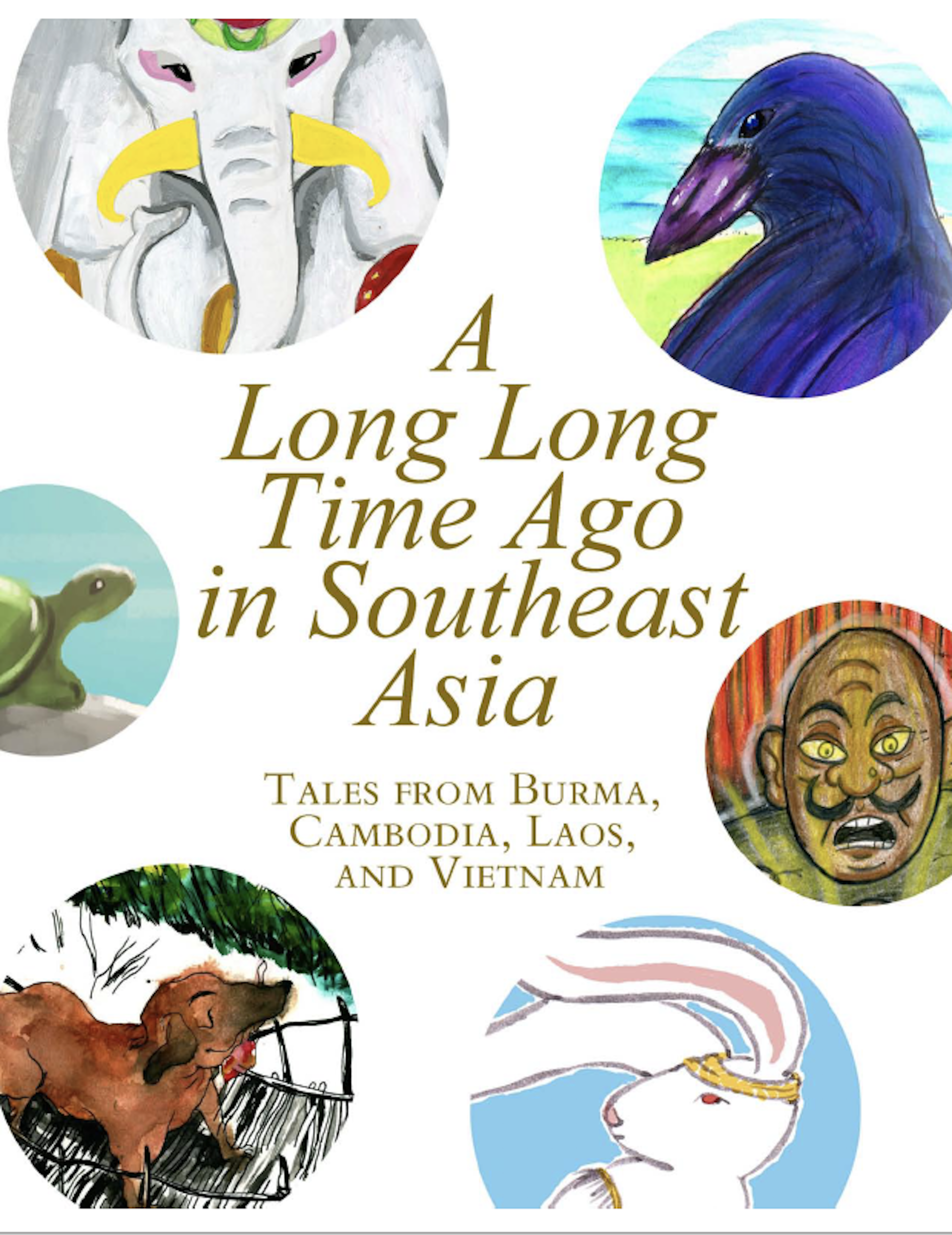
Illustrated by art students from our university, our multilingual children’s book is called “A Long Long Time Ago in Southeast Asia” and focuses on the Cambodian, Vietnamese, Laotian and Burmese communities.
In March 2018, we held a workshop to introduce this book to 25 Lowell public school elementary school teachers. During that session, we learned that teachers needed a broader understanding of the cultural contexts that shape Asian folktales for them to teach them effectively in their classrooms.
To that end, we also produced a scholarly collection of research articles, which we published in 2022, called “Perspectives on East and Southeast Asian Folktales.”
In our research, we found several functions of folktales to be useful to fight against racism, especially when such tales are read to children regularly. Many Asian countries, such as Korea and Vietnam, use folktales as part of an ethics education that is part of their core curricula.
First, folktales often contain explicit moral lessons on honesty, wisdom, good deeds and perseverance.
For example, “A Big Pot of Gold,” one of the Vietnamese folktales in our book, is about a poor but honest couple who decided not to take a pot of gold they accidentally found.
When a thief overheard the couple, he decided to steal the pot. But instead of gold, he got a pot full of snakes. When the thief returned the pot to the couple, it was again full of gold.
The story ends with community members explaining the moral lesson: If you are a good person, you will have good outcomes.
A second important function of Asian folktales is that they challenge stereotypes against Asians by using Asian protagonists who display culturally valued traits and exemplary behavioral norms.
Stereotypes associated with Asians as being quiet and passive are countered by individuals who act bravely to resolve problems.
A third function of Asian folktales is the use of social justice themes such as helping the poor and the weak.
In “The Big Pot of Gold,” for instance, the honest couple used the gold to help other poor people.
Using multicultural books to teach children about other cultures is not new.
When folktales are taught alongside other multicultural books, a wide spectrum of Asian American experiences gets represented and allows children of all races to read about people of different cultures.
That in itself is effective in reducing racism for future generations.
This article is republished from The Conversation, a nonprofit, independent news organization bringing you facts and trustworthy analysis to help you make sense of our complex world. It was written by: Minjeong Kim, UMass Lowell and Allyssa McCabe, UMass Lowell
Read more:
Young children’s words predict reading ability — 5 ways parents and caregivers can help grow them
Are America’s schools safe for Asian Americans?
Asian American mothers confront multiple crises of pandemic, anti-Asian hate and caregiving
Minjeong Kim has received funding from Creative Economy Grant of University of Massachusetts to conduct research cited in this article.
Allyssa McCabe does not work for, consult, own shares in or receive funding from any company or organization that would benefit from this article, and has disclosed no relevant affiliations beyond their academic appointment.






















































Comments