Senate approves nearly $61B of Ukraine foreign aid − here’s why it helps the US to keep funding Ukraine
Published in Political News

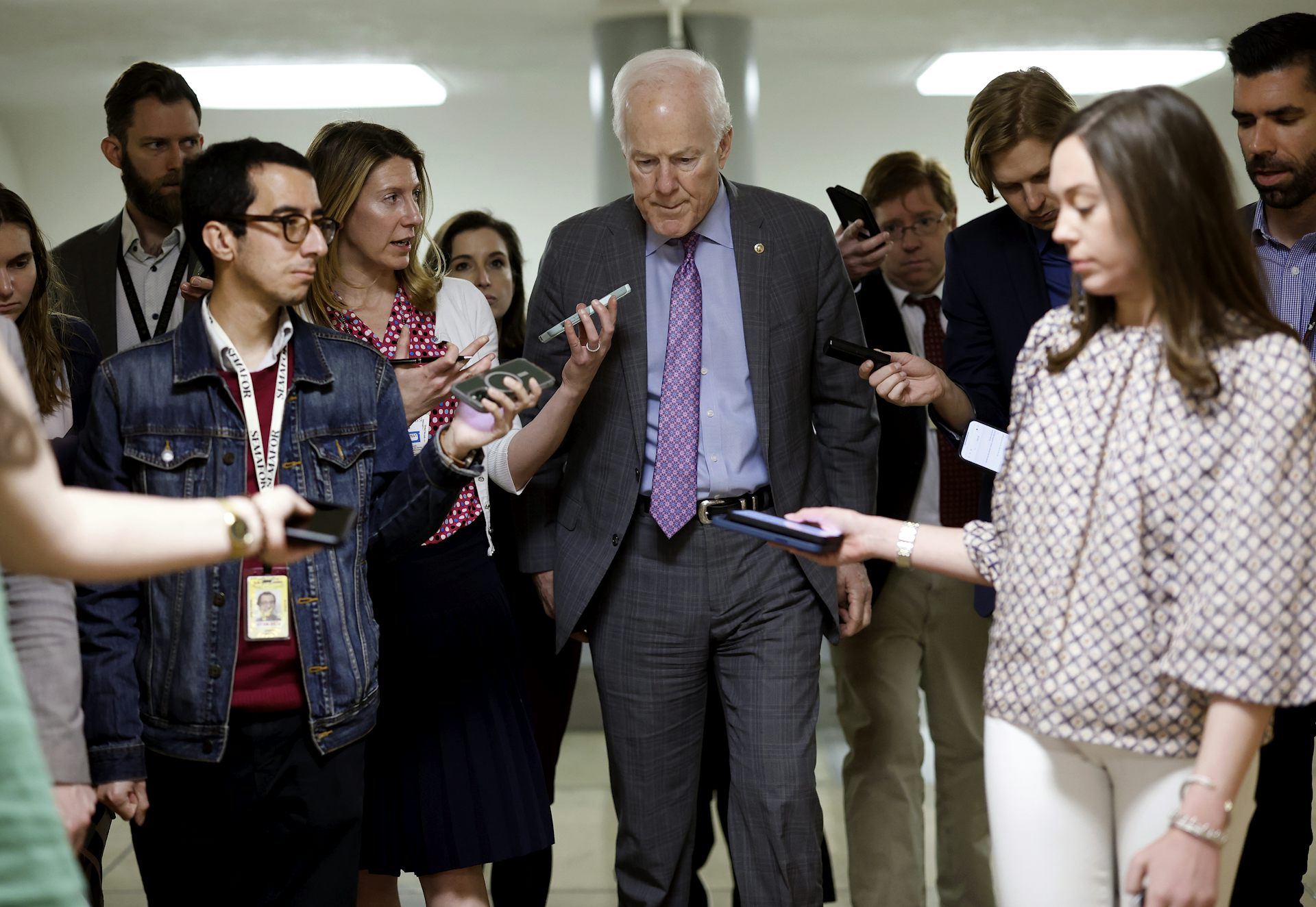




The Senate overwhelmingly approved a US$95.3 billion foreign aid funding package for Ukraine, Israel and Taiwan on April 23, 2024, following months of political infighting that stalled the bill in the House of Representatives. About $61 billion of this aid package will be spent on Ukraine, while $26 billion will go to Israel. Another $8 billion is designated for Taiwan.
President Joe Biden has said he would sign the bill into law within days.
The Senate voted for the aid package with a 79-18 vote late on Tuesday evening, while the House approved the bill on April 20 with a rare bipartisan coalition that voted 311-112 in favor of aid to Ukraine.
“Today’s outcome yet confirms another thing we’ve stressed from the beginning of this Congress. In divided government, the only way to ever get things done is bipartisanship,” Senate Majority Leader Chuck Schumer, a Democrat, said on April 23, before thanking House Speaker Mike Johnson, a Republican, for moving the legislation along.
The new legislation means that U.S. military supplies could be moved to Ukraine in a matter of days.
In early April 2024, Ukrainian President Volodymyr Zelenskyy laid out the stakes for the U.S. support saying, “If the Congress doesn’t help Ukraine, Ukraine will lose the war.” Russia had increased its bombing of Ukraine in recent months, and the battle lines between Russia and Ukraine have moved little in the past year.
Pressure increased on lawmakers to pass the aid package after Iran’s drone missile attack on Israel on April 14, 2024.
The U.S. has been the largest single donor backing Ukraine since Russian troops invaded the country in February 2022. Since then, the U.S. has sent Ukraine approximately $113 billion in a combination of cash, military supplies and machinery, as well as food and other humanitarian supplies.
As a scholar of Eastern Europe, I think there are a few important reasons why the U.S. has a lot at stake in supporting Ukraine.
Since February 2024, Johnson had delayed initiating a vote on the Ukraine foreign aid bill in the House of Representatives for a few reasons. One major factor was fighting between Republicans, who hold a slim majority in the House.
While some centrist Republican politicians supported Ukraine funding and pushed for a vote on the foreign aid package, others – hard-right Republicans – wanted a bill that prioritized what they said are American interests, meaning more of a focus on domestic U.S. problems.
Another issue was a threat of other Republicans trying to remove Johnson from his leadership role.
Rep. Thomas Massie of Kentucky called on Johnson to resign and joined Rep. Marjorie Taylor Greene of Georgia, a Republican who filed a motion on March 22, 2024, to prompt a vote that could push Johnson out of his House leadership position.
Eventually, Johnson reportedly settled on the idea that supporting the legislation was the right decision – and reached out to Democrats across the aisle to help him see the bills through.
As the House was stalling on a vote, Ukraine was rationing ammunition and supplies. This, in turn, provided an opportunity for Russia to strengthen its arsenal.
Delays with foreign aid to Ukraine give Putin time to move forward with plans to purchase ballistic missiles from Iran. National Security Council spokesperson John Kirby expressed concerns in early January 2024 that Russia was close to acquiring short-range ballistic weapons from Iran.
Russia already buys drones from Iran and ballistic missiles from North Korea.
In February, U.S. national security adviser Jake Sullivan pointed out that Ukrainian forces lost a major center of resistance in the east of Ukraine called Avdiivka to Russia because of a shortage of ammunition.
Without foreign aid from the U.S., Ukraine faces a strategic disadvantage that could lead to Russia winning the war. That could lead to Russia increasing its threats on nearby NATO countries.
There are other reasons why many experts think it helps the U.S. to back Ukraine. One factor is U.S. global power competition with China.
Russian and Chinese leaders declared a military and political partnership days before Russia’s invasion of Ukraine in February 2022. They announced on April 9, 2024, that they want to find ways to strengthen their joint security work across Asia and Europe.
U.S. political and military leaders have noted that supporting Ukraine and pushing back against Russia is one clear way to deter China from strengthening its global political power and military reach.
Navy Adm. Samuel J. Paparo said in February 2024 that Russia’s potential loss in Ukraine is “a deterrence in the western Pacific and directly reassures partners.”
The admiral said that China is studying the Ukraine invasion for its own purposes, in order to “effect a short, sharp conflict that presents a fait accompli to all of the world.” He called for the U.S. to continue to fund Ukraine’s war.
The U.S. needs its long-standing allies in Europe to help push back against China – and deterrence is only as effective as the size of the force doing the deterring.
Ely Ratner, the U.S. assistant secretary of defense for Indo-Pacific security affairs, recently explained this principle and how it relates to China: “We believe deterrence is real and deterrence is strong, and we’re working every day to keep it that way.”
Most of America’s military aid to Ukraine consists of arms and ammunition from existing U.S. stockpiles. More than one-third of the $61 billion spending includes $23 billion dedicated to replenishing weapons and ammunition systems for the U.S. military.
In December 2023, Biden signed a U.S. defense policy bill that authorizes a record-high $886 billion in spending from July 2023 through June 2024. This includes a 5.2% pay raise for troops, $11.5 billion in support of initiatives to help deter China and $800 million to support Ukraine’s counteroffensive war.
But it also allows for the purchasing of new ships, aircraft and other types of ammunition. For defense stocks, that means a promising start to 2024, as the military will be likely to boost defense contractors’ revenues looking to restock supplies shipped to Ukraine.
A majority of Americans still favor U.S. support of Ukraine, though about half of Republicans said in December 2023 that the U.S. is giving too much money to the country.
Even though politicians do not always follow public opinion, there are clear reasons why it is in the U.S.’s best interests to keep funding Ukraine.
This story is an update of an earlier article published on April 10, 2023.
This article is republished from The Conversation, a nonprofit, independent news organization bringing you facts and analysis to help you make sense of our complex world.
Read more:
US military spending in Ukraine reached nearly $50 billion in 2022 – but no amount of money alone is enough to end the war
Will the Israel-Gaza war affect Joe Biden’s chances of re-election? History might provide a guide
Tatsiana Kulakevich does not work for, consult, own shares in or receive funding from any company or organization that would benefit from this article, and has disclosed no relevant affiliations beyond their academic appointment.






















































Comments